




2 Gallon Water Heater Expansion Tanks


 --%3E %3Csvg version='1.1' id='Fill' xmlns='http://www.w3.org/2000/svg' xmlns:xlink='http://www.w3.org/1999/xlink' x='0px' y='0px' viewBox='0 0 100 100' enable-background='new 0 0 100 100' xml:space='preserve'%3E %3Cpath fill='%23F15C02' d='M79.44,0.95H20.56C9.78,0.95,0.95,9.78,0.95,20.56v58.87c0,10.79,8.82,19.61,19.61,19.61h58.87 c10.79,0,19.61-8.83,19.61-19.61V20.56C99.05,9.78,90.22,0.95,79.44,0.95z M65.38,58.24l9.38,29.58L49.69,69.78L24.5,87.82 l9.34-29.6L8.8,39.6l30.73-0.17c0,0,6.98-19.61,10-28.93c0.54,1.36,9.88,29.1,9.88,29.1H91.2L65.38,58.24z'/%3E %3C/svg%3E)

 --%3E %3Csvg version='1.1' id='No-RB' xmlns='http://www.w3.org/2000/svg' xmlns:xlink='http://www.w3.org/1999/xlink' x='0px' y='0px' viewBox='0 0 100 100' enable-background='new 0 0 100 100' xml:space='preserve'%3E %3Cpath fill='%23CECECE' d='M79.44,0.95H20.56C9.78,0.95,0.95,9.78,0.95,20.56v58.87c0,10.79,8.82,19.61,19.61,19.61h58.87 c10.79,0,19.61-8.83,19.61-19.61V20.56C99.05,9.78,90.22,0.95,79.44,0.95z M65.38,58.24l9.38,29.58L49.69,69.78L24.5,87.82 l9.34-29.6L8.8,39.6l30.73-0.17c0,0,6.98-19.61,10-28.93c0.54,1.36,9.88,29.1,9.88,29.1H91.2L65.38,58.24z'/%3E %3C/svg%3E)


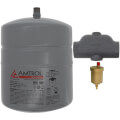
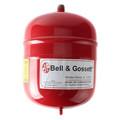
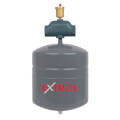
2 gallon water heater expansion tanks are the small pressurized tanks installed on the cold supply line of a residential water heater to absorb the extra volume created as heated water expands. Contractors add one whenever a system has a check valve, pressure-reducing valve, or backflow preventer on the supply side, since any of those components create a closed system where expanding water has nowhere to go without a tank to relieve the pressure. Inside the tank, a rubber bladder or diaphragm separates a fixed air charge from the water side, compressing as water pushes in and pushing back as demand draws water out. A 2 gallon size is the common choice for standard residential tank water heaters up to around 50 gallons, matched to typical household pressure and temperature settings.
Skipping an expansion tank on a closed system lets pressure spikes hit the water heater's tank, the pressure relief valve, and any fittings downstream every time the burner or element heats a full tank of water, which shortens the life of those components over time.
Subcategories
- Pre-Charged Bladder Tanks: Tanks shipped with a factory air charge already set, ready to install once the pressure is matched to the home's static supply pressure with a bicycle-style pump if needed. This is the most common style specified for residential closed systems. Matching the pre-charge to system pressure before installation is what keeps the tank working correctly from day one.
- Replacement Bladders and Diaphragms: The internal rubber component that separates air from water inside the tank body. A tank that has gone waterlogged, meaning the bladder has failed and the tank no longer holds an air cushion, is a common service call on older installations. Some tank designs allow the bladder to be replaced without swapping the whole tank shell.
- Mounting Brackets and Tank Tees: Hardware and fittings used to support the tank's weight and connect it into the cold supply line near the water heater. A tank tee gives the installer a dedicated port for the expansion tank without cutting an extra joint into the main supply run. Bracket support matters more on tanks mounted horizontally or on longer supply lines.
Buying Guide
Confirm the system actually needs a 2 gallon water heater expansion tank rather than a larger size by checking the water heater's rated capacity and the home's static water pressure. Most single-family homes with a standard 40 to 50 gallon tank and typical municipal pressure fall within the range a 2 gallon tank is designed to handle, but higher pressure or a larger water heater can call for the next size up.
Before installation, set the tank's air pre-charge to match the home's static supply pressure, not the factory default. A mismatch between pre-charge and system pressure is one of the most common reasons a newly installed tank fails to control pressure spikes as expected, since the air cushion needs to be compressed at roughly the same pressure the water side operates under to absorb expansion properly.
Check the mounting orientation the tank is rated for. Some tanks are designed to hang from the cold supply line using a tank tee, while others need a bracket or shelf support, particularly in tight mechanical closets where the tank sits close to the water heater. Confirm there is enough clearance for the tank plus its fitting before finalizing the location.
For replacement jobs, matching the outlet connection size and thread type to the existing tank tee avoids needing to replace fittings that are otherwise still in good condition.
Frequently Asked Questions
When is a water heater expansion tank required rather than optional?
It is generally needed whenever the water supply system is closed, meaning a check valve, pressure-reducing valve, or backflow preventer sits upstream of the water heater and prevents expanding water from pushing back into the municipal main.
How is the air pre-charge on an expansion tank set correctly?
The pre-charge should be adjusted with a tire-style pump and gauge to match the home's static water pressure, which is checked at a hose bibb or pressure gauge before the water heater fires.
What does it mean if an expansion tank feels heavy or sloshes like it is full of water?
That typically indicates the internal bladder has failed and the tank has gone waterlogged, losing its air cushion, which means it can no longer absorb expansion and should be replaced.
Can a 2 gallon expansion tank be used on a larger water heater?
It depends on the system's pressure and the water heater's capacity together, so checking a sizing chart against both figures is the reliable way to confirm a 2 gallon tank is adequate rather than assuming based on tank size alone.
Does the expansion tank need to be installed in a specific location on the supply line?
It should be installed on the cold supply line to the water heater, typically connected through a dedicated tank tee positioned close to the tank so it can respond quickly to pressure changes.
