



Filters
SORT
Product Availability –
Size –
Review Score –
 --%3E %3Csvg version='1.1' id='Fill' xmlns='http://www.w3.org/2000/svg' xmlns:xlink='http://www.w3.org/1999/xlink' x='0px' y='0px' viewBox='0 0 100 100' enable-background='new 0 0 100 100' xml:space='preserve'%3E %3Cpath fill='%23F15C02' d='M79.44,0.95H20.56C9.78,0.95,0.95,9.78,0.95,20.56v58.87c0,10.79,8.82,19.61,19.61,19.61h58.87 c10.79,0,19.61-8.83,19.61-19.61V20.56C99.05,9.78,90.22,0.95,79.44,0.95z M65.38,58.24l9.38,29.58L49.69,69.78L24.5,87.82 l9.34-29.6L8.8,39.6l30.73-0.17c0,0,6.98-19.61,10-28.93c0.54,1.36,9.88,29.1,9.88,29.1H91.2L65.38,58.24z'/%3E %3C/svg%3E)
Price Range –
ABS DWV 22-1/2° Street Elbows


 --%3E %3Csvg version='1.1' id='No-RB' xmlns='http://www.w3.org/2000/svg' xmlns:xlink='http://www.w3.org/1999/xlink' x='0px' y='0px' viewBox='0 0 100 100' enable-background='new 0 0 100 100' xml:space='preserve'%3E %3Cpath fill='%23CECECE' d='M79.44,0.95H20.56C9.78,0.95,0.95,9.78,0.95,20.56v58.87c0,10.79,8.82,19.61,19.61,19.61h58.87 c10.79,0,19.61-8.83,19.61-19.61V20.56C99.05,9.78,90.22,0.95,79.44,0.95z M65.38,58.24l9.38,29.58L49.69,69.78L24.5,87.82 l9.34-29.6L8.8,39.6l30.73-0.17c0,0,6.98-19.61,10-28.93c0.54,1.36,9.88,29.1,9.88,29.1H91.2L65.38,58.24z'/%3E %3C/svg%3E)
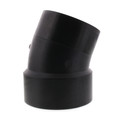
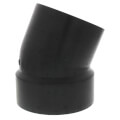

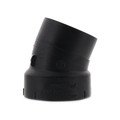
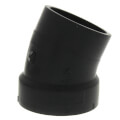
ABS DWV 22-1/2 degree street elbows make a shallow directional change in drain, waste, and vent piping made from ABS plastic, letting plumbers route a drain line around an obstruction or set a gentle slope without the sharper turn a 45 or 90 degree fitting would create. The street design means one end is a spigot that inserts directly into the next fitting's hub rather than requiring a separate piece of pipe between fittings, which keeps a tight transition compact.
These elbows are common on DWV runs where a long, gradual bend is preferable to a series of sharper turns, since fewer sharp direction changes generally means smoother drainage and less chance of blockage. ABS is a common DWV material in regions where it is code-approved, and plumbers working in those areas rely on street elbows like this one to keep fitting counts low on tight layouts.
Subcategories
- ABS DWV 22-1/2 Degree Street Elbows, Standard Hub: The standard configuration has one spigot end and one hub end, letting the fitting insert directly into an upstream fitting while accepting the next pipe or fitting downstream. This is the most commonly stocked version for general drain line work.
- ABS DWV 22-1/2 Degree Street Elbows, Long Turn: A long turn pattern extends the radius of the bend slightly compared to a standard short turn elbow, which some installations favor for smoother flow characteristics on longer horizontal runs. Plumbers select this style when the layout allows for the slightly larger footprint.
- ABS DWV 22-1/2 Degree Reducing Street Elbows: A reducing version changes pipe diameter and direction in a single fitting, combining a step-down transition with the shallow bend. This saves installing a separate reducer and elbow where a line needs to both turn and downsize at the same point in the run.
Buying Guide
Confirm that ABS DWV piping is code-approved for the job's location before ordering, since some jurisdictions specify PVC for DWV applications instead of ABS, and mixing the two materials in the same run is generally not permitted without an approved transition fitting.
Check pipe diameter against the rest of the DWV system, since street elbows are sized to match standard DWV pipe diameters and the fitting needs to correspond to the pipe already in use on that line.
Consider whether a 22-1/2 degree bend is the right angle for the layout, compared to a 45 or 90 degree elbow. A shallower angle like 22-1/2 degrees is often chosen specifically to maintain proper drainage slope over a longer run without introducing a sharp turn that could catch debris.
For tight spaces where a coupling between fittings is not practical, the street end's ability to insert directly into an upstream hub keeps the overall assembly shorter, which is worth factoring in when planning fitting counts for a job with limited clearance.
Frequently Asked Questions
What does the 22-1/2 degree angle mean on this fitting?
It refers to the angle of directional change the elbow introduces in the pipe run, which is a shallower turn than a 45 or 90 degree elbow. Plumbers use this angle when a gentler bend is needed to maintain proper drainage slope.
What is a street elbow, and how is it different from a standard elbow?
A street elbow has a spigot on one end instead of two hub ends, allowing it to insert directly into an upstream fitting without needing a separate piece of pipe in between. A standard elbow has hub connections on both ends.
Can ABS DWV fittings be used in any jurisdiction?
No. DWV material approval varies by local plumbing code, and some areas require PVC instead of ABS for drain, waste, and vent piping. Confirming local code requirements before purchasing ABS fittings is recommended.
Can ABS and PVC DWV fittings be joined directly?
ABS and PVC should not be solvent welded directly to each other. A code-approved transition fitting or coupling designed for dissimilar DWV materials is required where the two materials meet.
Why use a 22-1/2 degree elbow instead of two 45 degree elbows?
A single 22-1/2 degree elbow accomplishes a shallow direction change with one fitting instead of two, which reduces joint count and keeps the assembly more compact where space is limited.
