




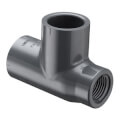
CPVC Schedule 80 Reducing Tees (S x FPT x S)

 --%3E %3Csvg version='1.1' id='No-RB' xmlns='http://www.w3.org/2000/svg' xmlns:xlink='http://www.w3.org/1999/xlink' x='0px' y='0px' viewBox='0 0 100 100' enable-background='new 0 0 100 100' xml:space='preserve'%3E %3Cpath fill='%23CECECE' d='M79.44,0.95H20.56C9.78,0.95,0.95,9.78,0.95,20.56v58.87c0,10.79,8.82,19.61,19.61,19.61h58.87 c10.79,0,19.61-8.83,19.61-19.61V20.56C99.05,9.78,90.22,0.95,79.44,0.95z M65.38,58.24l9.38,29.58L49.69,69.78L24.5,87.82 l9.34-29.6L8.8,39.6l30.73-0.17c0,0,6.98-19.61,10-28.93c0.54,1.36,9.88,29.1,9.88,29.1H91.2L65.38,58.24z'/%3E %3C/svg%3E)

CPVC Schedule 80 Reducing Tees (S x FPT x S) are threaded branch fittings that connect a smaller female-threaded outlet to a run of CPVC pipe, letting a plumber or process piping installer add a gauge, sensor, or reduced-size branch line without stepping down to a full coupling-and-bushing assembly. Spears Manufacturing makes these tees to ASTM F439, the fitting standard that pairs with pipe manufactured to ASTM F441. The socket ends solvent weld onto the pipe run while the branch outlet accepts a threaded fitting directly, which cuts down on the number of joints in a line. CPVC Schedule 80 carries a maximum service temperature of 200°F, higher than standard PVC, which is why installers reach for it on hot water distribution and corrosive chemical feed lines where PVC would soften or fail. Because the reducing tee combines a solvent-weld run with a threaded branch, it fits jobs where equipment or instrumentation needs a removable connection point.
Subcategories
- Small Diameter Reducing Tees: Small diameter reducing tees cover run sizes from 1/2 inch to 1 inch and are common on compact CPVC assemblies, chemical feed lines, and lab piping where space is limited. The socket ends solvent weld onto the pipe run while the threaded branch accepts a gauge, sensor, or smaller feed line. Spears manufactures this size range to ASTM F439 along with the rest of the Schedule 80 CPVC fitting line. A smaller branch thread keeps the overall fitting compact for tight mechanical spaces.
- Mid-Size Reducing Tees: Mid-size reducing tees cover run sizes from 1-1/4 inch to 2 inches and are a common range for industrial process piping and hot or corrosive fluid distribution. The larger run size carries more flow while the reduced branch still accepts a smaller threaded connection for instrumentation or a feed line. Fittings in this size range are manufactured to work with pipe made to ASTM F441, matching the fitting standard. Pressure rating at this size still follows the same temperature derate curve as the rest of the Schedule 80 CPVC line.
- Large Diameter Reducing Tees: Large diameter reducing tees start around 2-1/2 inches and go up from there, used on main process lines where a smaller branch outlet is needed for a gauge, sensor, or reduced feed line. The run carries the bulk of the flow while the threaded branch taps off a smaller connection without reducing the whole line down. Maximum service temperature stays at 200°F across this size range, the same as the smaller tees in the category. Checking the branch thread size against the connecting equipment is especially important at this size since mismatches are costlier to correct.
Buying Guide
Start by confirming the run size and the branch thread size separately, since a reducing tee is defined by both dimensions. The two socket ends need to match the outside diameter of the CPVC pipe already specified for the run, while the FPT branch needs to match the thread size of whatever gauge, valve, or smaller line will connect there. Mixing up nominal pipe size and actual fitting size is a common ordering mistake on Schedule 80 jobs, so checking the socket dimension against the pipe spec sheet before purchase avoids a wasted trip back to the supply counter. Temperature matters next. CPVC Schedule 80 reducing tees carry a maximum service temperature of 200°F, but the pressure rating at that fitting drops well below its rating at room temperature, so a job running hot water or a heated chemical needs its working pressure checked against the de-rated figure rather than the published room-temperature number. CPVC Schedule 80 Reducing Tees (S x FPT x S) are manufactured to ASTM F439 for use with pipe made to ASTM F441, and confirming both ends of an installation meet that same standard keeps the solvent-weld joint and the threaded joint consistent with each other. For process piping where chemical compatibility is a concern, checking the specific fluid against a CPVC compatibility chart before specifying the fitting avoids a failure down the line.
Frequently Asked Questions
What does S x FPT x S mean on a CPVC reducing tee?
The designation describes the three connection points; two ends are socket (S) for solvent welding onto CPVC pipe, and the branch outlet is female pipe thread (FPT) for a threaded connection. Reducing means the branch outlet is a smaller size than the run. The configuration lets a plumber add a threaded accessory, like a gauge or valve, directly into a solvent-welded pipe run.
What is the maximum temperature rating for CPVC Schedule 80 fittings?
CPVC Schedule 80 fittings carry a maximum service temperature of 200°F. Pressure rating drops as temperature rises, so the working pressure at 200°F is significantly lower than the rating at room temperature. Checking both numbers against the application keeps the fitting within its designed limits.
Can CPVC Schedule 80 reducing tees be used with PVC pipe?
Mixing CPVC fittings with PVC pipe is not recommended since the two materials solvent weld with different cements and have different thermal and chemical properties. CPVC Schedule 80 Reducing Tees are manufactured to ASTM F439 for use with CPVC pipe made to ASTM F441. Matching material type across the whole run keeps the joint rated to its published specifications.
Why choose CPVC over PVC for a reducing tee on a hot water or chemical line?
CPVC tolerates higher temperatures than standard PVC, with a maximum service temperature of 200°F compared to the lower rating typical of PVC. The higher tolerance makes CPVC Schedule 80 fittings a common choice for hot water distribution and chemical feed lines. Checking the specific fluid and temperature against a compatibility chart before ordering is still worth doing.
What sizes are available for CPVC Schedule 80 reducing tees in this configuration?
Reducing tees in the S x FPT x S configuration are available across a range of run sizes, from small diameter tees used on compact assemblies up to larger diameter tees used on main process lines. The branch thread size is sized smaller than the run in every case. Confirming both the run size and branch thread size against the project specification before ordering avoids a mismatched fitting.
