




Filters
SORT
Product Availability –
Size –
Review Score –
 --%3E %3Csvg version='1.1' id='Fill' xmlns='http://www.w3.org/2000/svg' xmlns:xlink='http://www.w3.org/1999/xlink' x='0px' y='0px' viewBox='0 0 100 100' enable-background='new 0 0 100 100' xml:space='preserve'%3E %3Cpath fill='%23F15C02' d='M79.44,0.95H20.56C9.78,0.95,0.95,9.78,0.95,20.56v58.87c0,10.79,8.82,19.61,19.61,19.61h58.87 c10.79,0,19.61-8.83,19.61-19.61V20.56C99.05,9.78,90.22,0.95,79.44,0.95z M65.38,58.24l9.38,29.58L49.69,69.78L24.5,87.82 l9.34-29.6L8.8,39.6l30.73-0.17c0,0,6.98-19.61,10-28.93c0.54,1.36,9.88,29.1,9.88,29.1H91.2L65.38,58.24z'/%3E %3C/svg%3E)
Price Range –
CPVC Transition Bushings


 --%3E %3Csvg version='1.1' id='No-RB' xmlns='http://www.w3.org/2000/svg' xmlns:xlink='http://www.w3.org/1999/xlink' x='0px' y='0px' viewBox='0 0 100 100' enable-background='new 0 0 100 100' xml:space='preserve'%3E %3Cpath fill='%23CECECE' d='M79.44,0.95H20.56C9.78,0.95,0.95,9.78,0.95,20.56v58.87c0,10.79,8.82,19.61,19.61,19.61h58.87 c10.79,0,19.61-8.83,19.61-19.61V20.56C99.05,9.78,90.22,0.95,79.44,0.95z M65.38,58.24l9.38,29.58L49.69,69.78L24.5,87.82 l9.34-29.6L8.8,39.6l30.73-0.17c0,0,6.98-19.61,10-28.93c0.54,1.36,9.88,29.1,9.88,29.1H91.2L65.38,58.24z'/%3E %3C/svg%3E)



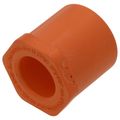


CPVC transition bushings are fittings that step down or step up between two different pipe sizing standards within a CPVC system, most commonly joining CTS (copper tube size) pipe to IPS (iron pipe size) pipe or fittings. Because CTS and IPS pipe of the same nominal size have different actual outside diameters, a straight coupling will not seal correctly between them, and a transition bushing is what makes that connection possible. These bushings solvent-weld into place the same way as other CPVC fittings, so no special tooling is needed beyond standard CPVC cleaner and cement. They come up on jobs that mix a CTS-sized branch line, common in hot and cold water distribution, with IPS-sized equipment connections or older piping that was installed to the other standard. Keeping a range of these bushings on hand lets a plumber adapt between the two sizing systems in the field instead of re-piping a section to match one standard throughout.
Subcategories
- CTS Spigot x IPS Bushings: These transition from a CTS-sized spigot end into an IPS-threaded or IPS-socket connection, commonly used where a CTS water distribution line needs to tie into IPS-sized equipment or fixture connections.
- IPS Spigot x CTS Bushings: These run the transition the other direction, stepping an IPS line down to a CTS connection, which comes up when adapting older IPS-standard piping into a newer CTS branch.
- Reducing Transition Bushings: Beyond bridging CTS to IPS, some bushings in this category also reduce to a smaller nominal pipe size at the same time, combining a size reduction and a standard transition in a single fitting rather than requiring two separate fittings.
Buying Guide
Identify which sizing standard is on each side of the transition before ordering, since CTS and IPS pipe of the same nominal size are not interchangeable and using the wrong bushing will not seal properly. Checking the existing pipe against a sizing reference, rather than assuming based on nominal size alone, avoids a mismatched fitting.
Confirm whether the connection needs to reduce in size at the same time as transitioning standards. A combined CPVC Transition Bushing that both reduces and transitions in one fitting simplifies the joint and reduces the number of solvent-welded connections in that section of line, which is generally preferable to stacking multiple fittings where a single one will do the job.
Check that both ends of the bushing match the connection types already on site, whether that is a spigot end going into a socket, or a threaded end that needs to mate with existing IPS threads. Getting the end types right the first time avoids reworking a joint after it has already been cemented.
Finally, follow standard CPVC solvent-cementing practice for the joint, including proper cleaner and primer where required and adequate cure time before pressurizing the line, since the bushing itself is only as reliable as the joint technique used to install it.
Frequently Asked Questions
What is the difference between CTS and IPS sizing?
CTS, or copper tube size, and IPS, or iron pipe size, are two different sizing standards where the same nominal pipe size has a different actual outside diameter. A transition bushing is needed to join the two because a standard coupling will not seal across that difference.
Can a transition bushing also reduce pipe size?
Yes, some transition bushings in this category combine a size reduction with the CTS to IPS transition in a single fitting, which cuts down on the number of separate fittings needed at that joint.
Do these bushings install the same way as standard CPVC fittings?
Yes, they solvent-weld into place using standard CPVC cleaner and cement, with no special tooling required beyond what is already used for other CPVC joints on the job.
When would a job need a CTS to IPS transition?
This comes up most often where a CTS-sized water distribution branch needs to connect to IPS-sized equipment, fixtures, or older piping installed to the other standard.
Is it possible to use the wrong transition bushing by mistake?
Yes, if the pipe standard on either side is misidentified. Confirming CTS versus IPS sizing on the existing pipe before ordering avoids a fitting that will not seal correctly once installed.
