




Carbon Steel NPT x Socket Weld Couplings (3000 lb)

 --%3E %3Csvg version='1.1' id='No-RB' xmlns='http://www.w3.org/2000/svg' xmlns:xlink='http://www.w3.org/1999/xlink' x='0px' y='0px' viewBox='0 0 100 100' enable-background='new 0 0 100 100' xml:space='preserve'%3E %3Cpath fill='%23CECECE' d='M79.44,0.95H20.56C9.78,0.95,0.95,9.78,0.95,20.56v58.87c0,10.79,8.82,19.61,19.61,19.61h58.87 c10.79,0,19.61-8.83,19.61-19.61V20.56C99.05,9.78,90.22,0.95,79.44,0.95z M65.38,58.24l9.38,29.58L49.69,69.78L24.5,87.82 l9.34-29.6L8.8,39.6l30.73-0.17c0,0,6.98-19.61,10-28.93c0.54,1.36,9.88,29.1,9.88,29.1H91.2L65.38,58.24z'/%3E %3C/svg%3E)
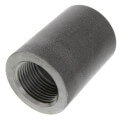
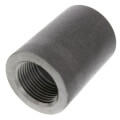
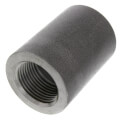
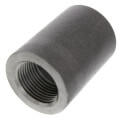

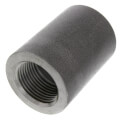
Carbon steel NPT x socket weld couplings are transition fittings that join a threaded pipe end to a section of pipe intended for welding, giving a contractor a single fitting instead of a threaded union and a separate weld fitting. One end accepts a standard tapered pipe thread while the other is machined to accept a pipe stub for a socket weld connection, making these couplings useful anywhere a system needs to switch joining methods, such as connecting threaded valves or gauges into an otherwise welded steel piping run. Built to a 3000 lb pressure class, these couplings are rated for demanding industrial and commercial piping systems carrying steam, compressed air, or process fluids at higher working pressures than a standard threaded coupling can safely handle. Because they eliminate an extra fitting at transition points, they simplify layout and reduce the number of potential leak paths in a piping system.
Subcategories
- Half Couplings: A single threaded or socket weld connection on one end with a plain, unthreaded stub on the other, typically welded directly into a pipe or vessel wall to add a threaded outlet. Common for adding gauge or instrument taps to an existing line.
- Full Couplings: Feature a threaded NPT connection on one end and a socket weld connection on the other, allowing two dissimilar piping methods to be joined in a single fitting. These are the most commonly stocked style for general transition work.
- Reducing Couplings: Step down from a larger socket weld connection to a smaller NPT thread size, or the reverse, letting a contractor tie a smaller threaded component into a larger welded pipe run without adding a separate reducer fitting.
Buying Guide
Pressure class is the first thing to confirm when selecting a carbon steel NPT x socket weld coupling. A 3000 lb coupling is built with a thicker wall section than lighter-duty threaded fittings, which matters most on systems carrying steam or compressed gas where a lower-rated fitting could fail under load. Matching the coupling's rating to the system's actual working pressure, not just its nominal pipe size, avoids installing an undersized fitting.
Pipe schedule compatibility on the socket weld side deserves equal attention. The socket weld end is machined to accept a specific outside diameter of pipe, and a mismatch between the coupling's socket depth and the pipe schedule being welded can leave a gap that weakens the joint. Confirming the pipe schedule in the drawings before ordering prevents a rework trip.
Thread engagement on the NPT side is worth checking as well, particularly on systems that will see thermal cycling. Tapered pipe threads rely on proper engagement depth to seal, and a coupling installed too loose or over-tightened can crack under repeated heating and cooling. Using a thread sealant rated for the system's fluid and temperature helps the joint hold up over time.
For piping runs that mix threaded valves, gauges, or instruments with welded steel pipe, standardizing on one supplier's coupling line across a project simplifies material tracking and helps confirm every fitting on the job meets the same pressure class. Buying couplings and matching pipe from a single source also reduces the chance of a dimensional mismatch showing up mid-installation.
Frequently Asked Questions
What does the 3000 lb rating mean on a socket weld coupling?
It refers to the fitting's pressure class, a standardized rating that indicates the maximum working pressure the coupling can handle at a given temperature. A 3000 lb class fitting is built with heavier wall thickness than lower-rated threaded fittings.
Can this coupling be used on a steam line?
Yes, 3000 lb carbon steel couplings are commonly specified for steam and other high-pressure applications, provided the coupling's temperature rating also matches the system's operating conditions.
Does the socket weld end require a gap before welding?
Most designs call for the pipe to be inserted until it bottoms out in the socket, then backed off slightly to leave a small expansion gap, which allows for thermal movement and helps prevent weld cracking. Installers should follow the applicable welding code for the exact gap specified.
What thread sealant works best on the NPT end?
A pipe thread sealant or tape rated for the system's fluid, pressure, and temperature range should be used; the correct choice depends on whether the line carries steam, compressed air, or another process fluid.
Are these couplings interchangeable with stainless steel versions?
No, carbon steel and stainless steel couplings are not typically mixed on the same system without accounting for galvanic corrosion between dissimilar metals, so the coupling material should generally match the surrounding pipe material.
