




Copper Press Pipe Fittings
Copper press fittings join copper pipe using a mechanical press connection instead of a soldered or brazed joint. An internal O-ring, compressed around the pipe by a press tool, seals the connection. They cover the same range of jobs as standard copper fittings, including elbows, tees, couplings, and adapters. They let a technician make a watertight connection without an open flame.
Press fittings have become common on plumbing, hydronic heating, and light commercial jobs where working around occupied spaces, combustible materials, or fire-watch requirements makes soldering impractical. A proper press connection depends on the fitting, the pipe, and the press tool jaw all matching the same size and system. Confirming compatibility across all three before starting a job avoids a failed joint down the line.

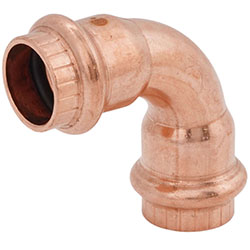


Subcategories
- Copper Press Fittings (Imported): Imported copper press fittings cover the same range of elbows, tees, and couplings as other press fitting lines at a different price point. They use the same press connection method and require a compatible press tool jaw sized to the fitting. Confirming pressure and temperature ratings against the job's requirements is a standard step regardless of manufacturer.
- Copper Press Tools: Press tools are the powered jaws and actuators used to form the mechanical connection on a copper press fitting, compressing the fitting's collar around the pipe and O-ring. The tool's jaw size and press profile need to match the fitting system being installed. Battery capacity and jaw interchangeability are common considerations when selecting a tool for daily use.
- Viega ProPress Fittings: ProPress fittings are Viega's copper press fitting line. They require a press tool jaw specific to the ProPress profile rather than a generic press jaw. Smart Connect features on some ProPress fittings are designed to prevent an unpressed joint from holding pressure, which can help identify a missed connection during testing.
Buying Guide
Selecting copper press fittings starts with confirming the press tool available on the job matches the fitting system being installed. Different manufacturers use different jaw profiles. A jaw built for one press fitting line does not necessarily form a proper seal on a fitting from a different line, even when the pipe size matches.
Pipe size and wall thickness need to match the fitting's rated range, since press fittings are designed around a specific outer diameter tolerance. Using pipe outside that tolerance, even slightly, can prevent the O-ring from sealing correctly once the joint is pressed.
System type matters as much as pipe size. Fittings rated for potable water systems are not always interchangeable with fittings rated for hydronic heating or refrigerant applications, since O-ring material and pressure ratings differ by intended use. Confirming the fitting's rated application against the job at hand avoids installing the wrong product.
Cost and price point vary across copper press fitting lines, while the underlying press method stays the same. Choosing between them often comes down to fitting availability, jaw compatibility with tools already owned, and brand-specific features like unpressed-connection indicators.
Verifying every joint has been pressed before pressurizing a system is a standard quality step regardless of which fitting line is used. An unpressed connection can sometimes hold briefly under low pressure before failing. Features that visually flag an unpressed joint reduce the chance of a missed connection making it into a finished system.
Frequently Asked Questions
Can different brands of copper press fittings be pressed with the same tool?
Not always. Press tool jaws are built to a specific profile that matches one fitting system. Using the wrong jaw profile can prevent the fitting from sealing correctly even if the pipe size matches. Confirming jaw compatibility with the specific fitting line before starting a job is important.
Do copper press fittings work for both water and refrigerant lines?
It depends on the fitting line. Fitting lines are rated for specific applications. The O-ring material and pressure ratings for a potable water fitting are not necessarily the same as those for a refrigerant or hydronic heating fitting. Checking the fitting's rated application against the job is necessary before installation.
How can I tell if a press fitting joint was actually pressed?
Smart Connect features on some ProPress fittings are designed to prevent an unpressed joint from holding pressure, which can help identify a missed connection during testing. Verifying every joint has been pressed before pressurizing the system is a standard quality step with any fitting line.
What should I weigh when choosing between copper press fitting lines?
The underlying press method stays the same across copper press fitting lines, while cost and price point vary. Choosing between lines often comes down to fitting availability, jaw compatibility with tools already owned, and brand-specific features like unpressed-connection indicators.
Why use press fittings instead of soldering?
A press connection uses a mechanical press instead of a soldered or brazed joint. A technician can make a watertight connection without an open flame. That helps on jobs around occupied spaces, combustible materials, or fire-watch requirements. The connection requires a press tool with a jaw that matches the fitting system.
Resources

 --%3E %3C!DOCTYPE svg PUBLIC '-//W3C//DTD SVG 1.1//EN' 'http://www.w3.org/Graphics/SVG/1.1/DTD/svg11.dtd'%3E %3Csvg version='1.1' id='Layer_1' xmlns='http://www.w3.org/2000/svg' xmlns:xlink='http://www.w3.org/1999/xlink' x='0px' y='0px' width='90px' height='90px' viewBox='0 0 90 90' enable-background='new 0 0 90 90' xml:space='preserve'%3E %3Crect x='27' y='23' fill='%23FFFFFF' width='43' height='44'/%3E %3Cg%3E %3Cdefs%3E %3Crect id='SVGID_1_' width='90' height='90'/%3E %3C/defs%3E %3CclipPath id='SVGID_2_'%3E %3Cuse xlink:href='%23SVGID_1_' overflow='visible'/%3E %3C/clipPath%3E %3Cpath clip-path='url(%23SVGID_2_)' fill='%234186AD' d='M45,0C20.1,0,0,20.1,0,45c0,24.9,20.1,45,45,45c24.9,0,45-20.1,45-45 C90,20.1,69.9,0,45,0'/%3E %3C/g%3E %3Cpath fill='%23FFFFFF' d='M60.6,47.4l-22.5,14c-0.5,0.3-1,0.399-1.5,0.399s-0.9-0.1-1.4-0.399c-0.9-0.5-1.4-1.4-1.4-2.5v-28 c0-1,0.6-2,1.4-2.5c0.9-0.5,2-0.5,2.9,0.1l22.5,14.1C61.4,43.1,61.9,44,61.9,45S61.4,46.9,60.6,47.4'/%3E %3C/svg%3E)


Subcategories
- Copper Press Fittings (Imported): Imported copper press fittings cover the same range of elbows, tees, and couplings as other press fitting lines at a different price point. They use the same press connection method and require a compatible press tool jaw sized to the fitting. Confirming pressure and temperature ratings against the job's requirements is a standard step regardless of manufacturer.
- Copper Press Tools: Press tools are the powered jaws and actuators used to form the mechanical connection on a copper press fitting, compressing the fitting's collar around the pipe and O-ring. The tool's jaw size and press profile need to match the fitting system being installed. Battery capacity and jaw interchangeability are common considerations when selecting a tool for daily use.
- Viega ProPress Fittings: ProPress fittings are Viega's copper press fitting line. They require a press tool jaw specific to the ProPress profile rather than a generic press jaw. Smart Connect features on some ProPress fittings are designed to prevent an unpressed joint from holding pressure, which can help identify a missed connection during testing.
Buying Guide
Selecting copper press fittings starts with confirming the press tool available on the job matches the fitting system being installed. Different manufacturers use different jaw profiles. A jaw built for one press fitting line does not necessarily form a proper seal on a fitting from a different line, even when the pipe size matches.
Pipe size and wall thickness need to match the fitting's rated range, since press fittings are designed around a specific outer diameter tolerance. Using pipe outside that tolerance, even slightly, can prevent the O-ring from sealing correctly once the joint is pressed.
System type matters as much as pipe size. Fittings rated for potable water systems are not always interchangeable with fittings rated for hydronic heating or refrigerant applications, since O-ring material and pressure ratings differ by intended use. Confirming the fitting's rated application against the job at hand avoids installing the wrong product.
Cost and price point vary across copper press fitting lines, while the underlying press method stays the same. Choosing between them often comes down to fitting availability, jaw compatibility with tools already owned, and brand-specific features like unpressed-connection indicators.
Verifying every joint has been pressed before pressurizing a system is a standard quality step regardless of which fitting line is used. An unpressed connection can sometimes hold briefly under low pressure before failing. Features that visually flag an unpressed joint reduce the chance of a missed connection making it into a finished system.
Frequently Asked Questions
Can different brands of copper press fittings be pressed with the same tool?
Not always. Press tool jaws are built to a specific profile that matches one fitting system. Using the wrong jaw profile can prevent the fitting from sealing correctly even if the pipe size matches. Confirming jaw compatibility with the specific fitting line before starting a job is important.
Do copper press fittings work for both water and refrigerant lines?
It depends on the fitting line. Fitting lines are rated for specific applications. The O-ring material and pressure ratings for a potable water fitting are not necessarily the same as those for a refrigerant or hydronic heating fitting. Checking the fitting's rated application against the job is necessary before installation.
How can I tell if a press fitting joint was actually pressed?
Smart Connect features on some ProPress fittings are designed to prevent an unpressed joint from holding pressure, which can help identify a missed connection during testing. Verifying every joint has been pressed before pressurizing the system is a standard quality step with any fitting line.
What should I weigh when choosing between copper press fitting lines?
The underlying press method stays the same across copper press fitting lines, while cost and price point vary. Choosing between lines often comes down to fitting availability, jaw compatibility with tools already owned, and brand-specific features like unpressed-connection indicators.
Why use press fittings instead of soldering?
A press connection uses a mechanical press instead of a soldered or brazed joint. A technician can make a watertight connection without an open flame. That helps on jobs around occupied spaces, combustible materials, or fire-watch requirements. The connection requires a press tool with a jaw that matches the fitting system.