




Filters
SORT
Product Availability –
Size –
Review Score –
 --%3E %3Csvg version='1.1' id='Fill' xmlns='http://www.w3.org/2000/svg' xmlns:xlink='http://www.w3.org/1999/xlink' x='0px' y='0px' viewBox='0 0 100 100' enable-background='new 0 0 100 100' xml:space='preserve'%3E %3Cpath fill='%23F15C02' d='M79.44,0.95H20.56C9.78,0.95,0.95,9.78,0.95,20.56v58.87c0,10.79,8.82,19.61,19.61,19.61h58.87 c10.79,0,19.61-8.83,19.61-19.61V20.56C99.05,9.78,90.22,0.95,79.44,0.95z M65.38,58.24l9.38,29.58L49.69,69.78L24.5,87.82 l9.34-29.6L8.8,39.6l30.73-0.17c0,0,6.98-19.61,10-28.93c0.54,1.36,9.88,29.1,9.88,29.1H91.2L65.38,58.24z'/%3E %3C/svg%3E)
 --%3E %3Csvg version='1.1' id='With-RB' xmlns='http://www.w3.org/2000/svg' xmlns:xlink='http://www.w3.org/1999/xlink' x='0px' y='0px' viewBox='0 0 100 100' enable-background='new 0 0 100 100' xml:space='preserve'%3E %3Cpath fill='%23FBC8B4' d='M79.44,0.95H20.56C9.78,0.95,0.95,9.78,0.95,20.56v58.87c0,10.79,8.82,19.61,19.61,19.61h58.87 c10.79,0,19.61-8.83,19.61-19.61V20.56C99.05,9.78,90.22,0.95,79.44,0.95z M65.38,58.24l9.38,29.58L49.69,69.78L24.5,87.82 l9.34-29.6L8.8,39.6l30.73-0.17c0,0,6.98-19.61,10-28.93c0.54,1.36,9.88,29.1,9.88,29.1H91.2L65.38,58.24z'/%3E %3C/svg%3E)
Copper to Tubular Couplings

 --%3E %3Csvg version='1.1' id='No-RB' xmlns='http://www.w3.org/2000/svg' xmlns:xlink='http://www.w3.org/1999/xlink' x='0px' y='0px' viewBox='0 0 100 100' enable-background='new 0 0 100 100' xml:space='preserve'%3E %3Cpath fill='%23CECECE' d='M79.44,0.95H20.56C9.78,0.95,0.95,9.78,0.95,20.56v58.87c0,10.79,8.82,19.61,19.61,19.61h58.87 c10.79,0,19.61-8.83,19.61-19.61V20.56C99.05,9.78,90.22,0.95,79.44,0.95z M65.38,58.24l9.38,29.58L49.69,69.78L24.5,87.82 l9.34-29.6L8.8,39.6l30.73-0.17c0,0,6.98-19.61,10-28.93c0.54,1.36,9.88,29.1,9.88,29.1H91.2L65.38,58.24z'/%3E %3C/svg%3E)

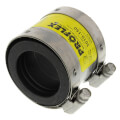
Copper to Tubular Couplings join rigid copper drain tubing to tubular slip-joint piping found on P-traps and lavatory drain assemblies. Fernco ProFlex models such as the 3010-150 and 3010-215 cover 1-1/2 inch and 2 inch by 1-1/2 inch size combinations, built around a stainless steel shield and 301 stainless steel clamp bands for a flexible, watertight seal. Plumbers use these couplings where a copper stub-out or copper drain line needs to connect directly to a tubular trap arm without matching thread or solvent-weld connections on both sides. The stainless steel shield adds rigidity against shear forces and heavy loads that an unshielded coupling alone would not resist as well, which matters on couplings installed inside a wall cavity or behind a fixture where the joint is not easily inspected after installation. Because copper and tubular components use different outside diameters at a given nominal size, selecting a coupling sized for the specific copper and tubular combination on site keeps the connection watertight.
Subcategories
- Standard 1-1/2 Inch Couplings: The Fernco 3010-150 connects 1-1/2 inch copper tubing to a 1-1/2 inch tubular trap arm, matching the most common lavatory drain size. A stainless steel shield covers the flexible coupling body, with 301 stainless steel clamp bands drawing the connection tight at each end. Plumbers use this size where a copper stub-out and an existing tubular trap are both standard lavatory diameter. The shielded design resists shear forces better than an unshielded flexible coupling would on its own.
- Reducing Couplings: The Fernco 3010-215 steps down from a 2 inch copper connection to a 1-1/2 inch tubular side, covering installations where the copper stub-out is larger than the trap arm it connects to. Plumbers use a reducing coupling rather than adding a separate reducer fitting ahead of a standard same-size coupling. The same stainless steel shield and 301 stainless steel clamp band construction carries over from the straight-size models. Reducing couplings keep a transition to a single fitting instead of stacking multiple connections.
- Related Tubular to Tubular Couplings: Fernco also offers tubular to tubular couplings, such as the 3002-155, for connecting two tubular drain components without a copper side at all. Plumbers reach for this style when both sides of a repair are tubular slip-joint pipe rather than rigid copper. Construction follows the same shielded coupling approach used across the ProFlex line. Choosing between a copper to tubular model and a tubular to tubular model depends entirely on what pipe material exists on each side of the joint.
- Related Copper to Copper Couplings: The 3003-150 connects copper tubing on both sides of a joint rather than transitioning to tubular pipe, useful on repairs where a tubular trap is being replaced with rigid copper on both legs. Plumbers select this version when upgrading an entire trap assembly from tubular to copper rather than just making a transition at one point. The same shielded stainless steel construction applies across the 3003 series. Keeping both copper to tubular and copper to copper options on a truck covers most trap repair scenarios encountered in the field.
Buying Guide
Start by measuring both sides of the joint being connected, since Copper to Tubular Couplings are sized by two separate diameters rather than one nominal pipe size. A 1-1/2 inch copper stub-out paired with a 1-1/2 inch tubular trap needs a straight-size coupling such as the 3010-150, while a larger copper connection meeting a smaller tubular trap arm calls for a reducing model such as the 3010-215.
Next, confirm which side of the repair is actually copper and which is tubular before ordering, since Fernco also sells tubular to tubular and copper to copper versions in the same ProFlex line. Grabbing the wrong combination leads to a coupling that will not seat properly on one side of the joint.
Installation location affects how much shielding matters. A coupling installed behind an accessible cabinet panel can be inspected and serviced easily, while one buried inside a wall cavity or finished ceiling benefits more from the added rigidity of a stainless steel shield and clamp bands, since a slow leak in a concealed location can cause hidden damage before anyone notices it.
Finally, check clamp band torque and seating during installation rather than assuming a shielded coupling seals on contact alone. Both stainless steel clamp bands need even, firm tightening around the full circumference of the shield to keep the coupling watertight under normal drain flow and occasional standing water in a trap during a clog.
Frequently Asked Questions
What sizes does the Fernco copper to tubular coupling come in?
Fernco ProFlex copper to tubular couplings include the 3010-150 for a 1-1/2 inch to 1-1/2 inch connection and the 3010-215 for a 2 inch copper to 1-1/2 inch tubular reduction. Matching both diameters on each side of the joint determines which model fits a given repair.
What material makes up the shield on these couplings?
The shield uses stainless steel construction paired with 301 stainless steel clamp bands to draw the connection tight at each end. The shielded design resists shear forces better than an unshielded flexible coupling would on its own.
Can a copper to tubular coupling be used when both sides of a repair are tubular?
A copper to tubular coupling will not seat correctly when both sides of the joint are tubular pipe. Fernco's tubular to tubular models, such as the 3002-155, are built for that specific pairing instead.
Does installation location change which coupling to choose?
Installation location affects how much the added rigidity of the stainless steel shield matters rather than which model fits, since a concealed joint inside a wall or ceiling benefits more from shielding than an accessible connection under an open cabinet. Diameter matching on both sides of the joint remains the main factor in selecting the right coupling.
How should the clamp bands be tightened during installation?
Clamp bands need even, firm tightening around the full circumference of the shield rather than tightening one side more than the other. Proper clamp seating keeps the coupling watertight under normal drain flow and occasional standing water in a trap.
