




Horizontal Fixed Blade Registers, OB (94AHOV Series)

 --%3E %3Csvg version='1.1' id='No-RB' xmlns='http://www.w3.org/2000/svg' xmlns:xlink='http://www.w3.org/1999/xlink' x='0px' y='0px' viewBox='0 0 100 100' enable-background='new 0 0 100 100' xml:space='preserve'%3E %3Cpath fill='%23CECECE' d='M79.44,0.95H20.56C9.78,0.95,0.95,9.78,0.95,20.56v58.87c0,10.79,8.82,19.61,19.61,19.61h58.87 c10.79,0,19.61-8.83,19.61-19.61V20.56C99.05,9.78,90.22,0.95,79.44,0.95z M65.38,58.24l9.38,29.58L49.69,69.78L24.5,87.82 l9.34-29.6L8.8,39.6l30.73-0.17c0,0,6.98-19.61,10-28.93c0.54,1.36,9.88,29.1,9.88,29.1H91.2L65.38,58.24z'/%3E %3C/svg%3E)

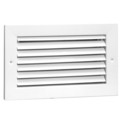
Horizontal Fixed Blade Registers, OB (94AHOV Series) are supply air registers built with a single set of fixed horizontal blades set at an oblique angle to direct airflow outward and downward from a wall or ceiling opening. HVAC installers and mechanical contractors use them on supply-side duct openings where a horizontal throw pattern distributes conditioned air across a room without an adjustable damper.
The fixed-blade design sets these registers apart from double-deflection models, which use two blade sets for both horizontal and vertical air direction. Because the blades are fixed rather than adjustable, the register's throw pattern is set at the time of manufacture, making it important to match the blade angle to the installation location. These registers are commonly installed in residential and light commercial ductwork where a simple, lower-cost air distribution point is needed, and matching the register's duct opening size to the actual duct or boot dimension keeps airflow consistent around the frame.
Subcategories
- Steel Frame Registers: Steel frame registers use a powder-coated steel construction, most commonly finished in white to blend with typical wall and ceiling surfaces. Contractors specify steel frame registers for standard residential supply air openings because of their durability and straightforward surface-mount installation. The steel frame holds its shape well under repeated painting or cleaning.
- Aluminum Frame Registers: Aluminum frame registers offer a lighter-weight alternative to steel, often chosen for larger duct openings or installations where corrosion resistance matters, such as basements or laundry areas. Mechanical contractors specify aluminum when the register will see periodic moisture exposure. The lighter frame also simplifies handling on larger register sizes.
- Multiple Duct Opening Sizes: These registers are manufactured across a range of duct neck sizes to match common residential and light commercial duct openings. Matching the register directly to an existing duct or boot avoids the need for a transition fitting. Installers select the opening size based on the duct dimension already in place rather than the room's overall airflow requirement alone.
- Oblique Blade Configurations: The oblique blade angle sets the fixed horizontal throw direction for the register, sending air outward and down rather than straight through the opening. Installers account for this fixed angle when choosing where on a wall or ceiling to locate the register relative to the room's layout. Because the angle can't be adjusted after installation, placement matters more with this style than with an adjustable register.
Buying Guide
Duct opening size is the first detail to confirm, since the register's neck dimension needs to match the existing duct or boot to avoid a transition fitting. Frame material, steel or aluminum, should be chosen based on the installation environment, with aluminum better suited to areas with periodic moisture exposure and steel serving as the standard choice for typical interior locations.
Because Horizontal Fixed Blade Registers, OB (94AHOV Series) use a fixed blade angle rather than an adjustable one, placement location matters more than it does with double-deflection registers. The oblique blade throws air outward and down from the opening, so positioning the register where that fixed throw pattern actually reaches the occupied space of the room avoids uneven conditioning.
Finish should match the surrounding wall or ceiling surface, with white being the standard option for most residential installations. For rooms with heavier traffic or cleaning needs, steel frames tend to hold up better to repeated handling than lighter aluminum options, while aluminum remains the better choice anywhere corrosion resistance is the priority.
Frequently Asked Questions
What does the oblique blade design do on this register style?
The oblique blade angle directs airflow outward and downward from the opening in a fixed pattern that can't be adjusted after installation. This makes register placement relative to the room layout more important than it is with adjustable double-deflection registers.
How is the correct duct opening size chosen for this register?
The register's neck dimension should match the existing duct or boot opening to avoid needing a transition fitting. Measuring the actual duct opening before ordering prevents a size mismatch during installation.
When should an aluminum frame be chosen over steel?
Aluminum frames hold up better in areas with periodic moisture exposure, such as basements or laundry rooms, due to their corrosion resistance. Steel frames remain the standard choice for typical interior rooms where moisture isn't a regular concern.
Can this register's airflow direction be adjusted after installation?
No, the fixed horizontal blades are set at the time of manufacture and can't be adjusted once installed. Register location should be planned around the fixed throw pattern before installation rather than after.
What's the difference between this register and a double-deflection register?
A double-deflection register uses two sets of blades to direct airflow both horizontally and vertically, while this fixed-blade style uses a single set of blades set at a fixed oblique angle. The fixed-blade design is typically a simpler, lower-cost option for straightforward supply air applications.
