




MegaPress Unions

 --%3E %3Csvg version='1.1' id='No-RB' xmlns='http://www.w3.org/2000/svg' xmlns:xlink='http://www.w3.org/1999/xlink' x='0px' y='0px' viewBox='0 0 100 100' enable-background='new 0 0 100 100' xml:space='preserve'%3E %3Cpath fill='%23CECECE' d='M79.44,0.95H20.56C9.78,0.95,0.95,9.78,0.95,20.56v58.87c0,10.79,8.82,19.61,19.61,19.61h58.87 c10.79,0,19.61-8.83,19.61-19.61V20.56C99.05,9.78,90.22,0.95,79.44,0.95z M65.38,58.24l9.38,29.58L49.69,69.78L24.5,87.82 l9.34-29.6L8.8,39.6l30.73-0.17c0,0,6.98-19.61,10-28.93c0.54,1.36,9.88,29.1,9.88,29.1H91.2L65.38,58.24z'/%3E %3C/svg%3E)

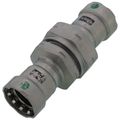
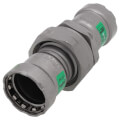
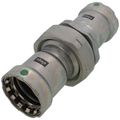

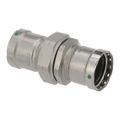
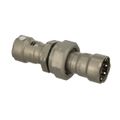
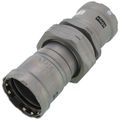
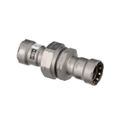
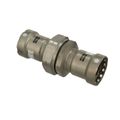
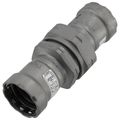
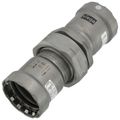


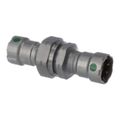
MegaPress unions are press-connect fittings that let a carbon steel or stainless steel pipe run be disconnected and reconnected at a specific point without cutting the pipe or breaking a threaded joint. Mechanical and plumbing contractors install unions like these anywhere a valve, meter, pump, or piece of equipment might need to come out for service or replacement down the road, since a straight coupling or elbow at that location would require cutting the pipe to separate it later. Because MegaPress fittings connect using a hydraulic press tool rather than welding or threading, a union in this system can be installed on the same job with the same tool as every other fitting in the run, without switching processes for that one connection point. The union seals using an EPDM or HNBR O-ring depending on the application, and matching that seal material to the piping system's actual use, whether hydronic heating, fire protection, or compressed air, is necessary for a reliable long-term joint. Placing unions at planned service points during rough-in saves significant labor compared to cutting in a union after the system is already in service.
Subcategories
- Standard MegaPress Unions: Standard carbon steel unions cover the most common sizes used in hydronic heating and fire protection piping, and they install with the same press tool jaw used for couplings and elbows in the same system. Placing one at each valve, pump, or piece of equipment during rough-in avoids needing to cut the pipe later if that component needs service. The union's two halves separate by hand once loosened, without needing to break a threaded or soldered joint.
- Stainless Steel MegaPress Unions: Stainless steel unions are used on piping systems handling more corrosive fluids or environments, such as certain process piping or installations where standard carbon steel isn't suitable long-term. They use the same press connection method as the carbon steel line but require a press tool and jaw set rated for stainless MegaPress fittings specifically. Matching the union's seal material to the application is just as important on stainless installations as on standard carbon steel ones.
- Union Elbows: Union elbows combine a 90-degree direction change with a serviceable disconnect point in a single fitting, which is useful in tight mechanical rooms where a straight union and a separate elbow wouldn't both fit in the available space. They're common just ahead of equipment connections where the piping needs to turn before it reaches the unit. Installing a union elbow instead of a standard elbow at these locations adds a service point without adding another fitting to the run.
- Dielectric Unions: Dielectric unions isolate dissimilar metals, such as a carbon steel MegaPress run connecting to copper or brass equipment, to prevent galvanic corrosion at that joint. Skipping a dielectric union at a dissimilar-metal transition is a common cause of accelerated corrosion showing up at that connection point years before the rest of the system. These unions still use the standard press connection on the carbon steel side while providing a non-conductive barrier at the joint.
Buying Guide
Deciding where to place a union starts with identifying every point in the run where a valve, pump, meter, or piece of equipment might realistically need to come out for service or replacement, since that's the situation a union is built to handle without cutting the pipe. Standard carbon steel unions cover the majority of hydronic and fire protection installations, while stainless steel versions are necessary on systems carrying more corrosive fluids or in environments where carbon steel wouldn't hold up long-term. At any point where the piping connects to a dissimilar metal, such as copper or brass equipment, a dielectric union prevents galvanic corrosion that would otherwise show up at that joint well before the rest of the system. In tight mechanical rooms, a union elbow combines a direction change and a service point in one fitting, which can solve a space problem that a separate union and elbow can't. Because MegaPress Unions install with the same press tool used for every other fitting in the system, there's no added labor cost to using a union instead of a standard coupling at a planned service point, aside from the part cost difference. Seal material also matters: confirming EPDM or HNBR compatibility with the system's actual fluid, whether that's hydronic water, fire protection water, or compressed air, avoids a seal failure that has nothing to do with the press connection itself. Planning union locations during rough-in, rather than adding them after the system is in service, is the most efficient way to use this fitting type.
Frequently Asked Questions
What's the difference between a MegaPress union and a regular coupling?
A coupling permanently joins two pipe ends and requires cutting the pipe to separate them later. A union is designed to be taken apart by hand at that joint without cutting, which makes it the right choice anywhere equipment might need to come out for service.
Do I need a special tool to install a MegaPress union?
No, standard carbon steel MegaPress unions install with the same press tool and jaw used for every other fitting in the standard carbon steel MegaPress system. Stainless steel MegaPress unions require a press tool and jaw set rated for stainless fittings specifically.
When should I use a dielectric union instead of a standard union?
Use a dielectric union any time the piping connects to a dissimilar metal, such as a carbon steel run terminating at copper or brass equipment. Skipping the dielectric union at that type of transition allows galvanic corrosion to develop at the joint over time.
Can a union elbow replace a standard elbow anywhere in the system?
It can be used anywhere a standard elbow would go, though it costs more, so most contractors reserve union elbows for locations where a service disconnect point is actually needed, such as just ahead of a piece of equipment. Using a standard elbow everywhere else keeps material costs down without losing the service points that matter.
What seal material should I use in a MegaPress union?
EPDM and HNBR are the two common seal materials, and the right choice depends on the fluid and application; HNBR is typically specified for applications involving oil or certain refrigerants, while EPDM covers standard hydronic and fire protection water systems. Checking the manufacturer's compatibility chart for the specific fluid in that system is the reliable way to confirm which seal material applies.
