




PEX Coils
PEX coils cover cross-linked polyethylene tubing sold in coiled lengths for both potable water plumbing and radiant heat installations. Plumbing coils supply hot and cold water throughout a building, while radiant heat coils form the closed loop tubing embedded in a floor or wall assembly.
Choosing between plumbing and radiant-rated PEX depends on the application, since radiant tubing typically includes an oxygen barrier layer that protects boiler components from oxygen corrosion in a closed loop. Coil length and diameter both factor into how many fittings a given run requires.

Subcategories
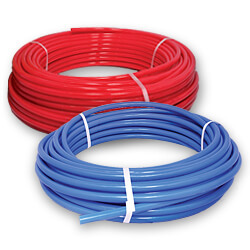
- PEX Plumbing Coils: PEX plumbing coils supply hot and cold potable water throughout a building, run from a manifold to individual fixtures in long continuous lengths that avoid fittings behind walls and floors.
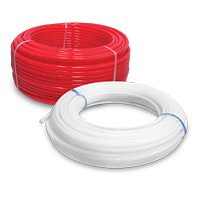
- Radiant Heat PEX Coils: Radiant heat PEX coils form the closed loop tubing embedded in a slab or subfloor that carries heated water to warm a room from the floor up, typically run in even spacing patterns from a manifold.
Buying Guide
Separate plumbing applications from radiant heat applications first, since PEX coils rated for potable water distribution and PEX coils built for closed loop radiant heat are tested to different pressure and temperature standards.
Check coil diameter and length against the run distance and fixture count being served, since a coil that's too short forces an added coupling and joint in a wall or slab that would otherwise stay leak free.
Confirm oxygen barrier construction for any coil going into a radiant heat loop that includes ferrous components like a boiler or steel manifold, since bare PEX allows oxygen diffusion that can accelerate corrosion in those parts over time.
Review the coil's PEX classification, since PEX-A, PEX-B, and PEX-C differ in flexibility and the fitting systems compatible with each, which affects both installation method and future repair options.
Order a bit of extra length beyond the measured run distance, since PEX coils can't be spliced mid-run as easily as rigid pipe and a short coil means restarting the run from the manifold.
Frequently Asked Questions
What's the difference between plumbing PEX coils and radiant heat PEX coils?
Plumbing coils are rated for potable water supply pressure and temperature, while radiant heat coils are built for the closed loop, lower pressure conditions of a floor heating system and often include an oxygen barrier layer.
Do PEX coils need an oxygen barrier for every application?
An oxygen barrier matters most in closed loop radiant heat systems that include ferrous metal components, since oxygen diffusion through bare PEX can contribute to corrosion in a boiler or steel manifold over time.
Can PEX coils be used with any fitting type?
Fitting compatibility depends on the PEX classification, since PEX-A, PEX-B, and PEX-C each pair with specific expansion, crimp, or push-fit fitting systems, so matching the fitting to the coil type prevents a failed connection.
How is coil length determined for a radiant heat loop?
Loop length is calculated from the spacing pattern and square footage being heated, with most residential loops kept under a manufacturer's maximum recommended length to maintain even heat output across the floor.
Is a manifold required when installing PEX coils?
A manifold is standard practice for both plumbing and radiant heat installations, since it lets each run be shut off, balanced, or serviced independently without affecting the rest of the system.
Resources
Subcategories
- PEX Plumbing Coils: PEX plumbing coils supply hot and cold potable water throughout a building, run from a manifold to individual fixtures in long continuous lengths that avoid fittings behind walls and floors.
- Radiant Heat PEX Coils: Radiant heat PEX coils form the closed loop tubing embedded in a slab or subfloor that carries heated water to warm a room from the floor up, typically run in even spacing patterns from a manifold.
Buying Guide
Separate plumbing applications from radiant heat applications first, since PEX coils rated for potable water distribution and PEX coils built for closed loop radiant heat are tested to different pressure and temperature standards.
Check coil diameter and length against the run distance and fixture count being served, since a coil that's too short forces an added coupling and joint in a wall or slab that would otherwise stay leak free.
Confirm oxygen barrier construction for any coil going into a radiant heat loop that includes ferrous components like a boiler or steel manifold, since bare PEX allows oxygen diffusion that can accelerate corrosion in those parts over time.
Review the coil's PEX classification, since PEX-A, PEX-B, and PEX-C differ in flexibility and the fitting systems compatible with each, which affects both installation method and future repair options.
Order a bit of extra length beyond the measured run distance, since PEX coils can't be spliced mid-run as easily as rigid pipe and a short coil means restarting the run from the manifold.
Frequently Asked Questions
What's the difference between plumbing PEX coils and radiant heat PEX coils?
Plumbing coils are rated for potable water supply pressure and temperature, while radiant heat coils are built for the closed loop, lower pressure conditions of a floor heating system and often include an oxygen barrier layer.
Do PEX coils need an oxygen barrier for every application?
An oxygen barrier matters most in closed loop radiant heat systems that include ferrous metal components, since oxygen diffusion through bare PEX can contribute to corrosion in a boiler or steel manifold over time.
Can PEX coils be used with any fitting type?
Fitting compatibility depends on the PEX classification, since PEX-A, PEX-B, and PEX-C each pair with specific expansion, crimp, or push-fit fitting systems, so matching the fitting to the coil type prevents a failed connection.
How is coil length determined for a radiant heat loop?
Loop length is calculated from the spacing pattern and square footage being heated, with most residential loops kept under a manufacturer's maximum recommended length to maintain even heat output across the floor.
Is a manifold required when installing PEX coils?
A manifold is standard practice for both plumbing and radiant heat installations, since it lets each run be shut off, balanced, or serviced independently without affecting the rest of the system.