




PVC Schedule 80 Street Tees (SPG x S x S)

 --%3E %3Csvg version='1.1' id='No-RB' xmlns='http://www.w3.org/2000/svg' xmlns:xlink='http://www.w3.org/1999/xlink' x='0px' y='0px' viewBox='0 0 100 100' enable-background='new 0 0 100 100' xml:space='preserve'%3E %3Cpath fill='%23CECECE' d='M79.44,0.95H20.56C9.78,0.95,0.95,9.78,0.95,20.56v58.87c0,10.79,8.82,19.61,19.61,19.61h58.87 c10.79,0,19.61-8.83,19.61-19.61V20.56C99.05,9.78,90.22,0.95,79.44,0.95z M65.38,58.24l9.38,29.58L49.69,69.78L24.5,87.82 l9.34-29.6L8.8,39.6l30.73-0.17c0,0,6.98-19.61,10-28.93c0.54,1.36,9.88,29.1,9.88,29.1H91.2L65.38,58.24z'/%3E %3C/svg%3E)

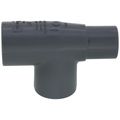


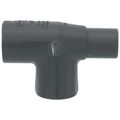
PVC Schedule 80 street tees in an SPG x S x S configuration branch a pressure pipe run into two additional connections while eliminating one solvent weld joint at the run connection. The spigot end inserts directly into an upstream fitting's socket, and the two remaining socket openings accept pipe or additional fittings for the straight-through run and the branch. Schedule 80 wall thickness gives these tees a higher pressure rating than Schedule 40 fittings of the same size, which is why they show up on industrial, chemical, and higher-pressure water system installations.
Because the street end removes a joint from the assembly, these tees are useful anywhere a branch connection needs to be made close to an existing fitting without adding a short piece of pipe as a spacer. Installers working on Schedule 80 systems rely on street-style fittings like this one to keep tight layouts, such as pump rooms or manifold assemblies, more compact.
Subcategories
- PVC Schedule 80 Street Tees, Standard Sizes: Standard sized street tees cover the common pipe diameters used on most Schedule 80 pressure systems, stocked for general branch connections on process, irrigation, and water treatment piping. These are the most frequently ordered configuration for straightforward branch takeoffs.
- PVC Schedule 80 Reducing Street Tees: Reducing versions combine a branch connection with a diameter change, letting a smaller branch line come off a larger main run through a single fitting. This avoids installing a separate reducer bushing at the branch takeoff.
Buying Guide
Confirm the pressure rating requirement for the system before choosing between Schedule 40 and Schedule 80 fittings. Schedule 80's thicker wall gives it a higher pressure rating at a given pipe size, which matters on process piping, chemical feed lines, and other applications where the system operates at higher working pressures than typical residential plumbing.
Check that the SPG x S x S configuration matches the connection needs of the branch point. The spigot end is designed to insert into an existing fitting's socket, so this configuration only works where the upstream connection is a compatible socket fitting rather than a length of plain pipe.
Verify chemical compatibility for the specific fluid or gas the system will carry, since Schedule 80 PVC is used across a range of industrial and process applications and not every chemical is compatible with PVC at every temperature and concentration.
For branch connections that also need a size change, a reducing street tee combines both functions in one fitting, which reduces joint count and lowers the chance of a leak point compared to assembling the same transition from two separate fittings.
Plan solvent cement selection around the pipe's operating pressure and temperature, since a proper solvent weld joint on Schedule 80 PVC depends on using cement rated for the pipe schedule and application.
Frequently Asked Questions
What does SPG x S x S mean on this fitting?
SPG refers to a spigot end that inserts into another fitting's socket, and S refers to a socket end that accepts pipe or another fitting's spigot. This tee has one spigot end and two socket ends.
What is the difference between Schedule 40 and Schedule 80 PVC fittings?
Schedule 80 fittings have a thicker wall than Schedule 40 fittings of the same nominal size, giving them a higher pressure rating. Schedule 80 is common on higher-pressure or industrial applications, while Schedule 40 is more typical for standard residential plumbing.
Can a street tee be used anywhere a standard tee is used?
A street tee can only be used where the spigot end connects into a compatible socket fitting. It cannot be used where the connection needs to accept a length of plain pipe on that end.
Is Schedule 80 PVC suitable for chemical or process piping?
PVC Schedule 80 is used across a range of chemical and process applications, but chemical compatibility depends on the specific fluid, concentration, and operating temperature involved. Checking a chemical resistance reference for the specific application is recommended before installation.
Why choose a reducing street tee instead of a standard tee with a bushing?
A reducing street tee combines the branch connection and the size reduction in a single fitting, which means one less solvent weld joint compared to installing a standard tee and a separate reducer bushing.
