



AC Registers & Grilles
AC registers and grilles cover the floor, wall, and ceiling components that deliver conditioned air into a room or pull return air back to the system. The selection spans residential floor and sidewall styles, ceiling diffusers built for 360-degree air distribution, and heavier commercial grilles designed for higher-traffic duct systems.
Matching a register or grille to the existing duct opening size and finish keeps airflow balanced and the installation looking finished. Contractors replacing damaged covers or upgrading a system's appearance can also find magnetic covers and accessory grilles that fit directly over existing openings without cutting into ductwork.

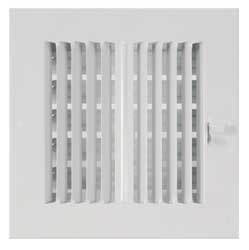
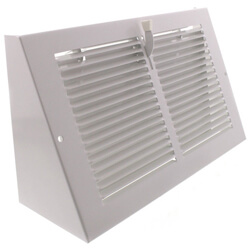
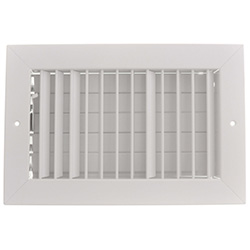



Floor Registers & Grilles are installed in floors over duct openings to supply heated or cooled air to a room or to serve as return air inlets. Floor registers include a damper controlled by a built-in lever that adjusts airflow from open to closed. Floor grilles are used for return air only and do not include a damper. Floor-mounted units must be sized to cover the duct boot opening with adequate overlap and should be selected in a finish that holds up to foot traffic and cleaning.
Sidewall/Ceiling Registers & Grilles deliver supply air or collect return air through wall and ceiling penetrations. Sidewall registers are available with single or double deflection blades that direct airflow horizontally and vertically for maximum throw and distribution. Ceiling registers are typically used with high-velocity systems or in rooms where floor mounting is not practical. Both types are sized to the duct opening and selected in a finish that matches the wall or ceiling material.
Commercial Registers & Grilles are built for higher-traffic environments and larger duct systems than standard residential registers. Commercial-grade units use heavier-gauge steel or aluminum construction and are available in larger face sizes to accommodate higher airflow volumes. Commercial registers are available in supply and return configurations and in adjustable and fixed-blade designs for different airflow direction requirements.
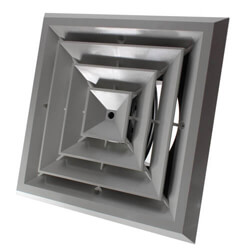
Diffusers are ceiling-mounted supply air outlets that distribute conditioned air in a 360-degree pattern, spreading airflow evenly across a room without creating concentrated drafts. Diffusers are most commonly used in commercial HVAC applications where uniform air distribution is required across large open floor plans. They connect to round or square duct boots and are selected by neck size and face size to match the duct system and ceiling grid layout.
Elima-Draft Magnetic Register/Vent Covers are insulated magnetic covers that attach directly over existing register or vent openings to block airflow in unused or over-conditioned rooms. Elima-Draft covers reduce heat loss and drafts without modifying the duct system. They are available in sizes to fit standard floor and sidewall register openings and can be removed and repositioned as heating and cooling needs change.
Airtec Diffusers, Grilles, & Accessories include a range of air distribution products for residential and light commercial HVAC systems. Airtec offers supply and return grilles, ceiling diffusers, and accessory components for completing register and grille installations. Airtec products are available in standard sizes to fit common duct boot dimensions and in finishes compatible with residential interior environments.
Register and grille sizing is based on the duct boot opening, not the face size of the unit. Measure the duct opening width and length, then select a register or grille with a face size large enough to cover the opening with adequate overlap on all sides. Most residential floor boots use 4 by 10 inch or 4 by 12 inch openings; sidewall and ceiling openings vary more widely.
Mounting location determines the product type. Floor registers require a damper and a finish that tolerates foot traffic. Sidewall and ceiling units are available with single or double deflection blades for directional control. Baseboard registers are designed to install over floor moldings. Return air locations use grilles without dampers.
Airflow direction matters for comfort. Double-deflection sidewall registers allow both horizontal and vertical blade adjustment, enabling precise airflow direction away from seating areas. Single-deflection registers direct air in one plane only. Ceiling diffusers distribute air radially in all directions, preferred for open-plan commercial spaces.
Finish selection should match the surrounding surface. White is the most common finish for residential use. Mill finish aluminum and steel are available for utility spaces. Commercial registers are available in additional finishes including primer coat for field painting.
Magnetic vent covers can reduce energy use in rooms that do not need conditioning, but blocking too many registers increases static pressure throughout the duct system. Blocking one or two registers typically does not cause problems, but blocking many registers can unbalance the system.
What's the difference between a register and a grille?
A register includes a built-in damper that can be opened or closed to control the amount of air flowing through the duct opening. Registers are used at supply air outlets where airflow adjustment is needed. A grille does not include a damper and is used primarily at return air inlets where airflow restriction is not desired. Both are available in floor, sidewall, and ceiling configurations.
How do I measure for a floor register?
Measure the width and length of the duct boot opening in the floor, not the hole in the subfloor above it. Registers are sold by their nominal duct opening size, so a 4 by 10 register is designed to fit a 4 by 10 boot opening. Confirm the actual face dimensions in the product specifications to ensure it covers the opening completely.
Can I use a ceiling register for a floor application?
Ceiling and sidewall registers are not designed for floor installation. Floor registers use a heavier finish and damper mechanism built to withstand foot traffic. Ceiling and sidewall registers have lighter construction that would not hold up in a floor application. For floor locations, always select a register specifically rated for floor installation.
What does single-deflection versus double-deflection mean on a sidewall register?
A single-deflection register has blades that move in one plane only, directing airflow either horizontally or vertically. A double-deflection register has two sets of independently adjustable blades, one for horizontal direction and one for vertical, allowing airflow to be aimed precisely in both planes. Double-deflection registers are preferred where drafts on occupants need to be avoided.
Do vent covers reduce energy efficiency?
Magnetic vent covers can reduce energy use in rooms that do not need conditioning, but blocking too many registers increases static pressure throughout the duct system. Higher static pressure causes the air handler to work harder. Blocking one or two registers in a properly sized system typically does not cause problems, but blocking many can unbalance the system. Consult a mechanical contractor if more than a few registers need to be closed off permanently.
Resources

 --%3E %3C!DOCTYPE svg PUBLIC '-//W3C//DTD SVG 1.1//EN' 'http://www.w3.org/Graphics/SVG/1.1/DTD/svg11.dtd'%3E %3Csvg version='1.1' id='Layer_1' xmlns='http://www.w3.org/2000/svg' xmlns:xlink='http://www.w3.org/1999/xlink' x='0px' y='0px' width='90px' height='90px' viewBox='0 0 90 90' enable-background='new 0 0 90 90' xml:space='preserve'%3E %3Crect x='27' y='23' fill='%23FFFFFF' width='43' height='44'/%3E %3Cg%3E %3Cdefs%3E %3Crect id='SVGID_1_' width='90' height='90'/%3E %3C/defs%3E %3CclipPath id='SVGID_2_'%3E %3Cuse xlink:href='%23SVGID_1_' overflow='visible'/%3E %3C/clipPath%3E %3Cpath clip-path='url(%23SVGID_2_)' fill='%234186AD' d='M45,0C20.1,0,0,20.1,0,45c0,24.9,20.1,45,45,45c24.9,0,45-20.1,45-45 C90,20.1,69.9,0,45,0'/%3E %3C/g%3E %3Cpath fill='%23FFFFFF' d='M60.6,47.4l-22.5,14c-0.5,0.3-1,0.399-1.5,0.399s-0.9-0.1-1.4-0.399c-0.9-0.5-1.4-1.4-1.4-2.5v-28 c0-1,0.6-2,1.4-2.5c0.9-0.5,2-0.5,2.9,0.1l22.5,14.1C61.4,43.1,61.9,44,61.9,45S61.4,46.9,60.6,47.4'/%3E %3C/svg%3E)
Other Resources
Floor Registers & Grilles are installed in floors over duct openings to supply heated or cooled air to a room or to serve as return air inlets. Floor registers include a damper controlled by a built-in lever that adjusts airflow from open to closed. Floor grilles are used for return air only and do not include a damper. Floor-mounted units must be sized to cover the duct boot opening with adequate overlap and should be selected in a finish that holds up to foot traffic and cleaning.
Sidewall/Ceiling Registers & Grilles deliver supply air or collect return air through wall and ceiling penetrations. Sidewall registers are available with single or double deflection blades that direct airflow horizontally and vertically for maximum throw and distribution. Ceiling registers are typically used with high-velocity systems or in rooms where floor mounting is not practical. Both types are sized to the duct opening and selected in a finish that matches the wall or ceiling material.
Commercial Registers & Grilles are built for higher-traffic environments and larger duct systems than standard residential registers. Commercial-grade units use heavier-gauge steel or aluminum construction and are available in larger face sizes to accommodate higher airflow volumes. Commercial registers are available in supply and return configurations and in adjustable and fixed-blade designs for different airflow direction requirements.
Diffusers are ceiling-mounted supply air outlets that distribute conditioned air in a 360-degree pattern, spreading airflow evenly across a room without creating concentrated drafts. Diffusers are most commonly used in commercial HVAC applications where uniform air distribution is required across large open floor plans. They connect to round or square duct boots and are selected by neck size and face size to match the duct system and ceiling grid layout.
Elima-Draft Magnetic Register/Vent Covers are insulated magnetic covers that attach directly over existing register or vent openings to block airflow in unused or over-conditioned rooms. Elima-Draft covers reduce heat loss and drafts without modifying the duct system. They are available in sizes to fit standard floor and sidewall register openings and can be removed and repositioned as heating and cooling needs change.
Airtec Diffusers, Grilles, & Accessories include a range of air distribution products for residential and light commercial HVAC systems. Airtec offers supply and return grilles, ceiling diffusers, and accessory components for completing register and grille installations. Airtec products are available in standard sizes to fit common duct boot dimensions and in finishes compatible with residential interior environments.
Register and grille sizing is based on the duct boot opening, not the face size of the unit. Measure the duct opening width and length, then select a register or grille with a face size large enough to cover the opening with adequate overlap on all sides. Most residential floor boots use 4 by 10 inch or 4 by 12 inch openings; sidewall and ceiling openings vary more widely.
Mounting location determines the product type. Floor registers require a damper and a finish that tolerates foot traffic. Sidewall and ceiling units are available with single or double deflection blades for directional control. Baseboard registers are designed to install over floor moldings. Return air locations use grilles without dampers.
Airflow direction matters for comfort. Double-deflection sidewall registers allow both horizontal and vertical blade adjustment, enabling precise airflow direction away from seating areas. Single-deflection registers direct air in one plane only. Ceiling diffusers distribute air radially in all directions, preferred for open-plan commercial spaces.
Finish selection should match the surrounding surface. White is the most common finish for residential use. Mill finish aluminum and steel are available for utility spaces. Commercial registers are available in additional finishes including primer coat for field painting.
Magnetic vent covers can reduce energy use in rooms that do not need conditioning, but blocking too many registers increases static pressure throughout the duct system. Blocking one or two registers typically does not cause problems, but blocking many registers can unbalance the system.
What's the difference between a register and a grille?
A register includes a built-in damper that can be opened or closed to control the amount of air flowing through the duct opening. Registers are used at supply air outlets where airflow adjustment is needed. A grille does not include a damper and is used primarily at return air inlets where airflow restriction is not desired. Both are available in floor, sidewall, and ceiling configurations.
How do I measure for a floor register?
Measure the width and length of the duct boot opening in the floor, not the hole in the subfloor above it. Registers are sold by their nominal duct opening size, so a 4 by 10 register is designed to fit a 4 by 10 boot opening. Confirm the actual face dimensions in the product specifications to ensure it covers the opening completely.
Can I use a ceiling register for a floor application?
Ceiling and sidewall registers are not designed for floor installation. Floor registers use a heavier finish and damper mechanism built to withstand foot traffic. Ceiling and sidewall registers have lighter construction that would not hold up in a floor application. For floor locations, always select a register specifically rated for floor installation.
What does single-deflection versus double-deflection mean on a sidewall register?
A single-deflection register has blades that move in one plane only, directing airflow either horizontally or vertically. A double-deflection register has two sets of independently adjustable blades, one for horizontal direction and one for vertical, allowing airflow to be aimed precisely in both planes. Double-deflection registers are preferred where drafts on occupants need to be avoided.
Do vent covers reduce energy efficiency?
Magnetic vent covers can reduce energy use in rooms that do not need conditioning, but blocking too many registers increases static pressure throughout the duct system. Higher static pressure causes the air handler to work harder. Blocking one or two registers in a properly sized system typically does not cause problems, but blocking many can unbalance the system. Consult a mechanical contractor if more than a few registers need to be closed off permanently.