




Rotalock Valves

 --%3E %3Csvg version='1.1' id='No-RB' xmlns='http://www.w3.org/2000/svg' xmlns:xlink='http://www.w3.org/1999/xlink' x='0px' y='0px' viewBox='0 0 100 100' enable-background='new 0 0 100 100' xml:space='preserve'%3E %3Cpath fill='%23CECECE' d='M79.44,0.95H20.56C9.78,0.95,0.95,9.78,0.95,20.56v58.87c0,10.79,8.82,19.61,19.61,19.61h58.87 c10.79,0,19.61-8.83,19.61-19.61V20.56C99.05,9.78,90.22,0.95,79.44,0.95z M65.38,58.24l9.38,29.58L49.69,69.78L24.5,87.82 l9.34-29.6L8.8,39.6l30.73-0.17c0,0,6.98-19.61,10-28.93c0.54,1.36,9.88,29.1,9.88,29.1H91.2L65.38,58.24z'/%3E %3C/svg%3E)

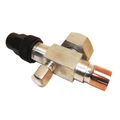
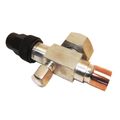
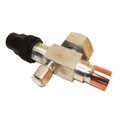
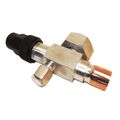
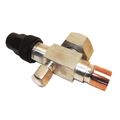
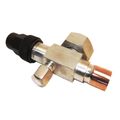
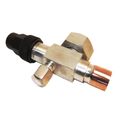
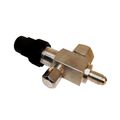
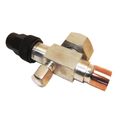

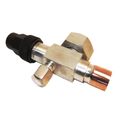

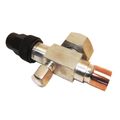
Rotalock valves provide a threaded, serviceable connection point on refrigeration and air conditioning compressors, letting a technician isolate the compressor from the rest of the system without cutting or brazing a line. The valve threads directly into a rotalock fitting on the compressor shell and accepts a matching adapter or gauge connection, which makes compressor changeouts and service work faster than an all-brazed setup. Refrigeration contractors rely on them most on commercial and industrial systems, where compressors get swapped or serviced more often than on residential equipment.
Because the connection is mechanical rather than soldered, a rotalock valve can be closed to trap refrigerant in the compressor or system side during a repair, then reopened once work is finished. That serviceability comes with a tradeoff: the threaded seal depends on a gasket or o-ring that needs to be replaced whenever the fitting is broken and remade, so keeping spare seals on hand alongside the valve itself is standard practice on any service call involving these connections.
Subcategories
- Suction and Discharge Rotalock Valves: These valves mount on the suction and discharge ports of a compressor shell, giving separate shutoff control on each side of the system during service. Isolating one port at a time lets a technician work on downstream components without releasing the full system charge. Body size and thread pattern need to match the compressor's existing fitting exactly. Most include a gauge port for reading pressure without breaking the main connection.
- Rotalock Adapters and Fittings: Adapters step a rotalock thread down or up to a different connection type, such as a flare or braze fitting, so equipment with mismatched connections can still be joined. They see regular use when replacing an older compressor with a different port style than the one it's replacing. Getting the thread pitch right is critical since a mismatched adapter won't seal even with a new gasket. Contractors typically stock a small range of adapter sizes for exactly this situation.
- Rotalock Valve Repair Parts: Replacement gaskets, o-rings, and caps keep existing rotalock valves sealing properly after repeated service visits. Every time a valve is opened and reclosed, the seal is under some wear, so a fresh gasket at reassembly reduces the chance of a slow leak developing later. Caps protect the valve stem and gauge port when the valve isn't actively being serviced. These parts are typically sold in kits sized to match specific valve bodies.
Buying Guide
The starting point for any rotalock valve purchase is matching thread size and pattern to the compressor it's going on. Rotalock fittings aren't universal across manufacturers, so a valve pulled off one compressor won't necessarily thread onto another without an adapter, and forcing a mismatched fit risks damaging the compressor's port threads permanently.
Port configuration matters just as much as thread size. Suction and discharge valves are typically sized differently on the same compressor, so replacing both means ordering two distinct valves rather than assuming one size fits every port. Checking whether the valve includes a built in gauge port saves an extra fitting later, since most refrigeration work requires reading pressure at some point during the service call.
Seal material is worth confirming for the refrigerant and oil type in use, since not every gasket compound holds up equally well across different refrigerant blends. Rotalock valves that ship with a spare gasket save a trip back to the supply house mid job, and stocking extra gaskets separately is worthwhile given how often the seal gets disturbed during normal service work.
Build quality shows up most in the valve body and stem threading, which see repeated wrenching over the life of the compressor. A valve with a well machined stem resists rounding off after repeated open and close cycles, which keeps future service calls on that same unit faster and less frustrating.
Frequently Asked Questions
What is the purpose of a rotalock valve on a compressor?
It gives a threaded, serviceable shutoff point on the compressor shell, letting a technician isolate the compressor from the rest of the refrigeration circuit for service without cutting or brazing a line.
Are rotalock valve threads standardized across compressor brands?
No, thread size and pattern vary by manufacturer and compressor model, which is why matching the valve exactly to the existing fitting, or using a proper adapter, is necessary before installation.
Does the gasket need to be replaced every time a rotalock valve is opened?
Replacing the gasket at reassembly is standard practice, since the seal takes wear each time the fitting is broken and remade, and reusing a worn gasket increases the risk of a slow refrigerant leak.
Can one rotalock valve serve both the suction and discharge port?
Generally not, since suction and discharge ports are often sized differently on the same compressor, so each port typically needs its own correctly sized valve.
What should be checked before ordering a rotalock adapter?
Confirming both the existing port's thread pattern and the connection type being adapted to, such as flare or braze, prevents ordering an adapter that won't seal against the compressor's fitting.
