




Stainless Steel Pipe Fittings
Stainless steel pipe fittings resist corrosion in applications where standard steel or copper fittings would degrade over time, covering Bluefin's house-brand line alongside Merit Brass fittings built to manufacturer specifications.
Choosing stainless steel over standard steel or copper fittings typically comes down to the application's exposure to moisture, chemicals, or outdoor conditions. Merit Brass fittings suit jobs specified to an exact manufacturer standard, while Bluefin offers a comparable option at a different price point.
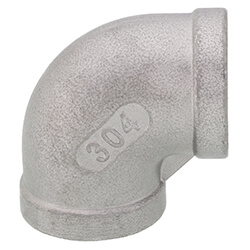


Subcategories
- Bluefin Stainless Steel Pipe Fittings: Plumbers and mechanical contractors reach for Bluefin, SupplyHouse's house brand, when they need a full threaded lineup, 90 degree and 45 degree elbows, street elbows, tees, crosses, couplings, reducing couplings, caps, plugs, bushings, and unions, in T304 stainless for general-purpose corrosion-resistant piping in mechanical rooms and exposed runs.
- Merit Brass Stainless Steel Pipe Fittings: Fabricators and contractors working to a manufacturer spec choose Merit Brass for 304/304L and 316/316L NPT-threaded and welded Schedule 40 nipples, couplings, and reducers built by the Cleveland, Ohio manufacturer to an ISO 9001 quality standard.
Buying Guide
Grade selection starts with what the piping run is exposed to. 304/304L handles general indoor piping, mechanical rooms, and most washdown areas without issue, while 316/316L adds molybdenum that improves resistance to chlorides, salts, and harsher cleaning chemicals, which matters in coastal installations, food processing areas, or anywhere aggressive washdown chemicals contact the pipe regularly.
Threaded NPT fittings let a run come apart for service or modification without cutting pipe, which suits mechanical rooms and equipment connections that may need future access. Welded and butt-weld fittings create a permanent, higher-integrity joint that holds up better under high pressure or high temperature, at the cost of needing a qualified welder and losing the ability to disassemble the joint later.
Schedule 10, 40, and 80 pipe wall thicknesses trade material cost and weight against pressure rating, with Schedule 40 covering most general-purpose runs and Schedule 80 reserved for higher-pressure or higher-abuse applications. Matching fitting schedule to the pipe schedule already specified for the job keeps wall thickness consistent through elbows, tees, and reducers instead of creating a weak point at each joint.
Bluefin covers the common threaded fitting shapes at a broad size range for general mechanical and plumbing work. Merit Brass adds a manufacturer-backed catalog with both 304 and 316 grades in threaded and welded configurations, which suits specs that call out a named manufacturer or need documentation tied to a specific ISO-certified production process.
Pairing stainless fittings with stainless pipe of the same or a compatible grade avoids galvanic corrosion issues that can show up when dissimilar metals sit in contact with moisture over time. Confirming grade, schedule, and connection type, threaded versus welded, against the rest of the run before ordering keeps the whole assembly consistent.
Frequently Asked Questions
What's the difference between 304 and 316 stainless steel fittings?
316 stainless includes molybdenum, which improves resistance to chlorides and harsher chemical exposure compared to 304. 304 covers general indoor piping and washdown areas well, while 316 is the better call for coastal installations, food processing, or anywhere aggressive cleaning chemicals contact the pipe.
Should a stainless steel pipe fitting be threaded or welded?
Threaded NPT fittings allow a joint to be taken apart for service or future changes without cutting pipe. Welded and butt-weld fittings create a stronger, permanent joint suited to high pressure or high temperature systems, but they require a qualified welder and can't be disassembled later.
What pipe schedule should stainless steel fittings match?
Fitting schedule should match the schedule of the pipe already specified for the run, commonly Schedule 40 for general-purpose work or Schedule 80 for higher-pressure applications. Mismatched schedules create inconsistent wall thickness at the joints, which is worth avoiding on any pressurized run.
What's the difference between Bluefin and Merit Brass stainless fittings?
Bluefin is SupplyHouse's house brand, covering common threaded shapes like elbows, tees, couplings, and unions in T304 stainless for general mechanical and plumbing work. Merit Brass is a manufacturer-backed line offering both 304 and 316 grades in threaded and welded configurations, useful when a spec calls for a named manufacturer or ISO-certified production.
Can stainless steel fittings be used with carbon steel pipe?
Mixing stainless fittings with carbon steel pipe risks galvanic corrosion where the two metals stay in contact with moisture over time. Matching stainless fittings to stainless pipe of a compatible grade avoids that issue and keeps the corrosion resistance consistent through the whole run.
Resources

 --%3E %3C!DOCTYPE svg PUBLIC '-//W3C//DTD SVG 1.1//EN' 'http://www.w3.org/Graphics/SVG/1.1/DTD/svg11.dtd'%3E %3Csvg version='1.1' id='Layer_1' xmlns='http://www.w3.org/2000/svg' xmlns:xlink='http://www.w3.org/1999/xlink' x='0px' y='0px' width='90px' height='90px' viewBox='0 0 90 90' enable-background='new 0 0 90 90' xml:space='preserve'%3E %3Crect x='27' y='23' fill='%23FFFFFF' width='43' height='44'/%3E %3Cg%3E %3Cdefs%3E %3Crect id='SVGID_1_' width='90' height='90'/%3E %3C/defs%3E %3CclipPath id='SVGID_2_'%3E %3Cuse xlink:href='%23SVGID_1_' overflow='visible'/%3E %3C/clipPath%3E %3Cpath clip-path='url(%23SVGID_2_)' fill='%234186AD' d='M45,0C20.1,0,0,20.1,0,45c0,24.9,20.1,45,45,45c24.9,0,45-20.1,45-45 C90,20.1,69.9,0,45,0'/%3E %3C/g%3E %3Cpath fill='%23FFFFFF' d='M60.6,47.4l-22.5,14c-0.5,0.3-1,0.399-1.5,0.399s-0.9-0.1-1.4-0.399c-0.9-0.5-1.4-1.4-1.4-2.5v-28 c0-1,0.6-2,1.4-2.5c0.9-0.5,2-0.5,2.9,0.1l22.5,14.1C61.4,43.1,61.9,44,61.9,45S61.4,46.9,60.6,47.4'/%3E %3C/svg%3E)
Subcategories
- Bluefin Stainless Steel Pipe Fittings: Plumbers and mechanical contractors reach for Bluefin, SupplyHouse's house brand, when they need a full threaded lineup, 90 degree and 45 degree elbows, street elbows, tees, crosses, couplings, reducing couplings, caps, plugs, bushings, and unions, in T304 stainless for general-purpose corrosion-resistant piping in mechanical rooms and exposed runs.
- Merit Brass Stainless Steel Pipe Fittings: Fabricators and contractors working to a manufacturer spec choose Merit Brass for 304/304L and 316/316L NPT-threaded and welded Schedule 40 nipples, couplings, and reducers built by the Cleveland, Ohio manufacturer to an ISO 9001 quality standard.
Buying Guide
Grade selection starts with what the piping run is exposed to. 304/304L handles general indoor piping, mechanical rooms, and most washdown areas without issue, while 316/316L adds molybdenum that improves resistance to chlorides, salts, and harsher cleaning chemicals, which matters in coastal installations, food processing areas, or anywhere aggressive washdown chemicals contact the pipe regularly.
Threaded NPT fittings let a run come apart for service or modification without cutting pipe, which suits mechanical rooms and equipment connections that may need future access. Welded and butt-weld fittings create a permanent, higher-integrity joint that holds up better under high pressure or high temperature, at the cost of needing a qualified welder and losing the ability to disassemble the joint later.
Schedule 10, 40, and 80 pipe wall thicknesses trade material cost and weight against pressure rating, with Schedule 40 covering most general-purpose runs and Schedule 80 reserved for higher-pressure or higher-abuse applications. Matching fitting schedule to the pipe schedule already specified for the job keeps wall thickness consistent through elbows, tees, and reducers instead of creating a weak point at each joint.
Bluefin covers the common threaded fitting shapes at a broad size range for general mechanical and plumbing work. Merit Brass adds a manufacturer-backed catalog with both 304 and 316 grades in threaded and welded configurations, which suits specs that call out a named manufacturer or need documentation tied to a specific ISO-certified production process.
Pairing stainless fittings with stainless pipe of the same or a compatible grade avoids galvanic corrosion issues that can show up when dissimilar metals sit in contact with moisture over time. Confirming grade, schedule, and connection type, threaded versus welded, against the rest of the run before ordering keeps the whole assembly consistent.
Frequently Asked Questions
What's the difference between 304 and 316 stainless steel fittings?
316 stainless includes molybdenum, which improves resistance to chlorides and harsher chemical exposure compared to 304. 304 covers general indoor piping and washdown areas well, while 316 is the better call for coastal installations, food processing, or anywhere aggressive cleaning chemicals contact the pipe.
Should a stainless steel pipe fitting be threaded or welded?
Threaded NPT fittings allow a joint to be taken apart for service or future changes without cutting pipe. Welded and butt-weld fittings create a stronger, permanent joint suited to high pressure or high temperature systems, but they require a qualified welder and can't be disassembled later.
What pipe schedule should stainless steel fittings match?
Fitting schedule should match the schedule of the pipe already specified for the run, commonly Schedule 40 for general-purpose work or Schedule 80 for higher-pressure applications. Mismatched schedules create inconsistent wall thickness at the joints, which is worth avoiding on any pressurized run.
What's the difference between Bluefin and Merit Brass stainless fittings?
Bluefin is SupplyHouse's house brand, covering common threaded shapes like elbows, tees, couplings, and unions in T304 stainless for general mechanical and plumbing work. Merit Brass is a manufacturer-backed line offering both 304 and 316 grades in threaded and welded configurations, useful when a spec calls for a named manufacturer or ISO-certified production.
Can stainless steel fittings be used with carbon steel pipe?
Mixing stainless fittings with carbon steel pipe risks galvanic corrosion where the two metals stay in contact with moisture over time. Matching stainless fittings to stainless pipe of a compatible grade avoids that issue and keeps the corrosion resistance consistent through the whole run.