




Reversing Valves

 --%3E %3Csvg version='1.1' id='No-RB' xmlns='http://www.w3.org/2000/svg' xmlns:xlink='http://www.w3.org/1999/xlink' x='0px' y='0px' viewBox='0 0 100 100' enable-background='new 0 0 100 100' xml:space='preserve'%3E %3Cpath fill='%23CECECE' d='M79.44,0.95H20.56C9.78,0.95,0.95,9.78,0.95,20.56v58.87c0,10.79,8.82,19.61,19.61,19.61h58.87 c10.79,0,19.61-8.83,19.61-19.61V20.56C99.05,9.78,90.22,0.95,79.44,0.95z M65.38,58.24l9.38,29.58L49.69,69.78L24.5,87.82 l9.34-29.6L8.8,39.6l30.73-0.17c0,0,6.98-19.61,10-28.93c0.54,1.36,9.88,29.1,9.88,29.1H91.2L65.38,58.24z'/%3E %3C/svg%3E)

 --%3E %3Csvg version='1.1' id='Fill' xmlns='http://www.w3.org/2000/svg' xmlns:xlink='http://www.w3.org/1999/xlink' x='0px' y='0px' viewBox='0 0 100 100' enable-background='new 0 0 100 100' xml:space='preserve'%3E %3Cpath fill='%23F15C02' d='M79.44,0.95H20.56C9.78,0.95,0.95,9.78,0.95,20.56v58.87c0,10.79,8.82,19.61,19.61,19.61h58.87 c10.79,0,19.61-8.83,19.61-19.61V20.56C99.05,9.78,90.22,0.95,79.44,0.95z M65.38,58.24l9.38,29.58L49.69,69.78L24.5,87.82 l9.34-29.6L8.8,39.6l30.73-0.17c0,0,6.98-19.61,10-28.93c0.54,1.36,9.88,29.1,9.88,29.1H91.2L65.38,58.24z'/%3E %3C/svg%3E)
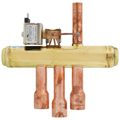
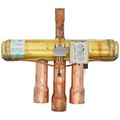
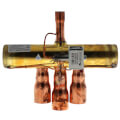

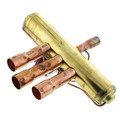
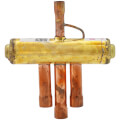

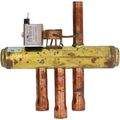
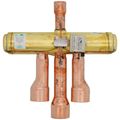
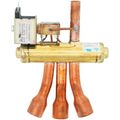
Reversing Valves are the component that lets a heat pump switch between heating and cooling using the same outdoor unit and compressor, rather than requiring separate systems for each mode. Mounted in the outdoor unit, the valve controls which direction refrigerant flows between the indoor and outdoor coils. During cooling, refrigerant flows so the indoor coil stays cold and absorbs heat from circulated air; when the thermostat calls for heat, the valve reverses that flow direction so the indoor coil runs hot instead, warming the air passing over it. The reversing valve is what makes a heat pump fundamentally different from a straight air conditioner, which only ever moves refrigerant in one direction. Because the valve sits directly in the refrigerant circuit and switches on every mode change, it takes on more wear cycles than most other parts in the system. Techs troubleshooting a heat pump that only works in one mode, cooling but not heating or the reverse, typically start by checking whether the reversing valve is receiving its control signal and actually shifting position.
Subcategories
- Reversing Valve Assemblies: A reversing valve assembly is the complete valve body mounted in the outdoor unit that redirects refrigerant flow between the indoor and outdoor coils. Techs replace the full assembly when the valve body itself is cracked, leaking refrigerant, or physically stuck in one position rather than shifting on command. Since the valve sits directly in the refrigerant circuit, swapping the full assembly requires recovering refrigerant and brazing new connections. Matching tonnage and port size to the existing outdoor unit is critical, since a mismatched body will not seal against the current line set.
- Solenoid Coils: The solenoid coil is the electrical component mounted on the valve body that shifts it between heating and cooling positions when energized by the thermostat's control signal. Coils commonly fail on their own, without the valve body itself being damaged, so swapping just the coil often resolves inconsistent mode switching. Replacing a coil does not require opening the refrigerant circuit, making it a quicker repair than a full assembly swap. Confirming voltage and connector type against the existing wiring harness prevents ordering the wrong coil.
- OEM Replacement Kits: OEM kits package a matched valve body and coil sized to specific model and tonnage ranges, aimed at techs who want factory-matched components instead of assembling a valve from separate parts. Kits typically include mounting hardware and sometimes a service valve for refrigerant recovery. Using a matched kit reduces the callback risk that comes from mismatched port sizing or coil voltage on a mixed-parts repair. Choosing a matched kit saves time on jobs where a technician wants one part number covering the whole repair.
- Universal Reversing Valves: Universal reversing valves are sized to fit a range of tonnages and connection configurations rather than one specific model, useful when an exact factory match is not readily available or the unit is older and its original part number is discontinued. Installers still need to confirm port size, tonnage range, and coil voltage against the existing system before choosing a universal valve. Field adjustment of line set connections is sometimes needed to fit a universal body into a specific unit's existing plumbing. Universal valves work well as a backup option on service calls where an exact factory part is not an option.
Buying Guide
Start by confirming a suspected reversing valve failure is not actually a thermostat, control board, or wiring problem, since misdiagnosis is the most common reason a valve swap does not fix the complaint. A heat pump that cools normally but will not heat, or heats but will not cool, combined with confirmed control signal and voltage reaching the valve's coil terminal, points to the valve itself. Once the valve is confirmed as the failure point, the next decision is coil-only replacement versus a full assembly swap. If the valve shifts correctly when manually actuated but does not respond to the thermostat's signal, a coil replacement usually solves it without opening the refrigerant circuit. If the valve body is stuck, cracked, or leaking, a full assembly replacement is required, along with refrigerant recovery and brazing equipment. Reversing Valves have to match the outdoor unit's tonnage and port size exactly, since a valve sized for a different tonnage range will not seat correctly against the existing line set even if coil voltage matches. Confirming whether the system is a heat-pump-specific configuration versus a straight air conditioner matters too, since the two are not interchangeable. When an exact OEM match is not available, a universal valve can work as a substitute, provided port size, tonnage range, and coil voltage are all confirmed against the existing system before ordering. Keeping the original unit's model and serial number on hand removes most of the guesswork when placing an order.
Frequently Asked Questions
How can a tech tell if a reversing valve has failed?
A heat pump that runs fine in cooling mode but blows cold air when set to heat, or the reverse, points to a reversing valve stuck in one position. Confirming control signal and voltage are reaching the valve's coil first rules out a wiring or thermostat issue before pulling the valve. Buzzing or clicking noises from the outdoor unit when the system tries to switch modes are another common symptom.
Can the coil be replaced without swapping the entire reversing valve?
Coil replacement is possible when the valve body still shifts correctly but does not respond to the thermostat's signal. Swapping just the coil avoids opening the refrigerant circuit, making it a faster repair than replacing the full assembly. If the valve body itself is stuck, cracked, or leaking refrigerant, the coil alone will not resolve the issue.
What is needed to order the correct reversing valve for a specific unit?
Matching the outdoor unit's tonnage, port size, and coil voltage to the replacement valve prevents ordering a part that will not seat against the existing line set. Keeping the original unit's model and serial number on hand when ordering removes most of the guesswork. Confirming whether the system is heat-pump specific versus a straight air conditioner configuration matters as well, since the two use different valve setups.
Does replacing a reversing valve always require refrigerant recovery?
Replacing the full valve assembly requires recovering refrigerant first, since the valve sits directly in the circuit and has to be brazed in and out. A coil-only replacement does not require recovery, since the coil handles only the electrical signal that shifts the valve and sits outside the refrigerant path. Confirming which repair is actually needed before starting determines what recovery equipment to bring on the call.
Is a universal reversing valve a reliable substitute for an OEM part?
Universal reversing valves can work as a substitute when an exact factory match is not readily available, provided port size, tonnage range, and coil voltage are all confirmed against the existing system. Field adjustment of line set connections is sometimes needed to fit a universal body into a unit's existing plumbing. OEM-matched kits are still the more straightforward option when they are available, since they eliminate the extra confirmation steps a universal valve requires.
