




Filters
SORT
Product Availability –
Tank Volume –
Review Score –
 --%3E %3Csvg version='1.1' id='Fill' xmlns='http://www.w3.org/2000/svg' xmlns:xlink='http://www.w3.org/1999/xlink' x='0px' y='0px' viewBox='0 0 100 100' enable-background='new 0 0 100 100' xml:space='preserve'%3E %3Cpath fill='%23F15C02' d='M79.44,0.95H20.56C9.78,0.95,0.95,9.78,0.95,20.56v58.87c0,10.79,8.82,19.61,19.61,19.61h58.87 c10.79,0,19.61-8.83,19.61-19.61V20.56C99.05,9.78,90.22,0.95,79.44,0.95z M65.38,58.24l9.38,29.58L49.69,69.78L24.5,87.82 l9.34-29.6L8.8,39.6l30.73-0.17c0,0,6.98-19.61,10-28.93c0.54,1.36,9.88,29.1,9.88,29.1H91.2L65.38,58.24z'/%3E %3C/svg%3E)
Price Range –
Watts ET Radiant Expansion Tanks

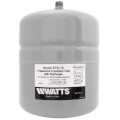

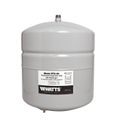


Watts ET radiant expansion tanks are pre-charged diaphragm tanks that absorb the volume change water undergoes as it heats and cools in a closed hydronic radiant heating loop. As boiler or system water temperature rises, the water expands and pushes into the tank's air-charged chamber, and the diaphragm keeps that air permanently separated from the system water so the air charge does not get absorbed over time. A properly sized expansion tank prevents the pressure relief valve from opening on every heating cycle and protects the boiler, circulator, and piping from the repeated pressure spikes that come with an undersized or missing tank. Installers size a Watts ET tank to the total system water volume and the operating temperature range of the radiant loop, and mount it on the supply or return side of the system per the boiler manufacturer's piping diagram.
Subcategories
- Small-Volume ET Tanks: Small-volume ET tanks serve single-zone radiant systems and smaller residential boiler loops where total system water content is limited. Installers pick these for one-room or small-addition radiant floor jobs and point-of-use hydronic setups. A compact wall or floor mount footprint makes them easier to fit into tight mechanical closets. Matching tank volume to actual system water content, not just boiler size, keeps the pressure response correct.
- Multi-Zone ET Tanks: Multi-zone ET tanks handle the larger water volume found in whole-house radiant systems with several manifolds and zone circuits. Hydronic contractors specify these on new construction and larger renovation jobs where multiple radiant loops share one boiler plant. Their higher acceptance volume reduces the chance of nuisance relief valve discharge as more zones call for heat. Sizing still depends on total system water content across every zone, not the tank alone.
- Replacement ET Tanks: Replacement ET tanks match the original Watts model and connection size so a failed tank can be swapped without repiping the system. Service technicians use these when an existing tank has lost its air charge or the diaphragm has failed, causing waterlogging and constant relief valve activity. Confirming the original tank's volume and connection thread size before ordering avoids a second trip. A waterlogged tank feels heavy and often has no give when pressed, which is a quick field check before ordering a replacement.
- Wall-Mount ET Tanks: Wall-mount ET tanks include an integrated bracket for vertical installation where floor space in the mechanical room is limited. Installers choose this style for retrofit jobs and tight utility closets common in older homes. The mounting bracket supports the tank's weight once charged with system water, so the wall structure needs to support the load. Orientation should follow the tank's labeling, since some models are designed to mount with the connection down.
Buying Guide
Sizing a Watts ET Radiant Expansion Tank correctly starts with calculating total system water volume across every zone, manifold, and length of tubing the boiler serves, since an undersized tank cannot absorb the full expansion of a large radiant loop even if it matches the boiler's nominal output. System operating temperature range matters as well: a radiant floor loop running at a lower average temperature expands less than a baseboard or panel radiator loop running hotter, so two systems with the same water volume can need different tank sizes. Fill pressure and the boiler's maximum operating pressure also factor into tank selection, since the tank's pre-charge should be set to match the system's cold fill pressure before it goes into service. Connection size and thread type need to match the piping at the installation point, and installers should confirm whether the application calls for a floor-standing or wall-mount tank based on available mechanical room space. For replacement jobs, matching the original tank's model number keeps the piping connections and mounting hardware compatible without additional fittings. Checking the tank's pre-charge pressure with a gauge before final connection, rather than assuming it arrived correctly set, catches a shipping or storage issue before it causes a callback.
Frequently Asked Questions
What size Watts ET expansion tank do I need for a radiant system?
Tank size depends on total system water volume across all zones and the operating temperature range of the radiant loop. Calculating water content from the tubing length, manifold, and boiler volume, then matching it to the tank manufacturer's sizing chart, gives an accurate selection.
How do I know if a radiant expansion tank has failed?
A failed tank often feels heavy and solid when tapped, rather than having some give from the air charge, and the system may show frequent pressure relief valve discharge. Checking the tank's air pre-charge with a gauge when the system is depressurized confirms whether the diaphragm has failed.
Where should an ET radiant expansion tank be installed?
Most Watts ET tanks install on the boiler's supply or return piping near the circulator, following the specific location shown in the boiler manufacturer's piping diagram. Correct placement keeps the tank exposed to consistent system pressure rather than a dead-end section of piping.
Can a larger expansion tank be used in place of the specified size?
A larger tank can generally be used as long as the connection size and pressure rating are compatible, and it will provide extra expansion capacity. Undersizing is the more common problem in the field, so oversizing slightly is rarely an issue.
Does the pre-charge pressure need to be adjusted before installation?
The tank's pre-charge should match the system's cold fill pressure before it is put into service, and checking it with a gauge rather than assuming the factory setting is correct helps avoid early waterlogging. Adjusting the charge with a bicycle-style pump and gauge is a normal step during commissioning.
