




Filters
SORT
Product Availability –
Size –
Connection Type –
Connection Method –
Review Score –
 --%3E %3Csvg version='1.1' id='Fill' xmlns='http://www.w3.org/2000/svg' xmlns:xlink='http://www.w3.org/1999/xlink' x='0px' y='0px' viewBox='0 0 100 100' enable-background='new 0 0 100 100' xml:space='preserve'%3E %3Cpath fill='%23F15C02' d='M79.44,0.95H20.56C9.78,0.95,0.95,9.78,0.95,20.56v58.87c0,10.79,8.82,19.61,19.61,19.61h58.87 c10.79,0,19.61-8.83,19.61-19.61V20.56C99.05,9.78,90.22,0.95,79.44,0.95z M65.38,58.24l9.38,29.58L49.69,69.78L24.5,87.82 l9.34-29.6L8.8,39.6l30.73-0.17c0,0,6.98-19.61,10-28.93c0.54,1.36,9.88,29.1,9.88,29.1H91.2L65.38,58.24z'/%3E %3C/svg%3E)
 --%3E %3Csvg version='1.1' id='With-RB' xmlns='http://www.w3.org/2000/svg' xmlns:xlink='http://www.w3.org/1999/xlink' x='0px' y='0px' viewBox='0 0 100 100' enable-background='new 0 0 100 100' xml:space='preserve'%3E %3Cpath fill='%23FBC8B4' d='M79.44,0.95H20.56C9.78,0.95,0.95,9.78,0.95,20.56v58.87c0,10.79,8.82,19.61,19.61,19.61h58.87 c10.79,0,19.61-8.83,19.61-19.61V20.56C99.05,9.78,90.22,0.95,79.44,0.95z M65.38,58.24l9.38,29.58L49.69,69.78L24.5,87.82 l9.34-29.6L8.8,39.6l30.73-0.17c0,0,6.98-19.61,10-28.93c0.54,1.36,9.88,29.1,9.88,29.1H91.2L65.38,58.24z'/%3E %3C/svg%3E)
Price Range –
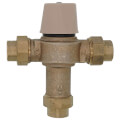
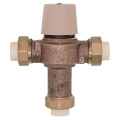
Watts LFMMVM1 Thermostatic Mixing Valves



 --%3E %3Csvg version='1.1' id='Half' xmlns='http://www.w3.org/2000/svg' xmlns:xlink='http://www.w3.org/1999/xlink' x='0px' y='0px' viewBox='0 0 100 100' enable-background='new 0 0 100 100' xml:space='preserve'%3E %3Cg%3E %3Cpath fill='%23F15C02' d='M30.05,70.23l3.79-12.01L8.8,39.6l30.73-0.17c0,0,6.98-19.61,10-28.93c0.54,1.36,9.88,29.1,9.88,29.1h1.58 L93.71,7.18c-3.58-3.82-8.66-6.23-14.28-6.23H20.56C9.78,0.95,0.95,9.78,0.95,20.56v58.87c0,5.41,2.22,10.32,5.79,13.88 L30.05,70.23z'/%3E %3C/g%3E %3Cpath fill='%23FBC8B4' d='M93.71,7.18L60.98,39.6H91.2L65.38,58.24l9.38,29.58L49.69,69.78L24.5,87.82l5.55-17.59L6.75,93.32 c3.55,3.54,8.44,5.73,13.82,5.73h58.87c10.79,0,19.61-8.83,19.61-19.61V20.56C99.05,15.4,97.01,10.69,93.71,7.18z'/%3E %3C/svg%3E)


 --%3E %3Csvg version='1.1' id='No-RB' xmlns='http://www.w3.org/2000/svg' xmlns:xlink='http://www.w3.org/1999/xlink' x='0px' y='0px' viewBox='0 0 100 100' enable-background='new 0 0 100 100' xml:space='preserve'%3E %3Cpath fill='%23CECECE' d='M79.44,0.95H20.56C9.78,0.95,0.95,9.78,0.95,20.56v58.87c0,10.79,8.82,19.61,19.61,19.61h58.87 c10.79,0,19.61-8.83,19.61-19.61V20.56C99.05,9.78,90.22,0.95,79.44,0.95z M65.38,58.24l9.38,29.58L49.69,69.78L24.5,87.82 l9.34-29.6L8.8,39.6l30.73-0.17c0,0,6.98-19.61,10-28.93c0.54,1.36,9.88,29.1,9.88,29.1H91.2L65.38,58.24z'/%3E %3C/svg%3E)


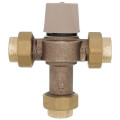
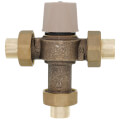
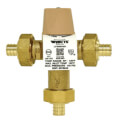
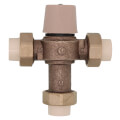
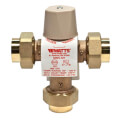

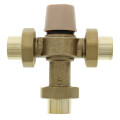
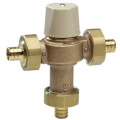
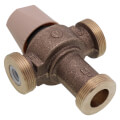
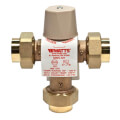

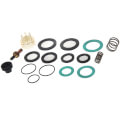
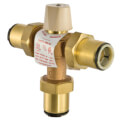
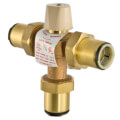


Watts LFMMVM1 thermostatic mixing valves blend hot and cold supply water to a set outlet temperature, protecting fixtures and occupants from scalding while still letting a water heater run hot enough to limit bacterial growth in storage. Plumbers install these at lavatories, showers, and other point-of-use fixtures where code or building policy calls for tempered water rather than raw water heater output. A lead-free brass body meets current lead-free installation requirements, and the valve's double-throttling design adjusts both hot and cold flow together to hold the mixed outlet temperature steady even when supply pressure shifts. Watts rates the LFMMVM1 for an adjustable outlet range of 80 to 120 degrees Fahrenheit, with accuracy within plus or minus 3 degrees. Choosing the right connection type and flow rating for the fixture it serves keeps the valve performing to that accuracy over time.
Subcategories
- Threaded and Solder Connection Valves: These models use standard threaded or sweat solder connections, making them a straightforward swap on existing copper or steel supply lines during a retrofit. Plumbers reach for this connection type most often on replacement jobs where the rough-in piping is already in place. The valve body and internal thermostat are the same lead-free brass construction used across the LFMMVM1 line. Confirming pipe size against the existing rough-in avoids an extra fitting at installation.
- PEX and CPVC Connection Valves: Valves in this group are built for PEX, PEX F1960 cold expansion, or CPVC supply piping, which suits new construction and remodels running those materials instead of copper. The connection style changes, but the valve's double-throttling design and 80 to 120 degree Fahrenheit adjustable range stay the same across the line. Matching the connection type to the piping already run on site avoids field adapters that add another point of failure. These are common on multi-family and residential remodel work where PEX is the primary supply material.
- Quick-Connect and Press Valves: These models use quick-connect or press-style end connections, cutting installation time on jobs where a mechanical or pressed joint is faster than threading or soldering. Contractors doing service or replacement work in occupied buildings often prefer this style since it avoids an open flame near finished surfaces. The internal thermostat and lead-free brass body match the rest of the LFMMVM1 line regardless of connection style. Available flow rate still ranges from 0.5 to 12 gallons per minute depending on the specific model.
Buying Guide
Start by confirming the fixture's flow requirement against the valve's rated range, since the LFMMVM1 line covers models rated from 0.5 up to 12 gallons per minute. A single lavatory faucet and a bank of showers call for different flow ratings even though both use the same basic valve design, so match the number to the actual fixture rather than defaulting to whichever model is on hand.
Connection type is the next filter, and it should follow the piping already run to the fixture location. Threaded and solder models suit copper retrofit work, PEX and CPVC models fit new construction running those materials, and quick-connect or press models speed up service calls in occupied spaces. Watts LFMMVM1 Thermostatic Mixing Valves keep the same internal thermostat and lead-free brass body across every connection option, so switching between them doesn't change performance.
Code compliance closes out the decision. Confirm which ASSE listing the job requires: ASSE 1017 covers valves at a hot water source, ASSE 1069 covers single-pipe tempered water applications, and ASSE 1070 covers individual or multiple fixture setups. Picking the wrong listing for the application is one of the most common reasons an inspector flags a mixing valve installation.
Frequently Asked Questions
Why install a thermostatic mixing valve instead of just turning down the water heater?
Keeping a water heater at a higher storage temperature limits bacterial growth in the tank, while a mixing valve brings that hot water down to a safe temperature right at the point of use. Turning the whole water heater down sacrifices that protection for the entire building. A mixing valve lets both goals coexist without a tradeoff.
What temperature range can the LFMMVM1 be set to?
The valve adjusts across an 80 to 120 degree Fahrenheit outlet range, with accuracy within plus or minus 3 degrees. That covers the typical range required for lavatories, showers, and similar fixtures. The exact setting should follow the code or building policy that applies to the job.
Does the connection type affect the valve's performance?
No, the double-throttling design and internal thermostat are the same across threaded, solder, PEX, CPVC, quick-connect, and press versions. Connection type is chosen to match the piping already on site, not for any difference in temperature control. Flow rating still needs to be checked against the specific model regardless of connection style.
What protects the valve from cross flow between hot and cold lines?
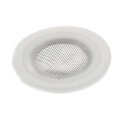
The LFMMVM1 includes integral check valves and filter washers on both the hot and cold inlets. That combination keeps debris out of the thermostat mechanism and prevents pressure differences from pushing water backward between the two supply lines. Both features come standard across the line.
Which ASSE listing applies to a job with a single mixed-water pipe feeding several fixtures?
ASSE 1069 covers single-pipe, tempered water applications, which is the listing most relevant to that setup. ASSE 1017 applies at the hot water source itself, and ASSE 1070 covers valves serving individual or multiple fixtures directly. Confirming the correct listing with the local code before ordering avoids a failed inspection.
