




Taco 4900 Series Air Separators

 --%3E %3Csvg version='1.1' id='Fill' xmlns='http://www.w3.org/2000/svg' xmlns:xlink='http://www.w3.org/1999/xlink' x='0px' y='0px' viewBox='0 0 100 100' enable-background='new 0 0 100 100' xml:space='preserve'%3E %3Cpath fill='%23F15C02' d='M79.44,0.95H20.56C9.78,0.95,0.95,9.78,0.95,20.56v58.87c0,10.79,8.82,19.61,19.61,19.61h58.87 c10.79,0,19.61-8.83,19.61-19.61V20.56C99.05,9.78,90.22,0.95,79.44,0.95z M65.38,58.24l9.38,29.58L49.69,69.78L24.5,87.82 l9.34-29.6L8.8,39.6l30.73-0.17c0,0,6.98-19.61,10-28.93c0.54,1.36,9.88,29.1,9.88,29.1H91.2L65.38,58.24z'/%3E %3C/svg%3E)



 --%3E %3Csvg version='1.1' id='No-RB' xmlns='http://www.w3.org/2000/svg' xmlns:xlink='http://www.w3.org/1999/xlink' x='0px' y='0px' viewBox='0 0 100 100' enable-background='new 0 0 100 100' xml:space='preserve'%3E %3Cpath fill='%23CECECE' d='M79.44,0.95H20.56C9.78,0.95,0.95,9.78,0.95,20.56v58.87c0,10.79,8.82,19.61,19.61,19.61h58.87 c10.79,0,19.61-8.83,19.61-19.61V20.56C99.05,9.78,90.22,0.95,79.44,0.95z M65.38,58.24l9.38,29.58L49.69,69.78L24.5,87.82 l9.34-29.6L8.8,39.6l30.73-0.17c0,0,6.98-19.61,10-28.93c0.54,1.36,9.88,29.1,9.88,29.1H91.2L65.38,58.24z'/%3E %3C/svg%3E)


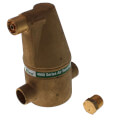
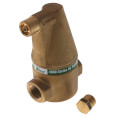
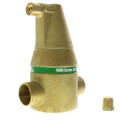
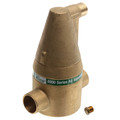
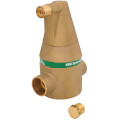
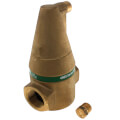
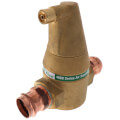
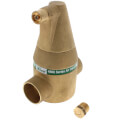
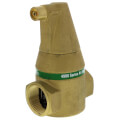
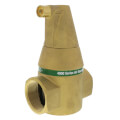
4900 Series Air Separators are Taco's bronze-body air separation fittings for closed-loop hydronic heating and cooling systems, rated for continuous operation up to 240 degrees F and 150 PSI. Air trapped in a hydronic loop reduces flow, causes gurgling noise at radiators and baseboard, and speeds up wear on circulator impellers and seals, so removing it at a single point in the piping is more effective than repeatedly bleeding individual zones. The 4900 Series uses patented PALL ring media inside the separator body to break large air bubbles down to microbubble size as water passes through, so air rises out of the flow and collects at the top vent instead of traveling downstream with the water. Connections range from 3/4 inch to 2 inches in press, sweat, or NPT, which covers most residential and light commercial boiler installations without needing a reducing fitting. Because the separator works in either flow direction, it can be installed without concern for pipe routing constraints that would rule out some other air-removal designs. For systems with recurring air problems, upgrading from a basic air scoop to a 4900 Series unit often resolves noise complaints that persistent purging couldn't fix.
Subcategories
- 3/4 Inch to 1 Inch Air Separators: The 3/4 inch and 1 inch sizes cover most single-family residential boiler installations, matching the supply piping already common on those systems. Both share the 4900 Series' 150 PSI and 240 degree F rating, and fit inline on the supply side without a reducing fitting on most jobs. Compact bronze construction keeps the fitting light enough to support on standard pipe hangers. Technicians replacing an undersized or failing air scoop on a residential system typically step up to one of these two sizes first.
- 1-1/4 Inch to 2 Inch Air Separators: Sizes from 1-1/4 inch through 2 inch handle the higher flow rates found in larger residential and light commercial systems with multiple zones or a bigger boiler plant. They share the same PALL ring air-removal media as the smaller sizes, scaled up to match the larger body diameter. Bidirectional flow capability means the fitting doesn't need to be installed with a specific orientation relative to the pump. Commercial installers use this size range on multi-zone systems where a single central air separator replaces several smaller scoops at each zone.
- Press Connection Air Separators: Press-connection models let a plumber join the 4900 Series directly into copper piping with a press tool instead of a torch, which speeds up installation on finished spaces where open flame isn't practical. The press ends use standard copper press fitting sizing, so no adapter is needed when the rest of the system piping is also press-joined. Air removal performance is identical to the sweat and NPT versions since only the connection method changes. Choosing press connections on a renovation job avoids the fire-watch requirements that sweat soldering can trigger in occupied buildings.
- Sweat & NPT Connection Air Separators: Sweat connections solder directly into copper piping, while NPT connections thread into steel or brass piping, covering both common piping materials used in existing hydronic systems. A retrofit into an older cast-iron boiler system with threaded steel mains typically calls for the NPT version, while a copper-piped residential system uses sweat. Both connection types carry the same 150 PSI, 240 degree F rating as the press version. Matching the connection type to the existing piping material, rather than converting the whole run to a different material, keeps a retrofit job simpler.
Buying Guide
Sizing a 4900 Series Air Separators installation starts with matching the connection size to the existing supply piping, since an undersized separator restricts flow and reduces air-removal effectiveness at higher flow rates. Confirm the system's actual operating pressure and temperature fall within the 150 PSI and 240 degree F rating before installing, especially on older commercial boiler plants that may run at the upper end of that range. Connection type matters for installation speed: press connections avoid open-flame soldering in occupied or finished spaces, sweat connections suit copper systems where soldering is already planned, and NPT threaded connections fit steel piping on older systems without cutting into copper. Placement on the supply side of the system, ahead of the main circulator and with the expansion tank connected to the separator's top tapping, gives the PALL ring media the best chance to separate air before it reaches the pump. On multi-zone systems, a single properly sized central separator generally outperforms several small air scoops scattered across zones, since it processes the full system flow rather than a fraction of it at each zone. Water and glycol mixtures up to 50 percent glycol are compatible with the 4900 Series, which matters on systems using antifreeze protection in unheated spaces or geothermal loops. For a system currently relying on an undersized or basic air scoop with recurring air complaints, upgrading to a properly sized 4900 Series unit is usually the more effective fix than adding a second scoop.
Frequently Asked Questions
What's the difference between the 4900 Series and a basic air scoop?
A basic air scoop relies on slowing the water flow to let air rise out naturally, while the 4900 Series adds patented PALL ring media inside the body that breaks large air bubbles down to microbubble size before they can travel downstream. The added separation stage makes the 4900 Series more effective on systems with persistent air problems that a basic scoop hasn't resolved.
Can the 4900 Series be installed in either direction on the pipe?
Yes, the fitting has bidirectional flow capability, so it doesn't need to be installed with the flow arrow pointing a specific way relative to the pump or boiler. Bidirectional flow simplifies retrofits where reversing the fitting's orientation would otherwise mean recutting the piping.
Does the 4900 Series work with glycol-based systems?
It's rated for water and water/glycol mixtures up to 50 percent glycol concentration, covering most systems using antifreeze protection for unheated spaces or geothermal applications.
How do I choose between press, sweat, and NPT connections?
Match the connection type to the piping already in the system: sweat for copper systems where soldering is planned, press for copper systems where avoiding open flame matters, and NPT for steel or brass threaded piping on older installations. All three connection types carry the same pressure and temperature rating.
Is there a minimum straight pipe run needed before or after the separator?
No, the 4900 Series has no required minimum piping run, which simplifies installation in mechanical rooms with limited space compared to some air-removal designs that need extra straight pipe on either side.
