



Filters
SORT
Product Availability –
Review Score –
 --%3E %3Csvg version='1.1' id='Fill' xmlns='http://www.w3.org/2000/svg' xmlns:xlink='http://www.w3.org/1999/xlink' x='0px' y='0px' viewBox='0 0 100 100' enable-background='new 0 0 100 100' xml:space='preserve'%3E %3Cpath fill='%23F15C02' d='M79.44,0.95H20.56C9.78,0.95,0.95,9.78,0.95,20.56v58.87c0,10.79,8.82,19.61,19.61,19.61h58.87 c10.79,0,19.61-8.83,19.61-19.61V20.56C99.05,9.78,90.22,0.95,79.44,0.95z M65.38,58.24l9.38,29.58L49.69,69.78L24.5,87.82 l9.34-29.6L8.8,39.6l30.73-0.17c0,0,6.98-19.61,10-28.93c0.54,1.36,9.88,29.1,9.88,29.1H91.2L65.38,58.24z'/%3E %3C/svg%3E)
Airflow



 --%3E %3Csvg version='1.1' id='No-RB' xmlns='http://www.w3.org/2000/svg' xmlns:xlink='http://www.w3.org/1999/xlink' x='0px' y='0px' viewBox='0 0 100 100' enable-background='new 0 0 100 100' xml:space='preserve'%3E %3Cpath fill='%23CECECE' d='M79.44,0.95H20.56C9.78,0.95,0.95,9.78,0.95,20.56v58.87c0,10.79,8.82,19.61,19.61,19.61h58.87 c10.79,0,19.61-8.83,19.61-19.61V20.56C99.05,9.78,90.22,0.95,79.44,0.95z M65.38,58.24l9.38,29.58L49.69,69.78L24.5,87.82 l9.34-29.6L8.8,39.6l30.73-0.17c0,0,6.98-19.61,10-28.93c0.54,1.36,9.88,29.1,9.88,29.1H91.2L65.38,58.24z'/%3E %3C/svg%3E)

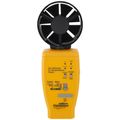
Airflow is the SupplyHouse category for the diagnostic instruments technicians use to measure duct velocity, static pressure, and volumetric flow rate on HVAC systems. Contractors reach for these tools when balancing supply and return registers, verifying total external static pressure on a furnace or air handler, or troubleshooting a system that isn't moving enough conditioned air. A capture hood measures volumetric flow directly at a register or diffuser, while a combination meter like the Fluke 922 reads air velocity and differential pressure across a range of 250 to 16,000 feet per minute in one handheld unit. Correct airflow readings matter because undersized or restricted ductwork drives up energy costs, shortens equipment life, and leaves rooms too hot or too cold no matter how the thermostat is set. Choosing the right instrument for the job keeps commissioning and service calls accurate and defensible.
Subcategories
- Airflow Capture Hoods (Balometers): Capture hoods fit directly over a supply or return register to trap and measure the full volume of air moving through it, giving a direct reading in cubic feet per minute. Balancing technicians and commissioning agents rely on them to verify that each room receives the design airflow called for in the duct layout. The CPS ABM-HOOD adds a low volume reducer plate that extends accurate readings down to 7 CFM for low-flow diffusers. A rugged control box and stored calibration curves keep readings consistent across a full day of register-by-register balancing.
- Manometers: Manometers measure differential and static gas pressure rather than velocity, connecting to test ports with silicone tubing to read manifold pressure, total external static pressure, or duct pressure drop across a filter or coil. Furnace and boiler technicians use them during startup to confirm gas pressure matches the manufacturer's specification and during service calls to spot a clogged filter or undersized return. The Testo 510 differential pressure manometer kit ships with silicone tubes for these point-to-point pressure checks. Digital models store multiple readings so a technician can document before-and-after pressure drops on the same call.
- Airflow Meters and Micromanometers: Airflow meters combine a velocity probe with a differential pressure sensor so a single handheld unit can calculate both duct velocity and static pressure. The Fluke 922 covers a velocity range of 250 to 16,000 feet per minute along with differential pressure and manifold pressure measurement, making it useful across residential and light commercial duct sizes. Technicians use these meters to spot-check velocity at multiple points across a duct cross-section rather than relying on a single reading. A built-in hold function locks in a value while working inside a tight mechanical room or attic.
Buying Guide
Start with what needs measuring. Balancing a duct system room by room calls for a capture hood that reads volumetric flow directly at the register, while diagnosing a static pressure problem on a furnace or air handler calls for a manometer connected to test ports on the supply and return plenums. A combination airflow meter earns its place on the truck when spot-checking velocity at multiple points inside a duct rather than at a single register.
Range matters as much as function. A meter rated for 250 to 16,000 feet per minute covers most residential branch and trunk lines, but confirm the low end of a capture hood against the smallest diffuser expected on the job. Standard hoods can miss very low volumes, which is why some, like the CPS ABM-HOOD, add a low volume reducer plate that extends accurate readings down to 7 CFM.
Airflow instruments also need to match the environment. A rugged case and stored calibration data matter on a crew that moves between attics, crawlspaces, and rooftop units all day. Silicone tubing and quick-connect fittings on a manometer save time when switching between gas manifold checks and static pressure readings on the same call.
Finally, weigh accuracy against the reporting the job requires. Code-mandated duct testing and warranty commissioning documentation call for calibrated, data-logging instruments, while a quick service diagnosis can often be handled with a simpler handheld meter.
Frequently Asked Questions
What's the difference between a capture hood and an airflow meter?
A capture hood measures the full volume of air moving through a single register or diffuser and gives a direct reading in cubic feet per minute. An airflow meter measures velocity and differential pressure at a point inside the duct or at the face of a coil, then calculates flow from that reading. Capture hoods work best for register-by-register balancing, while airflow meters suit spot checks and static pressure diagnostics.
What velocity range do handheld airflow meters typically cover?
Many handheld combination meters cover a wide range to handle both low-velocity return air and high-velocity supply branches. The Fluke 922, for example, reads air velocity and differential pressure across 250 to 16,000 feet per minute in a single unit. Checking the rated range against the duct sizes on a project keeps readings inside the meter's accurate zone.
Can a capture hood read very low airflow accurately?
Standard capture hoods can lose accuracy at very low volumes because so little air moves through the hood opening. Some models address this with a low volume reducer plate, which narrows the capture area and extends accurate readings down to 7 CFM. The accessory matters most on jobs with small diffusers or low-flow exhaust fans.
What's a manometer used for on an HVAC service call?
A manometer reads differential or static gas pressure rather than air velocity or volume. Technicians connect it to test ports with silicone tubing to confirm gas manifold pressure during startup or to measure total external static pressure and pressure drop across a filter or coil during diagnostics. The Testo 510 kit, for example, ships with silicone tubes built for these point-to-point checks.
Do airflow instruments need regular calibration?
Airflow instruments drift out of calibration with normal use, so periodic calibration keeps readings defensible for commissioning reports and code documentation. Digital models that store calibration curves and multiple readings make it easier to track that history across jobs. A quick field diagnosis has more tolerance for drift than formal duct testing does, but neither should rely on an instrument long overdue for calibration.
