




Filters
SORT
Product Availability –
Review Score –
 --%3E %3Csvg version='1.1' id='Fill' xmlns='http://www.w3.org/2000/svg' xmlns:xlink='http://www.w3.org/1999/xlink' x='0px' y='0px' viewBox='0 0 100 100' enable-background='new 0 0 100 100' xml:space='preserve'%3E %3Cpath fill='%23F15C02' d='M79.44,0.95H20.56C9.78,0.95,0.95,9.78,0.95,20.56v58.87c0,10.79,8.82,19.61,19.61,19.61h58.87 c10.79,0,19.61-8.83,19.61-19.61V20.56C99.05,9.78,90.22,0.95,79.44,0.95z M65.38,58.24l9.38,29.58L49.69,69.78L24.5,87.82 l9.34-29.6L8.8,39.6l30.73-0.17c0,0,6.98-19.61,10-28.93c0.54,1.36,9.88,29.1,9.88,29.1H91.2L65.38,58.24z'/%3E %3C/svg%3E)
Price Range –
Aquastats



 --%3E %3Csvg version='1.1' id='No-RB' xmlns='http://www.w3.org/2000/svg' xmlns:xlink='http://www.w3.org/1999/xlink' x='0px' y='0px' viewBox='0 0 100 100' enable-background='new 0 0 100 100' xml:space='preserve'%3E %3Cpath fill='%23CECECE' d='M79.44,0.95H20.56C9.78,0.95,0.95,9.78,0.95,20.56v58.87c0,10.79,8.82,19.61,19.61,19.61h58.87 c10.79,0,19.61-8.83,19.61-19.61V20.56C99.05,9.78,90.22,0.95,79.44,0.95z M65.38,58.24l9.38,29.58L49.69,69.78L24.5,87.82 l9.34-29.6L8.8,39.6l30.73-0.17c0,0,6.98-19.61,10-28.93c0.54,1.36,9.88,29.1,9.88,29.1H91.2L65.38,58.24z'/%3E %3C/svg%3E)

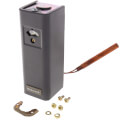
Aquastats are temperature-sensing controls used on hydronic boilers to monitor water temperature and turn the burner or circulator on and off to keep the system within a set range. They mount directly on the boiler, typically in a well that lets the sensing element contact the boiler water, and use that reading to control both the high-limit safety cutoff and the low-limit setting that determines when the burner fires.
Because an aquastat handles both routine temperature control and a safety limit function, a failed or miscalibrated unit can leave a boiler running too hot, cycling too often, or failing to reach temperature at all. Matching the replacement aquastat's temperature range and switch configuration to the original unit keeps both the control and safety functions working as the system was designed.
Subcategories
- Single-Stage Aquastats: Single-stage aquastats control one temperature setting, typically switching a single circulator or burner on and off at a fixed point, and they're common on simpler residential hydronic systems with a single heating zone.
- Combination High-Limit and Low-Limit Aquastats: Combination aquastats handle both the high-limit safety cutoff and a low-limit setting for burner operation in a single unit, which is the typical configuration on residential boilers where one control needs to manage both functions.
- Immersion Well Aquastats: Immersion well aquastats mount into a well fitting that's welded or threaded into the boiler so the sensing element contacts the boiler water directly, giving a more accurate reading than a strap-on style sensor mounted to the outside of the pipe.
Buying Guide
Confirm whether the boiler needs a single-stage or combination high-limit and low-limit aquastat before ordering, since a boiler wired for a combination control won't function correctly with a single-stage replacement, and the two are not interchangeable without rewiring.
Match the replacement aquastat's temperature range to the original, since Aquastats vary in how high a temperature they can be set to and swapping in a unit with a narrower range can prevent the system from reaching its intended setpoint.
Check the well size and thread type on the existing installation, since an immersion well aquastat needs to fit the well already installed in the boiler, and a mismatched thread size will require a different well or adapter.
Test the aquastat's high-limit function after any replacement, since this control's safety role means a miscalibrated or improperly set high-limit can allow the boiler to run hotter than intended even if the low-limit side is working correctly.
Frequently Asked Questions
What does an aquastat do on a boiler?
An aquastat monitors boiler water temperature and switches the burner or circulator on and off to keep the system within a set range, while also serving as a high-limit safety cutoff.
What is the difference between a single-stage and a combination aquastat?
A single-stage aquastat controls one temperature setting, while a combination aquastat handles both a high-limit safety cutoff and a separate low-limit setting for burner operation in one unit.
Why does an aquastat need to sit in a well rather than strap onto the pipe?
An immersion well lets the sensing element contact the boiler water directly, which gives a more accurate temperature reading than a sensor mounted to the outside of the pipe.
What happens if the wrong aquastat is installed on a boiler?
A control that doesn't match the boiler's wiring, such as a single-stage unit replacing a combination control, generally won't function correctly and can leave part of the system's temperature control or safety function inoperative.
Should the high-limit setting be tested after replacing an aquastat?
Yes, since the high-limit function is a safety control, confirming it's set and working correctly after a replacement helps prevent the boiler from running hotter than intended.
