




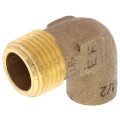
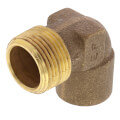
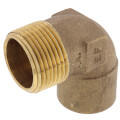
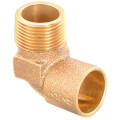
Brass 90° Elbows (C x M)

 --%3E %3Csvg version='1.1' id='No-RB' xmlns='http://www.w3.org/2000/svg' xmlns:xlink='http://www.w3.org/1999/xlink' x='0px' y='0px' viewBox='0 0 100 100' enable-background='new 0 0 100 100' xml:space='preserve'%3E %3Cpath fill='%23CECECE' d='M79.44,0.95H20.56C9.78,0.95,0.95,9.78,0.95,20.56v58.87c0,10.79,8.82,19.61,19.61,19.61h58.87 c10.79,0,19.61-8.83,19.61-19.61V20.56C99.05,9.78,90.22,0.95,79.44,0.95z M65.38,58.24l9.38,29.58L49.69,69.78L24.5,87.82 l9.34-29.6L8.8,39.6l30.73-0.17c0,0,6.98-19.61,10-28.93c0.54,1.36,9.88,29.1,9.88,29.1H91.2L65.38,58.24z'/%3E %3C/svg%3E)

 --%3E %3Csvg version='1.1' id='Fill' xmlns='http://www.w3.org/2000/svg' xmlns:xlink='http://www.w3.org/1999/xlink' x='0px' y='0px' viewBox='0 0 100 100' enable-background='new 0 0 100 100' xml:space='preserve'%3E %3Cpath fill='%23F15C02' d='M79.44,0.95H20.56C9.78,0.95,0.95,9.78,0.95,20.56v58.87c0,10.79,8.82,19.61,19.61,19.61h58.87 c10.79,0,19.61-8.83,19.61-19.61V20.56C99.05,9.78,90.22,0.95,79.44,0.95z M65.38,58.24l9.38,29.58L49.69,69.78L24.5,87.82 l9.34-29.6L8.8,39.6l30.73-0.17c0,0,6.98-19.61,10-28.93c0.54,1.36,9.88,29.1,9.88,29.1H91.2L65.38,58.24z'/%3E %3C/svg%3E)
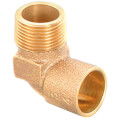
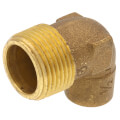
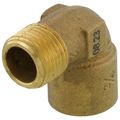

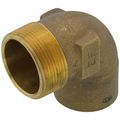
Brass 90° elbows (C x M) change the direction of a copper pipe run while transitioning from a solder cup connection to a male threaded outlet in a single fitting. Plumbers reach for this configuration whenever a soldered copper line needs to terminate at a threaded fixture, valve, or adapter, since it eliminates a separate transition fitting and one extra joint that could leak. Brass construction resists dezincification and holds up to the heat of soldering better than some alternative materials, which is why these elbows remain a standard choice on potable water, heating, and general plumbing runs. Common uses include connecting a copper supply line to a threaded valve body, a water heater fitting, or an appliance connection where the far side of the joint is threaded rather than soldered. Because the fitting combines two different connection types, getting the pipe size and thread size both correct before soldering avoids a mismatched joint discovered after the torch is already out.
Subcategories
- Standard Residential Sizes (1/2 Inch and 3/4 Inch): Half-inch and three-quarter-inch brass C x M elbows cover the majority of residential and light commercial plumbing work, from fixture supply connections to branch lines feeding a water heater or valve. Plumbers keep these on hand as some of the most frequently used transition fittings on a service truck. They're common wherever a soldered copper branch needs to terminate at a threaded valve or appliance connection.
- Larger Commercial Sizes (1 Inch and Above): One-inch and larger brass C x M elbows serve commercial and light industrial applications where mains and larger branch lines carry higher flow. Mechanical contractors specify these on jobs feeding larger fixtures, mechanical equipment, or distribution mains where a threaded connection point is still required. Larger sizes see less frequent use than residential sizing but are stocked for exactly this kind of transition.
- Lead-Free and Potable Water Rated Fittings: Lead-free brass elbows are manufactured to meet potable water standards for drinking water applications. Plumbers specify these on any job supplying water for human consumption, where codes require lead-free rated fittings throughout the system. Confirming the lead-free rating before ordering is a standard check on residential and commercial water supply jobs alike.
- Heating and Non-Potable Applications: Brass C x M elbows used in hydronic heating or other non-potable systems don't require the same lead-free certification as drinking water lines, though many contractors still stock lead-free fittings across the board to simplify inventory. These fittings perform the same soldered-to-threaded transition in heating loops, radiant systems, and other closed-loop applications.
Buying Guide
Confirming both connection sizes before ordering is the first step with any C x M fitting. The solder cup side needs to match the copper pipe's outer diameter, and the male thread side needs to match the fitting or valve it will connect to, since these two dimensions don't always scale together across a manufacturer's catalog.
Lead-free certification matters on any job touching potable water. Plumbing codes increasingly require lead-free rated brass throughout a drinking water system, so confirming the fitting carries the correct certification avoids a failed inspection or a callback to swap fittings after the job is finished.
Wall thickness and brass grade affect how well a fitting tolerates repeated heating during soldering, particularly on larger commercial sizes where more heat is needed to flow solder around the joint. A fitting that's been overheated during a previous attempt can weaken before it's even installed.
Thread type on the male end should be confirmed against whatever it's mating to, since most fittings use standard NPT threads but some specialty valves or appliance connections use a different thread standard.
For jobs with a mix of soldered and threaded connections throughout, keeping a stock of C x M elbows in the common residential sizes alongside a smaller supply of larger commercial sizes covers most service and installation work without over-ordering less frequently used sizes.
Frequently Asked Questions
What does C x M mean on a brass elbow?
C x M describes the two connection types on the fitting: a solder cup (C) on one end for a copper pipe, and a male thread (M) on the other end for connecting to a threaded valve, fixture, or adapter.
Do I need a lead-free brass elbow for my job?
Lead-free rated fittings are required on any system supplying water for human consumption. Non-potable applications like closed-loop heating don't carry the same requirement, though many contractors stock lead-free fittings across all their work to simplify inventory.
Can I use a brass 90° elbow on a heating loop instead of a potable water line?
Yes. Brass C x M elbows work the same way in hydronic heating and other non-potable closed-loop systems as they do in potable water lines, performing the same soldered-to-threaded transition.
Why use a C x M elbow instead of a separate coupling and adapter?
A C x M elbow combines the direction change and the connection transition into a single fitting, which means one less soldered joint and one less potential leak point compared to piecing the transition together with separate fittings.
What size brass elbow do most residential jobs need?
Half-inch and three-quarter-inch sizes cover the large majority of residential plumbing work, including fixture supply lines and connections to water heaters and valves.
