




Filters
SORT
Product Availability –
Size –
Review Score –
 --%3E %3Csvg version='1.1' id='Fill' xmlns='http://www.w3.org/2000/svg' xmlns:xlink='http://www.w3.org/1999/xlink' x='0px' y='0px' viewBox='0 0 100 100' enable-background='new 0 0 100 100' xml:space='preserve'%3E %3Cpath fill='%23F15C02' d='M79.44,0.95H20.56C9.78,0.95,0.95,9.78,0.95,20.56v58.87c0,10.79,8.82,19.61,19.61,19.61h58.87 c10.79,0,19.61-8.83,19.61-19.61V20.56C99.05,9.78,90.22,0.95,79.44,0.95z M65.38,58.24l9.38,29.58L49.69,69.78L24.5,87.82 l9.34-29.6L8.8,39.6l30.73-0.17c0,0,6.98-19.61,10-28.93c0.54,1.36,9.88,29.1,9.88,29.1H91.2L65.38,58.24z'/%3E %3C/svg%3E)
CPVC Compression Couplings


 --%3E %3Csvg version='1.1' id='No-RB' xmlns='http://www.w3.org/2000/svg' xmlns:xlink='http://www.w3.org/1999/xlink' x='0px' y='0px' viewBox='0 0 100 100' enable-background='new 0 0 100 100' xml:space='preserve'%3E %3Cpath fill='%23CECECE' d='M79.44,0.95H20.56C9.78,0.95,0.95,9.78,0.95,20.56v58.87c0,10.79,8.82,19.61,19.61,19.61h58.87 c10.79,0,19.61-8.83,19.61-19.61V20.56C99.05,9.78,90.22,0.95,79.44,0.95z M65.38,58.24l9.38,29.58L49.69,69.78L24.5,87.82 l9.34-29.6L8.8,39.6l30.73-0.17c0,0,6.98-19.61,10-28.93c0.54,1.36,9.88,29.1,9.88,29.1H91.2L65.38,58.24z'/%3E %3C/svg%3E)

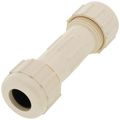


CPVC Compression Couplings are mechanical fittings that join sections of CPVC pipe, or transition between CPVC and other pipe materials, without solvent welding. A nut, stainless steel gripper ring, and O-ring create the seal instead of glued joints, making the fittings useful for repairs on existing pipe systems where cutting in a solvent weld isn't practical, as well as new installations on plain-end pipe. Maximum service temperature runs to 180 degrees Fahrenheit, matching typical hot and cold water distribution use. Unlike compression fittings built for metal pipe, CPVC-rated compression couplings use a stainless steel gripper ring shaped like a thin, toothed washer along with an O-ring, rather than a smooth metal ferrule, since CPVC needs a different sealing approach than copper or steel pipe. CTS-sized versions meet NSF International standards under NSF Standard 61 and ASTM D2846 for potable water use. Plumbers making repairs or transitions where solvent welding isn't an option rely on this fitting style to complete a leak-free joint without cement or curing time.
Subcategories
- Repair Couplings: Repair couplings join plain-end CPVC pipe on existing systems, letting plumbers cut in a new section without solvent welding on a live line. The repair style works well when a section of CPVC needs replacing but the surrounding pipe can't be dried or prepped for a solvent weld joint. The nut, gripper ring, and O-ring design creates the seal without cement, so the repair is ready as soon as the nut is tightened. Plumbers keep these on hand for emergency repairs where drying time for a solvent weld isn't available.
- CTS Transition Couplings: CTS transition couplings size to copper tube size standards, matching common CPVC pipe used in hot and cold water distribution. The couplings meet NSF International standards under NSF Standard 61 and ASTM D2846 for potable water service. The CTS sizing keeps the coupling compatible with standard CPVC pipe diameters found in residential and light commercial plumbing. Plumbers use CTS transition couplings specifically for potable water applications where standards compliance matters.
- CPVC-to-Metal Transition Fittings: CPVC-to-metal transition fittings combine a CPVC end with a metal end, using an elastomeric seal to join the two pipe materials without solvent welding or soldering. The metal end comes configured as solder joint socket, compression ferrule, or threaded connection, depending on what the metal-side pipe needs. Plumbers use these transition fittings where CPVC water lines connect to existing copper or steel piping, common in water heater connections or main supply transitions. PTFE tape or approved thread sealant applies only to NPT threaded connections on these fittings, not to the CPVC or compression side.
- Standard CPVC Compression Couplings: Standard CPVC compression couplings join two sections of plain-end CPVC pipe of the same diameter, without a metal or transition component. The nut, gripper ring, and O-ring design applies here the same as on repair and transition couplings, sealing the joint mechanically instead of chemically. Maximum service temperature runs to 180 degrees Fahrenheit, matching general hot and cold water distribution use. Plumbers use this style for straightforward pipe-to-pipe joints where solvent welding isn't practical or available on site.
Buying Guide
Selecting CPVC Compression Couplings starts with identifying what's being joined. Repair and standard couplings connect two sections of CPVC pipe without a metal or transition component, while CPVC-to-metal transition fittings join CPVC to copper, steel, or other metal piping using an elastomeric seal instead of solder or solvent weld. Confirming which pipe materials meet at the joint determines which coupling style is needed.
Sizing follows CTS standards for most residential and light commercial CPVC systems, so matching coupling size to the nominal pipe diameter keeps the gripper ring and O-ring sealing correctly. Compression fittings built specifically for CPVC use a stainless steel gripper ring along with an O-ring, different from standard metal compression fittings that rely on a smooth ferrule, so substituting a metal-rated compression fitting onto CPVC pipe isn't a safe swap.
Service conditions matter too. Maximum service temperature on CPVC compression couplings runs to 180 degrees Fahrenheit, suited for hot and cold water distribution but not for compressed air or other gas service. For potable water applications, confirming NSF Standard 61 and ASTM D2846 compliance on the specific coupling keeps the installation within code. On CPVC-to-metal transition fittings with threaded metal ends, PTFE tape or approved thread sealant applies only to the NPT threaded side, never to the CPVC or compression connection, since sealant there can interfere with the gripper ring seal.
Frequently Asked Questions
Can CPVC compression couplings be used for repairs on existing pipe?
CPVC compression couplings work well for repairs on existing pipe systems, letting plumbers cut in a new section of plain-end pipe without solvent welding on a live line. The nut, gripper ring, and O-ring design seals the joint mechanically as soon as the nut is tightened, without needing cure time. Plumbers keep these on hand specifically for repairs where drying the pipe for a solvent weld joint isn't practical.
What temperature can CPVC compression couplings handle?
CPVC compression couplings carry a maximum service temperature of 180 degrees Fahrenheit, suited for hot and cold water distribution. They're not rated for compressed air or other gas service. Checking system operating temperature against this limit before installation confirms the fitting is suited to the application.
How does a CPVC compression fitting differ from a standard metal compression fitting?
CPVC compression fittings use an O-ring along with a stainless steel gripper ring shaped like a thin, toothed washer, instead of the smooth metal ferrule used on standard metal compression fittings. Metal-rated compression fittings aren't a safe substitute on CPVC pipe, since the sealing method is built specifically around the pipe material. Matching fitting type to pipe material keeps the joint sealing correctly under pressure.
Can a CPVC compression coupling connect to copper or steel pipe?
Direct CPVC-to-metal transitions use a dedicated transition fitting with a CPVC end and a metal end joined by an elastomeric seal, rather than a standard CPVC compression coupling. The metal end on these transition fittings comes as solder joint socket, compression ferrule, or threaded connection. Plumbers use these transition fittings specifically where CPVC water lines meet existing copper or steel piping.
Are CPVC compression couplings rated for potable water?
CTS-sized CPVC compression couplings meet NSF International standards under NSF Standard 61 and ASTM D2846 for potable water service. Confirming this compliance on the specific coupling matters for any potable water installation subject to code inspection. Standard sizing under CTS keeps the coupling compatible with common CPVC pipe diameters used in residential and light commercial plumbing.
