




HVAC Capacitors
HVAC capacitors store and release electrical energy to start and run the motors found in furnaces, air conditioners, and other HVAC equipment. The category covers run, start, and dual motor run capacitors along with hard start devices that combine a start capacitor with a potential relay for harder-starting compressors.
Matching microfarad rating and voltage to the original capacitor keeps a motor operating within its designed electrical parameters. Capacitor testers in this category let technicians confirm a suspect capacitor has actually failed before replacing it, since a weak but still-functioning capacitor can sometimes be mistaken for a bad motor.
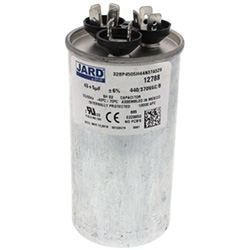
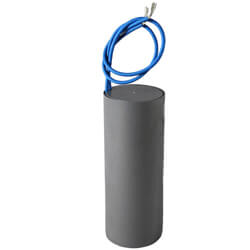

Dual Motor Run Capacitors are single round or oval capacitor cans with three terminals that serve both the compressor motor and the condenser fan motor from one component. The dual capacitor has two sections with different microfarad ratings sharing a common ground terminal. The replacement dual capacitor must match the original's dual microfarad ratings, voltage rating, and terminal configuration.
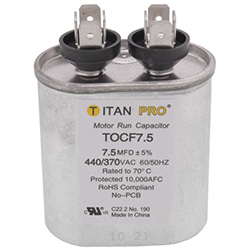
Motor Run Capacitors are single-section capacitors that remain in the motor circuit during normal operation, providing a phase shift to the motor's start winding that improves efficiency, power factor, and running torque. They are rated for continuous duty and used when the compressor and fan motor each have their own dedicated run capacitor rather than sharing a dual capacitor.
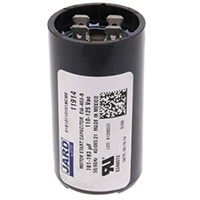
Motor Start Capacitors provide high initial capacitance to the motor's start winding during startup, generating the additional torque needed to bring the motor from a standstill to operating speed. Once the motor reaches approximately 75 percent of full speed, a relay disconnects the start capacitor from the circuit. Start capacitors are rated for intermittent duty only and are not designed for continuous operation.
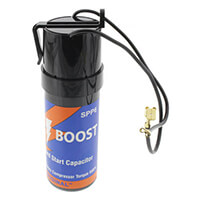
Hard Start Devices are kits combining a start capacitor and a potential relay to provide an additional torque boost during compressor startup. They are commonly added to older HVAC units, units operating with low voltage supply, or units with partially restricted refrigerant circuits. Hard start kits are installed in parallel with the existing run capacitor and significantly reduce the time the compressor motor draws high starting current.
Lighting Capacitors are used in fluorescent and HID lighting ballast circuits to correct power factor and regulate electrical current to the lamp. They help prevent flickering, reduce reactive power draw, and extend lamp and ballast service life. Lighting capacitors are sized by microfarad rating and voltage for the specific ballast and lamp combination.
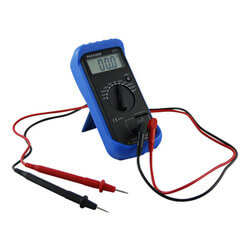
Capacitor Testers and Accessories are diagnostic tools used to measure the actual microfarad value of a capacitor and compare it to the rated value. A capacitor testing more than 6 percent below its rated microfarad value should be replaced. Capacitor testers allow technicians to diagnose a failing capacitor before the motor fails completely, reducing service cost and preventing compressor replacement.
The replacement capacitor's microfarad rating must match the original within plus or minus 6 percent. A replacement more than 6 percent below the rated value will result in reduced motor torque and efficiency, increased motor temperature, and premature winding failure. The voltage rating must equal or exceed the original. A 440V capacitor can replace a 370V capacitor safely; a 370V capacitor should not replace a 440V capacitor.
Hard start kits should be considered for compressors that struggle to start, particularly in high-ambient-temperature conditions or systems with long refrigerant line sets resulting in elevated suction pressure at startup. A hard start kit reduces locked rotor current draw time, reducing thermal stress on the compressor motor and the electrical supply circuit.
Capacitor testing should be part of every HVAC preventive maintenance inspection. Annual testing during spring startup allows replacement of degraded capacitors before the high-demand summer season, when failure is most likely to occur under peak operating load.
How do I know if my HVAC capacitor has failed?
Common symptoms include the air conditioner failing to start, the condenser fan spinning slowly or not at all, the compressor humming but not starting, or the system running but not cooling effectively. Capacitor failure can be confirmed with a multimeter set to capacitance mode: a reading more than 6 percent below the rated microfarad value indicates a capacitor that should be replaced.
Can I replace an HVAC capacitor myself?
Capacitors store electrical charge even when the power is off and can deliver a severe shock. Before handling a capacitor, disconnect system power and discharge the capacitor using an insulated discharge tool. The replacement must exactly match the original microfarad rating and have a voltage rating equal to or higher than the original. If there is uncertainty about the procedure or correct part, contact a licensed HVAC technician.
What is the difference between a run capacitor and a start capacitor?
A run capacitor remains in the motor circuit during normal operation providing a continuous phase shift to improve efficiency and running torque. It is designed for continuous duty. A start capacitor connects only during startup to generate additional starting torque and is disconnected by a relay once the motor reaches operating speed. Start capacitors are not designed for continuous operation and will fail quickly if they remain in the circuit after startup.
How do I read the ratings on an HVAC capacitor?
The capacitor label shows microfarad rating in MFD or uF and the voltage rating in volts AC. For dual capacitors, both microfarad values are separated by a plus sign, for example 45+5 MFD 440V identifies a 45 microfarad compressor section and a 5 microfarad fan motor section rated at 440 volts. The replacement must match both MFD values and have a voltage rating equal to or higher than the original.
How long do HVAC capacitors typically last?
Most HVAC run capacitors last 10 to 20 years under normal conditions, but heat accelerates degradation. Capacitors in outdoor condensing units in hot climates or poorly ventilated equipment rooms may fail in 5 to 7 years. Annual capacitor testing during preventive maintenance identifies degraded capacitors before they cause a no-cooling failure during peak demand.
Resources
 --%3E %3C!DOCTYPE svg PUBLIC '-//W3C//DTD SVG 1.1//EN' 'http://www.w3.org/Graphics/SVG/1.1/DTD/svg11.dtd'%3E %3Csvg version='1.1' id='Layer_1' xmlns='http://www.w3.org/2000/svg' xmlns:xlink='http://www.w3.org/1999/xlink' x='0px' y='0px' width='90px' height='90px' viewBox='0 0 90 90' enable-background='new 0 0 90 90' xml:space='preserve'%3E %3Crect x='27' y='23' fill='%23FFFFFF' width='43' height='44'/%3E %3Cg%3E %3Cdefs%3E %3Crect id='SVGID_1_' width='90' height='90'/%3E %3C/defs%3E %3CclipPath id='SVGID_2_'%3E %3Cuse xlink:href='%23SVGID_1_' overflow='visible'/%3E %3C/clipPath%3E %3Cpath clip-path='url(%23SVGID_2_)' fill='%234186AD' d='M45,0C20.1,0,0,20.1,0,45c0,24.9,20.1,45,45,45c24.9,0,45-20.1,45-45 C90,20.1,69.9,0,45,0'/%3E %3C/g%3E %3Cpath fill='%23FFFFFF' d='M60.6,47.4l-22.5,14c-0.5,0.3-1,0.399-1.5,0.399s-0.9-0.1-1.4-0.399c-0.9-0.5-1.4-1.4-1.4-2.5v-28 c0-1,0.6-2,1.4-2.5c0.9-0.5,2-0.5,2.9,0.1l22.5,14.1C61.4,43.1,61.9,44,61.9,45S61.4,46.9,60.6,47.4'/%3E %3C/svg%3E)
Dual Motor Run Capacitors are single round or oval capacitor cans with three terminals that serve both the compressor motor and the condenser fan motor from one component. The dual capacitor has two sections with different microfarad ratings sharing a common ground terminal. The replacement dual capacitor must match the original's dual microfarad ratings, voltage rating, and terminal configuration.
Motor Run Capacitors are single-section capacitors that remain in the motor circuit during normal operation, providing a phase shift to the motor's start winding that improves efficiency, power factor, and running torque. They are rated for continuous duty and used when the compressor and fan motor each have their own dedicated run capacitor rather than sharing a dual capacitor.
Motor Start Capacitors provide high initial capacitance to the motor's start winding during startup, generating the additional torque needed to bring the motor from a standstill to operating speed. Once the motor reaches approximately 75 percent of full speed, a relay disconnects the start capacitor from the circuit. Start capacitors are rated for intermittent duty only and are not designed for continuous operation.
Hard Start Devices are kits combining a start capacitor and a potential relay to provide an additional torque boost during compressor startup. They are commonly added to older HVAC units, units operating with low voltage supply, or units with partially restricted refrigerant circuits. Hard start kits are installed in parallel with the existing run capacitor and significantly reduce the time the compressor motor draws high starting current.
Lighting Capacitors are used in fluorescent and HID lighting ballast circuits to correct power factor and regulate electrical current to the lamp. They help prevent flickering, reduce reactive power draw, and extend lamp and ballast service life. Lighting capacitors are sized by microfarad rating and voltage for the specific ballast and lamp combination.
Capacitor Testers and Accessories are diagnostic tools used to measure the actual microfarad value of a capacitor and compare it to the rated value. A capacitor testing more than 6 percent below its rated microfarad value should be replaced. Capacitor testers allow technicians to diagnose a failing capacitor before the motor fails completely, reducing service cost and preventing compressor replacement.
The replacement capacitor's microfarad rating must match the original within plus or minus 6 percent. A replacement more than 6 percent below the rated value will result in reduced motor torque and efficiency, increased motor temperature, and premature winding failure. The voltage rating must equal or exceed the original. A 440V capacitor can replace a 370V capacitor safely; a 370V capacitor should not replace a 440V capacitor.
Hard start kits should be considered for compressors that struggle to start, particularly in high-ambient-temperature conditions or systems with long refrigerant line sets resulting in elevated suction pressure at startup. A hard start kit reduces locked rotor current draw time, reducing thermal stress on the compressor motor and the electrical supply circuit.
Capacitor testing should be part of every HVAC preventive maintenance inspection. Annual testing during spring startup allows replacement of degraded capacitors before the high-demand summer season, when failure is most likely to occur under peak operating load.
How do I know if my HVAC capacitor has failed?
Common symptoms include the air conditioner failing to start, the condenser fan spinning slowly or not at all, the compressor humming but not starting, or the system running but not cooling effectively. Capacitor failure can be confirmed with a multimeter set to capacitance mode: a reading more than 6 percent below the rated microfarad value indicates a capacitor that should be replaced.
Can I replace an HVAC capacitor myself?
Capacitors store electrical charge even when the power is off and can deliver a severe shock. Before handling a capacitor, disconnect system power and discharge the capacitor using an insulated discharge tool. The replacement must exactly match the original microfarad rating and have a voltage rating equal to or higher than the original. If there is uncertainty about the procedure or correct part, contact a licensed HVAC technician.
What is the difference between a run capacitor and a start capacitor?
A run capacitor remains in the motor circuit during normal operation providing a continuous phase shift to improve efficiency and running torque. It is designed for continuous duty. A start capacitor connects only during startup to generate additional starting torque and is disconnected by a relay once the motor reaches operating speed. Start capacitors are not designed for continuous operation and will fail quickly if they remain in the circuit after startup.
How do I read the ratings on an HVAC capacitor?
The capacitor label shows microfarad rating in MFD or uF and the voltage rating in volts AC. For dual capacitors, both microfarad values are separated by a plus sign, for example 45+5 MFD 440V identifies a 45 microfarad compressor section and a 5 microfarad fan motor section rated at 440 volts. The replacement must match both MFD values and have a voltage rating equal to or higher than the original.
How long do HVAC capacitors typically last?
Most HVAC run capacitors last 10 to 20 years under normal conditions, but heat accelerates degradation. Capacitors in outdoor condensing units in hot climates or poorly ventilated equipment rooms may fail in 5 to 7 years. Annual capacitor testing during preventive maintenance identifies degraded capacitors before they cause a no-cooling failure during peak demand.