




Filters
SORT
Product Availability –
Size –
Review Score –
 --%3E %3Csvg version='1.1' id='Fill' xmlns='http://www.w3.org/2000/svg' xmlns:xlink='http://www.w3.org/1999/xlink' x='0px' y='0px' viewBox='0 0 100 100' enable-background='new 0 0 100 100' xml:space='preserve'%3E %3Cpath fill='%23F15C02' d='M79.44,0.95H20.56C9.78,0.95,0.95,9.78,0.95,20.56v58.87c0,10.79,8.82,19.61,19.61,19.61h58.87 c10.79,0,19.61-8.83,19.61-19.61V20.56C99.05,9.78,90.22,0.95,79.44,0.95z M65.38,58.24l9.38,29.58L49.69,69.78L24.5,87.82 l9.34-29.6L8.8,39.6l30.73-0.17c0,0,6.98-19.61,10-28.93c0.54,1.36,9.88,29.1,9.88,29.1H91.2L65.38,58.24z'/%3E %3C/svg%3E)
Price Range –
Copper DWV 90° Elbows


 --%3E %3Csvg version='1.1' id='No-RB' xmlns='http://www.w3.org/2000/svg' xmlns:xlink='http://www.w3.org/1999/xlink' x='0px' y='0px' viewBox='0 0 100 100' enable-background='new 0 0 100 100' xml:space='preserve'%3E %3Cpath fill='%23CECECE' d='M79.44,0.95H20.56C9.78,0.95,0.95,9.78,0.95,20.56v58.87c0,10.79,8.82,19.61,19.61,19.61h58.87 c10.79,0,19.61-8.83,19.61-19.61V20.56C99.05,9.78,90.22,0.95,79.44,0.95z M65.38,58.24l9.38,29.58L49.69,69.78L24.5,87.82 l9.34-29.6L8.8,39.6l30.73-0.17c0,0,6.98-19.61,10-28.93c0.54,1.36,9.88,29.1,9.88,29.1H91.2L65.38,58.24z'/%3E %3C/svg%3E)
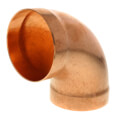
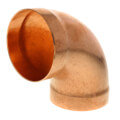
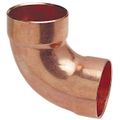
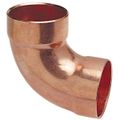

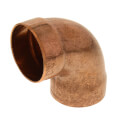
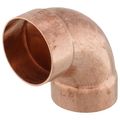
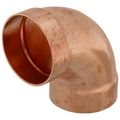
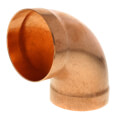
Copper DWV 90 degree elbows are solder fittings built for drain, waste, and vent piping that change a copper pipe run's direction by a full right angle. Unlike pressure-rated copper fittings used for water supply, DWV fittings are designed around gravity flow, so their interior is shaped to keep waste moving smoothly through the turn rather than to hold back pressurized water. Plumbers use them anywhere a vent stack or drain line needs to turn 90 degrees, such as routing a vent through a wall plate or changing a horizontal drain run into a vertical stack. The fitting solders onto copper DWV pipe the same way pressure fittings do, but the two families aren't interchangeable because their wall thickness and interior geometry differ. Copper DWV systems remain common in older buildings and renovation work where matching the existing copper drainage material keeps the system consistent.
Subcategories
- Standard Copper DWV 90° Elbows: These are the general-purpose fitting for turning a copper drain or vent line a full right angle, sized to match the most common residential DWV pipe diameters. Plumbers use them on vent stacks running through framing and on drain lines changing from horizontal to vertical. The smooth interior radius on a standard 90 degree DWV elbow is shaped differently than a pressure fitting to reduce the chance of waste catching at the turn.
- Long Turn Copper DWV 90° Elbows: A long turn, or long sweep, 90 degree elbow uses a wider radius bend than a standard elbow, which keeps waste flowing with less turbulence through the direction change. Plumbers favor long turn fittings on drain lines carrying solid waste, since the gentler curve reduces the chance of a clog forming at the bend compared to a sharper turn.
- Copper DWV Elbow Fittings and Adapters: Reducing elbows and adapter fittings let installers transition between different copper DWV pipe diameters or connect to another material partway through a run. These come into play on renovation jobs where an older copper DWV system ties into newer PVC or ABS drainage, requiring a fitting rated for that specific transition.
Buying Guide
The first decision when buying a copper DWV 90 degree elbow is confirming it's actually a DWV fitting and not a pressure-rated copper fitting. The two look similar but aren't built the same: DWV fittings have thinner walls and different interior geometry suited to gravity drainage, while pressure fittings are built to hold back supply-line water pressure. Installing a pressure fitting in a drain application, or vice versa, doesn't meet the intended use of either part.
Choosing between a standard and a long turn elbow depends on what's flowing through the line. Vent lines that only carry air don't need the gentler curve of a long turn fitting, so a standard 90 degree elbow works fine and takes up less space. Drain lines carrying solid waste benefit from the wider radius of a long turn elbow, which reduces the chance of material catching at the bend.
Matching the elbow's diameter exactly to the existing copper DWV pipe is essential for a solid solder joint. Because DWV pipe sizing differs from pressure-rated copper pipe sizing in some diameters, checking the pipe against the fitting before soldering avoids a poor fit that could lead to a leak.
For renovation work tying into an older copper DWV system, checking whether a transition adapter is needed to connect to PVC, ABS, or cast iron elsewhere in the run saves an extra trip. Local plumbing code may also restrict which materials can be joined directly, so confirming code requirements for mixed-material DWV connections is worth doing before starting the job.
Buying enough elbows and matching adapters for the full run, rather than piecing together fittings after the job is underway, keeps a copper DWV installation moving without interruption. Keeping the wall thickness and diameter consistent with the rest of the system protects against a mismatched joint that could fail under the drain line's flow.
Frequently Asked Questions
What does DWV stand for in plumbing fittings?
DWV stands for drain, waste, and vent, referring to fittings and pipe designed for gravity-fed wastewater and venting systems rather than pressurized water supply lines. DWV fittings have different wall thickness and interior shaping than pressure-rated fittings of the same nominal size.
Can copper DWV fittings be used for water supply lines?
Copper DWV fittings are built for drain and vent applications, not for holding back pressurized water. A pressure-rated copper fitting should be used for water supply lines instead of a DWV fitting.
What's the difference between a standard and a long turn 90 degree elbow?
A long turn elbow uses a wider radius bend than a standard elbow, which keeps waste flowing more smoothly through the direction change. Standard elbows work well on vent lines that only carry air, while long turn elbows are preferred on drain lines carrying solid waste.
Can a copper DWV elbow be soldered to PVC pipe?
Copper and PVC can't be soldered directly together. A transition fitting rated for connecting copper to PVC is needed wherever a copper DWV system ties into a PVC drainage run.
Are copper DWV fittings still used in new construction?
Copper DWV systems are less common in new construction than PVC or ABS, but they remain in use for renovation and repair work on buildings with existing copper drainage. Matching new fittings to an existing copper system keeps the drainage material consistent.
