




Filters
SORT
Product Availability –
Size –
Review Score –
 --%3E %3Csvg version='1.1' id='Fill' xmlns='http://www.w3.org/2000/svg' xmlns:xlink='http://www.w3.org/1999/xlink' x='0px' y='0px' viewBox='0 0 100 100' enable-background='new 0 0 100 100' xml:space='preserve'%3E %3Cpath fill='%23F15C02' d='M79.44,0.95H20.56C9.78,0.95,0.95,9.78,0.95,20.56v58.87c0,10.79,8.82,19.61,19.61,19.61h58.87 c10.79,0,19.61-8.83,19.61-19.61V20.56C99.05,9.78,90.22,0.95,79.44,0.95z M65.38,58.24l9.38,29.58L49.69,69.78L24.5,87.82 l9.34-29.6L8.8,39.6l30.73-0.17c0,0,6.98-19.61,10-28.93c0.54,1.36,9.88,29.1,9.88,29.1H91.2L65.38,58.24z'/%3E %3C/svg%3E)
Price Range –
Copper Reducer Couplings





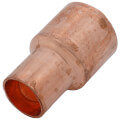


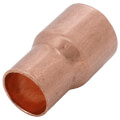


 --%3E %3Csvg version='1.1' id='No-RB' xmlns='http://www.w3.org/2000/svg' xmlns:xlink='http://www.w3.org/1999/xlink' x='0px' y='0px' viewBox='0 0 100 100' enable-background='new 0 0 100 100' xml:space='preserve'%3E %3Cpath fill='%23CECECE' d='M79.44,0.95H20.56C9.78,0.95,0.95,9.78,0.95,20.56v58.87c0,10.79,8.82,19.61,19.61,19.61h58.87 c10.79,0,19.61-8.83,19.61-19.61V20.56C99.05,9.78,90.22,0.95,79.44,0.95z M65.38,58.24l9.38,29.58L49.69,69.78L24.5,87.82 l9.34-29.6L8.8,39.6l30.73-0.17c0,0,6.98-19.61,10-28.93c0.54,1.36,9.88,29.1,9.88,29.1H91.2L65.38,58.24z'/%3E %3C/svg%3E)

Copper reducer couplings join two straight runs of copper tube in different diameters, letting a plumber transition pipe size without an offset or a second fitting. They're sized by their two working diameters, such as 3/4 by 1/2 inch, and installed with the same sweat-soldering technique as a standard same-size coupling. Most reducer couplings are wrought copper rather than cast, which solders faster and produces a cleaner joint under a torch. A reducer coupling keeps the transition inline and straight, which matters on a retrofit where the existing run has no room for an elbow or a bushing to make the size change. Picking the right reducer size upfront avoids stocking a bushing adapter or cutting into more of the existing run than the job requires.
Subcategories
- FTG x C Reducer Couplings: FTG by C reducers combine a fitting-to-fitting end with a standard cup-to-copper end, letting a plumber tie directly into another fitting's outlet without an extra coupling. That configuration sees regular use where a reducer lands right at a tee or elbow outlet rather than in the middle of a straight run. Stocking a few common FTG x C sizes alongside standard C x C reducers covers most residential repipe jobs.
- C x C Reducer Couplings: Cup by cup reducers are the standard configuration, with both ends sized to slide over copper tube for a sweated joint. A plumber cutting into an existing 3/4 inch run to feed a 1/2 inch branch typically reaches for this configuration first, since both ends solder the same way as a standard coupling. Keeping a range of common size pairs on the truck covers most repair and remodel calls without a special order.
- Large-Diameter Reducer Couplings: Reducer couplings above 2 inches show up more often on commercial and light-industrial jobs than residential ones, where main lines step down to smaller branch runs. Soldering a larger reducer takes more heat and a longer dwell time than a residential-size fitting, so a tech working one of these budgets extra time on the torch. Confirming wall thickness matches the pipe type, Type L versus Type M, matters more at larger diameters where a mismatch is harder to force-fit.
Buying Guide
Start by confirming both diameters on the existing run before ordering a reducer coupling. A reducer is labeled by its two working sizes, larger first, so a 3/4 by 1/2 inch fitting reduces from 3/4 inch pipe down to 1/2 inch, not the other way around. Getting that order backward means a return trip to the supply counter mid-job.
Next, decide whether the reducer needs to land inline on a straight run or tie directly into another fitting's outlet. A standard C x C reducer works for the first case, while an FTG x C configuration saves a coupling when the size change happens right at a tee or elbow. Copper Reducer Couplings in both configurations are stocked in the same common sizes, so switching between them doesn't usually mean a special order.
Material and wall thickness matter most on larger-diameter jobs. Confirm the pipe is Type L or Type M copper before soldering, since wall thickness affects how much heat and dwell time the joint needs to seat properly. On a repipe or remodel where the old run's diameter isn't obvious from the outside, measuring the actual outer diameter rather than guessing from the nominal size prevents ordering a reducer that doesn't seat cleanly on either end. Finally, dry-fit before soldering on any reducer landing near an existing fitting, since tight clearances around a reducer's shoulder can crowd a neighboring joint more than a standard coupling would.
Frequently Asked Questions
How are copper reducer couplings sized?
By their two working diameters, larger size first, so a 3/4 by 1/2 inch reducer steps down from 3/4 inch pipe to 1/2 inch pipe.
What's the difference between a C x C and an FTG x C reducer?
A C x C reducer has two cup ends for a standard sweated joint on a straight run. An FTG x C reducer has one fitting-to-fitting end, letting it tie directly into another fitting's outlet without an extra coupling.
Does pipe type affect how a reducer coupling solders?
Wall thickness varies between Type L and Type M copper, and a thicker wall needs more heat and dwell time to seat the joint properly, so confirming pipe type before soldering avoids a cold joint.
Can a reducer coupling replace a bushing adapter?
In most inline applications, yes. A reducer coupling keeps the transition straight without the offset a bushing can introduce, which matters on tight retrofit runs.
Why does dry-fitting matter more with a reducer coupling than a standard coupling?
A reducer's shoulder takes up more room than a same-size coupling, so dry-fitting first confirms it won't crowd a neighboring joint before committing to solder.
