




Eaton CH Circuit Breakers

 --%3E %3Csvg version='1.1' id='No-RB' xmlns='http://www.w3.org/2000/svg' xmlns:xlink='http://www.w3.org/1999/xlink' x='0px' y='0px' viewBox='0 0 100 100' enable-background='new 0 0 100 100' xml:space='preserve'%3E %3Cpath fill='%23CECECE' d='M79.44,0.95H20.56C9.78,0.95,0.95,9.78,0.95,20.56v58.87c0,10.79,8.82,19.61,19.61,19.61h58.87 c10.79,0,19.61-8.83,19.61-19.61V20.56C99.05,9.78,90.22,0.95,79.44,0.95z M65.38,58.24l9.38,29.58L49.69,69.78L24.5,87.82 l9.34-29.6L8.8,39.6l30.73-0.17c0,0,6.98-19.61,10-28.93c0.54,1.36,9.88,29.1,9.88,29.1H91.2L65.38,58.24z'/%3E %3C/svg%3E)
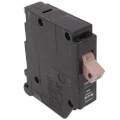

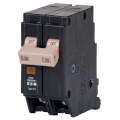
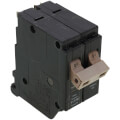
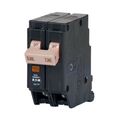
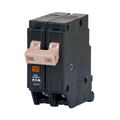

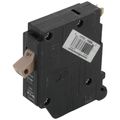
Eaton CH circuit breakers protect residential and light commercial branch circuits by tripping the breaker fully to the off position on a fault, which eliminates the guesswork of figuring out whether a breaker actually tripped or was manually switched off. These breakers are rated for services up to 240 volts, specifically 120/240V, with a standard interrupt rating of 10kAIC across the line, and they're available in 1, 2, and 3-pole configurations to match different circuit loads. Each pole requires 3/4 inch of panel space, a detail that matters when calculating how many circuits a given CH load center can hold. The thermal-magnetic trip mechanism is designed to ride through mild, temporary overloads without nuisance tripping while still reacting almost instantly to a genuine short circuit. Electricians specifying replacement breakers or new panel fill need to match pole count, amperage, and interrupt rating exactly to the existing CH load center, since breaker compatibility across panel types isn't universal.
Subcategories
- 1-Pole CH Breakers: Single-pole breakers protect standard 120-volt branch circuits like lighting and receptacle circuits, rated at 10kAIC and available across a range of amperages. Residential electricians use these most often when filling out a panel schedule for general-purpose circuits. Each pole takes 3/4 inch of bus space in the load center. These are the most commonly stocked breaker type for CH panels.
- 2-Pole CH Breakers: Two-pole breakers cover 240-volt circuits for larger loads like electric ranges, dryers, and HVAC equipment, still carrying the standard 10kAIC interrupt rating at 120/240V. Contractors wiring a new circuit for a major appliance or an air handler reach for this configuration. Larger 2-pole models rated 150 to 225 amps as main breakers carry a higher 25kAIC interrupt rating for added protection at the service entrance. Two poles take up double the bus space of a single-pole breaker.
- 3-Pole CH Breakers: Three-pole breakers serve three-phase circuits, typically found in light commercial applications rather than standard residential wiring. Electricians working on commercial CH panel installations use these to protect three-phase motor loads or equipment. Interrupt rating and voltage specifications follow the same CH series standards as single and two-pole models. Panel space requirements scale accordingly across three bus positions.
- CH Main Breakers: Main breakers control power to the entire load center and are rated separately from branch breakers, with 150 to 225 ampere CH main breakers carrying a 25kAIC interrupt rating. Electricians replacing a failed main breaker or upgrading service capacity need to match this rating exactly to the panel's listed specifications. The higher interrupt rating on mains reflects the greater fault current they may need to clear at the service entrance. Getting main breaker amperage and AIC rating wrong is a safety issue, not just a compatibility one.
Buying Guide
Confirm the existing load center accepts CH-series breakers specifically, since Eaton's breaker families aren't interchangeable across different panel types even when they physically appear similar. Next, match pole count to the circuit being protected. Single-pole breakers handle standard 120-volt circuits, two-pole units handle 240-volt loads like ranges and HVAC equipment, and three-pole breakers apply to three-phase commercial circuits. Eaton CH circuit breakers carry a standard interrupt rating of 10kAIC at 120/240V, which covers typical residential and light commercial fault current, but main breakers rated 150 to 225 amps step up to 25kAIC, so replacing a main breaker requires checking that higher rating specifically rather than assuming standard branch breaker specs apply. Amperage needs to match the circuit's calculated load exactly, since undersizing trips the breaker under normal use and oversizing removes the protection the circuit conductor needs. Panel space is a real constraint too. Each pole takes 3/4 inch of bus space, so a full panel replacement or an addition to an existing panel needs that math done before ordering breakers, not after. For anyone standardizing a facility's electrical maintenance stock, sticking with the CH platform across a property simplifies replacement part inventory since breakers stay compatible with every CH load center on site instead of mixing breaker families that don't cross over.
Frequently Asked Questions
What voltage and amperage do Eaton CH circuit breakers support?
CH breakers are rated for services up to 240 volts, specifically 120/240V, with amperage options covering standard residential and light commercial branch circuits. Main breakers in the CH line go up to 225 amps. Matching amperage exactly to the calculated circuit load is essential, not just picking a close value.
What's the interrupt rating on a standard CH breaker?
Standard CH branch breakers carry a 10kAIC interrupt rating at 120/240V, which covers typical residential and light commercial fault current levels. Main breakers rated 150 to 225 amps step up to a 25kAIC rating for the higher fault current possible at the service entrance. Confirming the correct rating for main versus branch breakers avoids installing an underrated breaker.
Can a CH breaker be installed in a different manufacturer's panel?
CH-series breakers are designed specifically for CH load centers and aren't universally interchangeable with other breaker families, even from the same manufacturer. Installing a mismatched breaker family is both a compatibility problem and a safety issue. Checking the panel's listed compatible breaker types before ordering replacements is the safest approach.
How much panel space does each pole take up?
Each pole on a CH circuit breaker requires 3/4 inch of bus space inside the load center. That measurement determines how many single, double, or triple-pole breakers a given panel can physically hold. Planning pole count against available panel space before starting a job prevents running out of room mid-installation.
What does it mean that CH breakers trip fully to the off position?
When a CH breaker trips due to an overload or fault, the handle moves completely to the off position rather than stopping somewhere in between. That design makes it immediately obvious during troubleshooting whether a breaker tripped from a fault or was simply switched off manually. It removes the ambiguity that can slow down diagnosing an electrical problem in the field.
