




Filters
SORT
Product Availability –
Brand –
Size –
Review Score –
 --%3E %3Csvg version='1.1' id='Fill' xmlns='http://www.w3.org/2000/svg' xmlns:xlink='http://www.w3.org/1999/xlink' x='0px' y='0px' viewBox='0 0 100 100' enable-background='new 0 0 100 100' xml:space='preserve'%3E %3Cpath fill='%23F15C02' d='M79.44,0.95H20.56C9.78,0.95,0.95,9.78,0.95,20.56v58.87c0,10.79,8.82,19.61,19.61,19.61h58.87 c10.79,0,19.61-8.83,19.61-19.61V20.56C99.05,9.78,90.22,0.95,79.44,0.95z M65.38,58.24l9.38,29.58L49.69,69.78L24.5,87.82 l9.34-29.6L8.8,39.6l30.73-0.17c0,0,6.98-19.61,10-28.93c0.54,1.36,9.88,29.1,9.88,29.1H91.2L65.38,58.24z'/%3E %3C/svg%3E)
 --%3E %3Csvg version='1.1' id='With-RB' xmlns='http://www.w3.org/2000/svg' xmlns:xlink='http://www.w3.org/1999/xlink' x='0px' y='0px' viewBox='0 0 100 100' enable-background='new 0 0 100 100' xml:space='preserve'%3E %3Cpath fill='%23FBC8B4' d='M79.44,0.95H20.56C9.78,0.95,0.95,9.78,0.95,20.56v58.87c0,10.79,8.82,19.61,19.61,19.61h58.87 c10.79,0,19.61-8.83,19.61-19.61V20.56C99.05,9.78,90.22,0.95,79.44,0.95z M65.38,58.24l9.38,29.58L49.69,69.78L24.5,87.82 l9.34-29.6L8.8,39.6l30.73-0.17c0,0,6.98-19.61,10-28.93c0.54,1.36,9.88,29.1,9.88,29.1H91.2L65.38,58.24z'/%3E %3C/svg%3E)
Price Range –
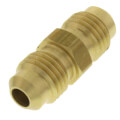
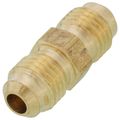
Flare Unions


 --%3E %3Csvg version='1.1' id='Half' xmlns='http://www.w3.org/2000/svg' xmlns:xlink='http://www.w3.org/1999/xlink' x='0px' y='0px' viewBox='0 0 100 100' enable-background='new 0 0 100 100' xml:space='preserve'%3E %3Cg%3E %3Cpath fill='%23F15C02' d='M30.05,70.23l3.79-12.01L8.8,39.6l30.73-0.17c0,0,6.98-19.61,10-28.93c0.54,1.36,9.88,29.1,9.88,29.1h1.58 L93.71,7.18c-3.58-3.82-8.66-6.23-14.28-6.23H20.56C9.78,0.95,0.95,9.78,0.95,20.56v58.87c0,5.41,2.22,10.32,5.79,13.88 L30.05,70.23z'/%3E %3C/g%3E %3Cpath fill='%23FBC8B4' d='M93.71,7.18L60.98,39.6H91.2L65.38,58.24l9.38,29.58L49.69,69.78L24.5,87.82l5.55-17.59L6.75,93.32 c3.55,3.54,8.44,5.73,13.82,5.73h58.87c10.79,0,19.61-8.83,19.61-19.61V20.56C99.05,15.4,97.01,10.69,93.71,7.18z'/%3E %3C/svg%3E)

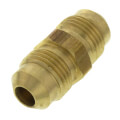
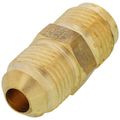
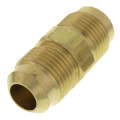
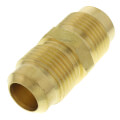
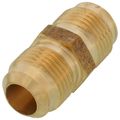
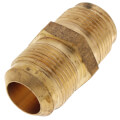
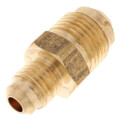
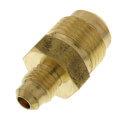
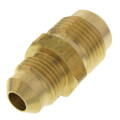
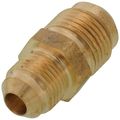
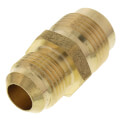

Flare unions are three-piece fittings that join two lengths of tubing end to end using a flared tube end, a mating nut, and a threaded body, creating a metal-to-metal seal without solder or a permanent joint. They show up most often on refrigeration lines, fuel gas piping, and hydraulic runs where a technician needs a connection that can be taken apart later for service or replacement. Because the seal relies on the flare itself rather than an O-ring or gasket, a clean, properly formed flare on both tube ends matters more than it does with compression or push-to-connect fittings.
Contractors reach for flare unions when a run needs a disconnect point partway along its length, such as joining two coils of tubing or adding a serviceable break near an appliance connection. Their appeal on refrigeration and gas work comes down to reliability under vibration and thermal cycling, conditions where a soldered joint can eventually crack and a flared connection tends to hold.
Subcategories
- Brass Flare Unions: Brass is the standard material for flare unions on refrigerant and fuel gas lines because it resists corrosion and machines to a precise flare seat. Most residential and light commercial installers stock brass unions in the common copper tubing sizes they run day to day. The softer metal also forms a tighter seal against a copper flare than harder alloys do.
- Steel Flare Unions: Steel and steel-alloy flare unions hold up in higher-pressure or higher-temperature applications where brass would be a weaker choice, such as certain industrial refrigeration and hydraulic circuits. Technicians working on commercial equipment often keep a few steel unions on hand for lines that see more mechanical stress than a typical residential system. The added strength comes with more effort to thread and seat correctly, so careful torque control still matters.
- Reducing Flare Unions: Reducing flare unions connect two different tubing sizes in a single fitting, which avoids stacking a coupling and an adapter to make the same transition. They come up often when tying a smaller branch line into a larger main run on a refrigeration or gas system. Keeping a few common reducing sizes in truck stock saves a trip back to the supply house mid-job.
- Long Flare Unions: Long-body flare unions extend farther than a standard union, giving more thread engagement and a longer straight section to work with in tight mechanical rooms or where a run needs extra support near the joint. They're a practical substitute where a standard-length union would leave too little clearance to tighten properly. The added length also helps when a joint needs to bridge a small gap between two fixed points.
Buying Guide
Selecting flare unions starts with matching the fitting to the tubing's outside diameter and confirming the thread type lines up with the mating equipment, since a mismatched thread pitch will strip before it seals. Refrigeration and fuel gas applications each have their own common sizing conventions, so checking the equipment's connection spec before ordering avoids a fitting that looks right but won't thread on correctly.
Material choice matters just as much as size. Brass flare unions cover the vast majority of residential and light commercial refrigerant and gas work, while steel or alloy versions are worth stepping up to on systems that run hotter, carry higher pressure, or see more vibration over time. Flare unions used on gas lines should also be rated for that service specifically, since not every union intended for refrigerant work carries the same gas-rated seal.
Reducing versions are worth stocking for jobs where a branch line ties into a different tubing size, since they cut down on the number of separate fittings needed at a single joint. Long-body unions are the better call in cramped mechanical spaces where a standard union would leave too little room to get a wrench on both sides. Whatever the configuration, inspecting the flare itself before assembly, checking for cracks, unevenness, or an incomplete cone, catches most sealing problems before the joint is ever tightened down.
Frequently Asked Questions
What's the difference between a flare union and a compression fitting?
A flare union seals metal to metal against a flared tube end formed with a flaring tool, while a compression fitting seals against a ferrule that bites into the tube as the nut is tightened. Flare connections are more common on refrigeration and gas lines where the joint may need to be serviced later.
Can flare unions be reused after disassembly?
A flare union can often be reused if the flare itself is still in good condition, but inspecting for cracks, flattening, or an uneven seat before reassembly is worth the extra minute. A damaged flare should be recut rather than reused.
Are brass flare unions rated for gas line use?
Not every brass flare union intended for refrigerant service is rated for fuel gas. Checking that a fitting is specifically listed for gas use before installing it on a gas line avoids a code violation or a joint that isn't rated for the application.
When should a reducing flare union be used instead of a standard one?
A reducing flare union makes sense when a branch line needs to tie into a main run of a different tubing size. It replaces what would otherwise take a separate coupling and adapter stacked together.
Why would a long-body flare union be chosen over a standard length?
A long-body union gives more thread engagement and extra straight length to work with, which helps in tight mechanical rooms where there isn't much clearance to tighten a standard-length fitting.
