




Geothermal Socket Fusion Fittings

 --%3E %3Csvg version='1.1' id='No-RB' xmlns='http://www.w3.org/2000/svg' xmlns:xlink='http://www.w3.org/1999/xlink' x='0px' y='0px' viewBox='0 0 100 100' enable-background='new 0 0 100 100' xml:space='preserve'%3E %3Cpath fill='%23CECECE' d='M79.44,0.95H20.56C9.78,0.95,0.95,9.78,0.95,20.56v58.87c0,10.79,8.82,19.61,19.61,19.61h58.87 c10.79,0,19.61-8.83,19.61-19.61V20.56C99.05,9.78,90.22,0.95,79.44,0.95z M65.38,58.24l9.38,29.58L49.69,69.78L24.5,87.82 l9.34-29.6L8.8,39.6l30.73-0.17c0,0,6.98-19.61,10-28.93c0.54,1.36,9.88,29.1,9.88,29.1H91.2L65.38,58.24z'/%3E %3C/svg%3E)

Geothermal Socket Fusion Fittings are HDPE pipe fittings that join sections of geothermal ground loop piping through heat fusion rather than mechanical or glued connections. The fittings on this page come from Ground Energy Systems and are molded from PE100/PE4710 resin, the highest-rated HDPE grade currently used in ground loop piping, and are manufactured to ASTM D2683. A socket fusion joint forms when a heated iron melts the fitting socket and the pipe end at the same time, then the two surfaces are pressed together to cool into a single fused piece with no seam to leak. The fusion process is why HDPE loops can run buried and pressurized for decades without a mechanical joint to maintain. Fittings in this category include elbows, reducers, and couplings sized for the IPS dimensions common on residential and light commercial ground loop runs. Because a failed buried joint means excavation, geothermal installers depend on a correctly fused fitting to hold for the life of the loop field.
Subcategories
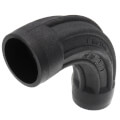
- Socket Fusion Elbows: Socket fusion elbows change the direction of a ground loop run without introducing a mechanical joint underground. The Ground Energy Systems GGE55 is a 1 inch IPS socket fusion 90 degree Geo Glide thin-wall sweep elbow, built with a tapered leading edge and ribbed exterior that lets insulation slide onto the pipe after fusion. The generous sweep radius on the Geo Glide design reduces pressure drop through the turn compared to a tighter-radius elbow. Installers fuse the elbow directly onto the HDPE pipe ends on both sides of the bend.
- Socket Fusion Reducers: Reducers step a loop from a larger trunk line to a smaller branch size without a mechanical coupling. The Ground Energy Systems SPC54 is a 1 inch by 3/4 inch socket fusion reducer sized for IPS HDPE pipe. Ground loop designs often run a larger supply main and branch to smaller individual loops, and the reducer makes that transition with the same fused, leak-free joint used throughout the field. The fitting is molded from the same PE100/PE4710 resin as the rest of the GES line.
- Socket Fusion Couplings: Couplings join two straight sections of pipe in the same diameter, most often to splice a run that is longer than a single coil length or to repair a damaged section. The Ground Energy Systems SPC66 is a 1-1/4 inch socket fusion coupling built for IPS HDPE pipe. Because the coupling fuses rather than glues or clamps, the joint reaches the same strength and pressure rating as the pipe itself. Geothermal contractors keep a stock of couplings on hand for splicing loop field runs in the field.
Buying Guide
Selecting the right fitting for a ground loop job starts with confirming the pipe's dimension standard and diameter. Geothermal Socket Fusion Fittings in this category are sized to IPS dimensions, so matching the fitting to the exact IPS size and SDR of the pipe on the job is the first checkpoint before fusing anything. Pipe compatibility comes next. GES fittings are molded from PE100/PE4710 resin and are built to work with PE3408, PE3608, PE100, and PE4710 HDPE pipe, the grades most commonly specified on current geothermal loop field designs. Confirming the loop field's design documents call for a compatible resin grade avoids a mismatch that could affect the fusion bond. Fitting type depends on the layout. Elbows change direction at header runs or well connections, reducers transition a trunk line to individual loop branches at a smaller diameter, and couplings splice straight runs or repair damaged sections. Mapping out the loop field layout before ordering helps avoid a mid-installation trip for a missing fitting. Fusion equipment matters too, since socket fusion requires a heated iron sized to the fitting's socket depth and the correct fusion time and temperature for the resin grade being joined. Because every fused joint becomes a permanent, buried connection, following the fitting manufacturer's fusion procedure closely on each joint protects the loop field's pressure rating for the decades it stays in the ground.
Frequently Asked Questions
What makes a socket fusion joint different from a glued or threaded fitting?
A socket fusion joint forms when a heated iron melts both the fitting socket and the pipe end at the same time, and the two melted surfaces are pressed together to cool into one continuous piece of HDPE. There's no glue, thread sealant, or mechanical seal involved, which is why fused joints hold the same pressure rating as the pipe itself.
What pipe is compatible with Ground Energy Systems socket fusion fittings?
GES fittings are molded from PE100/PE4710 resin and are built to work with PE3408, PE3608, PE100, and PE4710 HDPE pipe, the grades most commonly specified on geothermal loop field designs today. Matching the pipe's SDR and IPS size to the fitting before fusing is still the first step on any job.
What's the Geo Glide design on the socket fusion elbows?
The Geo Glide elbow design uses a thin wall with a tapered leading edge and a ribbed exterior that lets loop insulation slide onto the pipe after the fitting is fused in place. A generous sweep radius also reduces pressure drop through the turn compared to a tighter bend.
When does a job call for a socket fusion reducer instead of a coupling?
A reducer transitions a loop from a larger trunk diameter to a smaller branch size, such as the GES SPC54 1 inch by 3/4 inch reducer, while a coupling like the SPC66 joins two sections of the same diameter. Loop field designs that branch a main supply line into smaller individual loops typically need reducers at each branch point.
What standard are Ground Energy Systems socket fusion fittings built to?
GES socket fusion fittings are manufactured to ASTM D2683, and the HDPE resin used in them meets or exceeds ASTM D3350. Both standards govern the fitting's dimensions, material properties, and fusion compatibility with IPS HDPE pipe used in geothermal loop fields.
