




Mueller Streamline ACR Copper Press Caps
 --%3E %3Csvg version='1.1' id='Fill' xmlns='http://www.w3.org/2000/svg' xmlns:xlink='http://www.w3.org/1999/xlink' x='0px' y='0px' viewBox='0 0 100 100' enable-background='new 0 0 100 100' xml:space='preserve'%3E %3Cpath fill='%23F15C02' d='M79.44,0.95H20.56C9.78,0.95,0.95,9.78,0.95,20.56v58.87c0,10.79,8.82,19.61,19.61,19.61h58.87 c10.79,0,19.61-8.83,19.61-19.61V20.56C99.05,9.78,90.22,0.95,79.44,0.95z M65.38,58.24l9.38,29.58L49.69,69.78L24.5,87.82 l9.34-29.6L8.8,39.6l30.73-0.17c0,0,6.98-19.61,10-28.93c0.54,1.36,9.88,29.1,9.88,29.1H91.2L65.38,58.24z'/%3E %3C/svg%3E)

 --%3E %3Csvg version='1.1' id='No-RB' xmlns='http://www.w3.org/2000/svg' xmlns:xlink='http://www.w3.org/1999/xlink' x='0px' y='0px' viewBox='0 0 100 100' enable-background='new 0 0 100 100' xml:space='preserve'%3E %3Cpath fill='%23CECECE' d='M79.44,0.95H20.56C9.78,0.95,0.95,9.78,0.95,20.56v58.87c0,10.79,8.82,19.61,19.61,19.61h58.87 c10.79,0,19.61-8.83,19.61-19.61V20.56C99.05,9.78,90.22,0.95,79.44,0.95z M65.38,58.24l9.38,29.58L49.69,69.78L24.5,87.82 l9.34-29.6L8.8,39.6l30.73-0.17c0,0,6.98-19.61,10-28.93c0.54,1.36,9.88,29.1,9.88,29.1H91.2L65.38,58.24z'/%3E %3C/svg%3E)
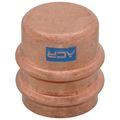
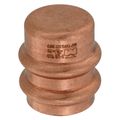
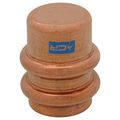
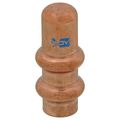
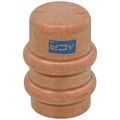
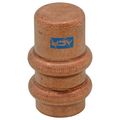

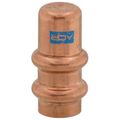
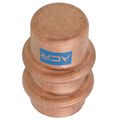
Mueller Streamline ACR Copper Press Caps are end fittings that seal off the end of a copper refrigerant line without brazing, using a mechanical press connection instead of an open flame. HVAC and refrigeration technicians use them to cap unused line stubs, service ports, or the end of a run during pressure testing and system modifications. The caps are built with Mueller's DualSeal Ring Design, described as the industry's only press fitting with dual independent sealing elements, and are rated for continuous operating pressure up to 700 PSI. They are available in eight sizes ranging from 1/4 inch to 1-3/8 inch OD, covering the common tube diameters found on residential and light commercial refrigerant lines. Compatibility with refrigerants including R-410A, R-407C, R-134a, and R-404A makes the caps suitable across most current system types. Because no torch is required, crews reduce installation time on jobsites where hot work permits or fire watch requirements would otherwise delay a repair or retrofit.
Subcategories
- 1/4 Inch to 1/2 Inch ACR Press Caps: Smaller diameter press caps in the 1/4 inch to 1/2 inch range cap off liquid lines and small service ports on residential split systems and mini splits. Residential HVAC technicians reach for these sizes most often when sealing a stub during a condenser swap or capping an unused branch on a multi-zone line set. Like the full ACR press cap line, they use Mueller's DualSeal Ring Design and are rated for continuous operating pressure up to 700 PSI. The mechanical press connection lets a technician finish the cap without a torch on jobs where flame permits are restricted.
- 5/8 Inch to 7/8 Inch ACR Press Caps: Mid-range press caps covering 5/8 inch to 7/8 inch OD fit the larger liquid and suction lines common on bigger residential systems and light commercial rooftop units. Commercial service technicians use these sizes when capping a suction line during equipment changeouts or sealing a branch left over from a reconfigured line set. The caps share the same DualSeal Ring Design and 700 PSI continuous operating pressure rating as the rest of the line. Compatibility with refrigerants including R-410A and R-407C covers most equipment installed in this size range.
- 1-1/8 Inch to 1-3/8 Inch ACR Press Caps: Larger press caps from 1-1/8 inch to 1-3/8 inch OD are sized for suction lines on larger commercial and light industrial refrigeration systems. Refrigeration mechanics use these sizes to cap a line during a compressor or condenser replacement on multi-ton equipment. Continuous operating pressure remains rated to 700 PSI, with sealing rings rated to 300°F for systems that see higher discharge line temperatures. A ten-year limited warranty backs the caps in this size range along with the rest of the ACR press fitting line.
Buying Guide
Matching the cap size to the tube OD is the first step, since ACR press fittings are sized to the actual outside diameter of the copper line rather than a nominal pipe size. Confirm the tube is clean, round, and free of scoring before pressing, because the DualSeal Ring Design depends on a smooth surface to hold pressure over time. Check that the press tool jaw matches the fitting size and brand compatibility listed by Mueller, since a mismatched jaw can under-crimp the connection and lead to a leak under pressure. Mueller Streamline ACR Copper Press Caps carry a continuous operating pressure rating of 700 PSI, which covers standard refrigerant pressures on most residential and light commercial systems, so verify the system's design pressure falls within that rating before specifying press over braze. Refrigerant compatibility also matters. The caps are approved for R-410A, R-407C, R-134a, and R-404A, so confirm the system charge matches one of those before installing. On jobs where hot work permits, fire watch, or occupied space restrictions make brazing impractical, a press cap removes the open flame step entirely while still meeting the same pressure and temperature ratings. Crews replacing a compressor or capping an abandoned line in an occupied building benefit most from the faster, flameless installation. Stocking a full run of sizes from 1/4 inch through 1-3/8 inch on the truck avoids a return trip when a job calls for an unexpected size.
Frequently Asked Questions
What is the pressure rating of Mueller Streamline ACR press caps?
Mueller Streamline ACR Copper Press Caps carry a continuous operating pressure rating of 700 PSI. The rating applies across the full size range from 1/4 inch through 1-3/8 inch OD. That pressure rating covers standard refrigerant pressures on most residential and light commercial systems.
Which refrigerants are compatible with ACR press caps?
Mueller Streamline ACR Copper Press Caps are approved for use with R-410A, R-407C, R-134a, and R-404A refrigerants. Compatibility across this range covers most current residential and light commercial system charges. Confirming the system's refrigerant against this list before installation avoids a seal failure later.
Do ACR press caps need brazing?
ACR Copper Press Caps do not require brazing. The caps use a mechanical press connection with Mueller's DualSeal Ring Design instead of an open flame. The design makes them useful on jobs where hot work permits or fire watch requirements restrict brazing.
What sizes are available for ACR press caps?
Mueller Streamline ACR Copper Press Caps come in eight sizes ranging from 1/4 inch to 1-3/8 inch OD. Coverage across this range fits residential split system line sets as well as larger commercial suction lines. Matching cap size to the actual tube outside diameter, not a nominal pipe size, is critical for a proper seal.
What temperature range can ACR press caps handle?
Mueller Streamline ACR Copper Press Caps carry a continuous operating temperature rating from negative 40 degrees Fahrenheit to 250 degrees Fahrenheit. Sealing rings within the fitting are rated up to 300 degrees Fahrenheit for systems that see higher discharge line temperatures. The range covers the temperature swings typical of both residential and commercial refrigerant lines.
