



Refrigeration Press Fittings
Refrigerant copper press fittings let technicians join refrigerant lines using a press tool instead of a torch, reducing the fire risk and time associated with brazing. The category covers Mueller Streamline's ACR line, RLS Refrigerant Fittings, and ZoomLock and ZoomLock MAX fittings built for different pressure and refrigerant requirements.
ZoomLock MAX fittings are built specifically for higher-pressure, low-GWP refrigerants used in newer equipment, while standard ZoomLock fittings cover everyday press-fit refrigerant work. Choosing a flame-free press connection is especially useful on occupied job sites or retrofit work where brazing near existing materials poses a fire risk.

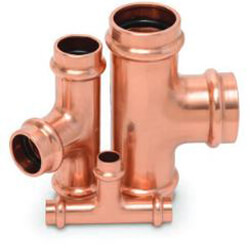
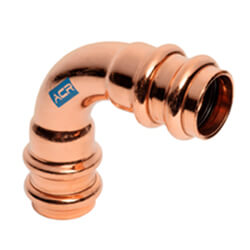


Subcategories
- Mueller Streamline ACR Copper Press Fittings: Mueller Streamline's ACR copper press fittings pair a DualSeal ring design with three points of circular crimping, giving installers a backup seal on split-system and light commercial refrigerant lines. The line covers hard-drawn copper from 1/4 inch through 1-3/8 inch, carries a design pressure of 775 psig, and operates continuously between negative 40 and 300 degrees Fahrenheit for use on R410A systems. A 10-year limited warranty backs the fittings.
- RLS Refrigerant Fittings: RLS Refrigerant Fittings give technicians a flame-free option for jobs where a hot work permit or fire watch isn't practical, since the joint forms with a press tool instead of a torch. The line is UL 207 listed to 700 psi and spans sizes from 1/4 inch up to 2-1/8 inch, covering everything from mini-split branch lines to larger commercial refrigeration runs. Crews often reach for RLS fittings on retrofit and service calls where nitrogen purging would add time to a repair.
- ZoomLock MAX Fittings: ZoomLock MAX fittings target higher-pressure and low-GWP refrigerant applications, with a maximum rated pressure of 700 psi and a minimum burst pressure of 2,100 psi under UL 207 testing. The line is compatible with R410A, R32, and CO2 (R744) systems, with a continuous operating temperature up to 250 degrees Fahrenheit and an O-ring rating down to negative 40 degrees Fahrenheit. Technicians working on CO2 racks, low-GWP retrofits, or higher-pressure commercial refrigeration systems rely on the extra pressure margin, and the fittings carry a 15-year warranty.
- ZoomLock Refrigerant Fittings: ZoomLock Refrigerant Fittings cover the everyday side of press-fit refrigerant work, joining copper lines on standard split systems, heat pumps, and light commercial equipment without a torch. The fittings use HNBR seals rated for common refrigerants such as R410A and R32, and technicians pair them with a dedicated ZoomLock jaw on their press tool for a proper crimp. They suit new installation and service work where flame-free connections speed up rooftop and attic jobs.
Buying Guide
Choosing between a press fitting and a brazed joint starts with the job site itself. Confined spaces, occupied buildings, roofs with limited fire watch access, and systems already charged with refrigerant all favor a flame-free connection. Brazing still makes sense on larger commercial runs where a contractor already has torches staged and where fitting cost per joint matters more than setup time.
Pressure rating and refrigerant compatibility should match the system before matching brand loyalty. Standard R410A and R32 residential and light commercial work fits within the 700 psi range most press fitting lines cover, but CO2 (R744) racks and other high-pressure or low-GWP refrigerant applications need a line explicitly rated and tested for that gas, such as ZoomLock MAX.
Press tool jaw compatibility narrows the decision fast. Each manufacturer pairs its fittings with a specific jaw profile, so a shop already running one brand of press tool will save time and avoid carrying multiple jaw sets by staying within that fitting line.
Size range matters on jobs that mix small branch lines with larger suction or liquid lines. Confirm the fitting line covers the full diameter range needed, from small mini-split connections up through larger commercial suction lines, so the same crimping method and inventory of fittings carries through the whole job.
Warranty length and tube prep requirements round out the decision. Longer warranties often track with more robust sealing designs, but every press fitting depends on a clean, round, properly deburred tube end and correct insertion depth. No press fitting will hold a seal on a tube that wasn't cut and prepped to the manufacturer's tolerance, regardless of brand or pressure rating.
Frequently Asked Questions
Can press fittings replace brazed joints on any refrigerant line?
Most residential and light commercial R410A and R32 lines can use press fittings in place of brazing, provided the fitting line is rated for the system's operating pressure and refrigerant. Higher pressure applications, such as CO2 (R744) systems, need a fitting specifically tested and listed for that refrigerant, like ZoomLock MAX.
Do press fittings need a different press tool for each brand?
Yes, generally. Manufacturers design their fittings around a specific jaw profile, and a jaw made for one brand typically will not seal another brand's fitting correctly. Shops that stock multiple fitting lines usually keep separate jaw sets for each.
What sizes of refrigerant copper press fittings are available?
Range varies by brand, but coverage generally spans from 1/4 inch mini-split branch lines up to 2-1/8 inch commercial suction lines, with RLS Refrigerant Fittings covering that full range and Mueller Streamline ACR fittings running from 1/4 inch through 1-3/8 inch.
How do press fittings hold up under vacuum during evacuation?
Listed fittings such as ZoomLock MAX are tested to hold vacuum levels down to 500 microns, which covers standard system evacuation targets before charging. A proper crimp and clean tube prep are what keep the seal tight during that draw down.
Is nitrogen purging still necessary when using press fittings?
Purging protects against oxidation and scale inside copper lines mainly during brazing, so flame-free press connections remove much of that need. Many crews still purge on longer runs or when a system mixes brazed and pressed joints, since any open flame elsewhere in the line still calls for it.
Resources

 --%3E %3C!DOCTYPE svg PUBLIC '-//W3C//DTD SVG 1.1//EN' 'http://www.w3.org/Graphics/SVG/1.1/DTD/svg11.dtd'%3E %3Csvg version='1.1' id='Layer_1' xmlns='http://www.w3.org/2000/svg' xmlns:xlink='http://www.w3.org/1999/xlink' x='0px' y='0px' width='90px' height='90px' viewBox='0 0 90 90' enable-background='new 0 0 90 90' xml:space='preserve'%3E %3Crect x='27' y='23' fill='%23FFFFFF' width='43' height='44'/%3E %3Cg%3E %3Cdefs%3E %3Crect id='SVGID_1_' width='90' height='90'/%3E %3C/defs%3E %3CclipPath id='SVGID_2_'%3E %3Cuse xlink:href='%23SVGID_1_' overflow='visible'/%3E %3C/clipPath%3E %3Cpath clip-path='url(%23SVGID_2_)' fill='%234186AD' d='M45,0C20.1,0,0,20.1,0,45c0,24.9,20.1,45,45,45c24.9,0,45-20.1,45-45 C90,20.1,69.9,0,45,0'/%3E %3C/g%3E %3Cpath fill='%23FFFFFF' d='M60.6,47.4l-22.5,14c-0.5,0.3-1,0.399-1.5,0.399s-0.9-0.1-1.4-0.399c-0.9-0.5-1.4-1.4-1.4-2.5v-28 c0-1,0.6-2,1.4-2.5c0.9-0.5,2-0.5,2.9,0.1l22.5,14.1C61.4,43.1,61.9,44,61.9,45S61.4,46.9,60.6,47.4'/%3E %3C/svg%3E)

Subcategories
- Mueller Streamline ACR Copper Press Fittings: Mueller Streamline's ACR copper press fittings pair a DualSeal ring design with three points of circular crimping, giving installers a backup seal on split-system and light commercial refrigerant lines. The line covers hard-drawn copper from 1/4 inch through 1-3/8 inch, carries a design pressure of 775 psig, and operates continuously between negative 40 and 300 degrees Fahrenheit for use on R410A systems. A 10-year limited warranty backs the fittings.
- RLS Refrigerant Fittings: RLS Refrigerant Fittings give technicians a flame-free option for jobs where a hot work permit or fire watch isn't practical, since the joint forms with a press tool instead of a torch. The line is UL 207 listed to 700 psi and spans sizes from 1/4 inch up to 2-1/8 inch, covering everything from mini-split branch lines to larger commercial refrigeration runs. Crews often reach for RLS fittings on retrofit and service calls where nitrogen purging would add time to a repair.
- ZoomLock MAX Fittings: ZoomLock MAX fittings target higher-pressure and low-GWP refrigerant applications, with a maximum rated pressure of 700 psi and a minimum burst pressure of 2,100 psi under UL 207 testing. The line is compatible with R410A, R32, and CO2 (R744) systems, with a continuous operating temperature up to 250 degrees Fahrenheit and an O-ring rating down to negative 40 degrees Fahrenheit. Technicians working on CO2 racks, low-GWP retrofits, or higher-pressure commercial refrigeration systems rely on the extra pressure margin, and the fittings carry a 15-year warranty.
- ZoomLock Refrigerant Fittings: ZoomLock Refrigerant Fittings cover the everyday side of press-fit refrigerant work, joining copper lines on standard split systems, heat pumps, and light commercial equipment without a torch. The fittings use HNBR seals rated for common refrigerants such as R410A and R32, and technicians pair them with a dedicated ZoomLock jaw on their press tool for a proper crimp. They suit new installation and service work where flame-free connections speed up rooftop and attic jobs.
Buying Guide
Choosing between a press fitting and a brazed joint starts with the job site itself. Confined spaces, occupied buildings, roofs with limited fire watch access, and systems already charged with refrigerant all favor a flame-free connection. Brazing still makes sense on larger commercial runs where a contractor already has torches staged and where fitting cost per joint matters more than setup time.
Pressure rating and refrigerant compatibility should match the system before matching brand loyalty. Standard R410A and R32 residential and light commercial work fits within the 700 psi range most press fitting lines cover, but CO2 (R744) racks and other high-pressure or low-GWP refrigerant applications need a line explicitly rated and tested for that gas, such as ZoomLock MAX.
Press tool jaw compatibility narrows the decision fast. Each manufacturer pairs its fittings with a specific jaw profile, so a shop already running one brand of press tool will save time and avoid carrying multiple jaw sets by staying within that fitting line.
Size range matters on jobs that mix small branch lines with larger suction or liquid lines. Confirm the fitting line covers the full diameter range needed, from small mini-split connections up through larger commercial suction lines, so the same crimping method and inventory of fittings carries through the whole job.
Warranty length and tube prep requirements round out the decision. Longer warranties often track with more robust sealing designs, but every press fitting depends on a clean, round, properly deburred tube end and correct insertion depth. No press fitting will hold a seal on a tube that wasn't cut and prepped to the manufacturer's tolerance, regardless of brand or pressure rating.
Frequently Asked Questions
Can press fittings replace brazed joints on any refrigerant line?
Most residential and light commercial R410A and R32 lines can use press fittings in place of brazing, provided the fitting line is rated for the system's operating pressure and refrigerant. Higher pressure applications, such as CO2 (R744) systems, need a fitting specifically tested and listed for that refrigerant, like ZoomLock MAX.
Do press fittings need a different press tool for each brand?
Yes, generally. Manufacturers design their fittings around a specific jaw profile, and a jaw made for one brand typically will not seal another brand's fitting correctly. Shops that stock multiple fitting lines usually keep separate jaw sets for each.
What sizes of refrigerant copper press fittings are available?
Range varies by brand, but coverage generally spans from 1/4 inch mini-split branch lines up to 2-1/8 inch commercial suction lines, with RLS Refrigerant Fittings covering that full range and Mueller Streamline ACR fittings running from 1/4 inch through 1-3/8 inch.
How do press fittings hold up under vacuum during evacuation?
Listed fittings such as ZoomLock MAX are tested to hold vacuum levels down to 500 microns, which covers standard system evacuation targets before charging. A proper crimp and clean tube prep are what keep the seal tight during that draw down.
Is nitrogen purging still necessary when using press fittings?
Purging protects against oxidation and scale inside copper lines mainly during brazing, so flame-free press connections remove much of that need. Many crews still purge on longer runs or when a system mixes brazed and pressed joints, since any open flame elsewhere in the line still calls for it.