




PEX Manifolds & Water Manifold Systems
PEX Manifolds are the central distribution points that split a single water supply line into multiple individual runs, each feeding one fixture or zone. Instead of running pipe from fixture to fixture in a series, a home-run plumbing layout routes a dedicated line from the manifold to every sink, tub, and appliance. This simplifies shutoffs and troubleshooting later. This layout has become common in both new construction and radiant heating installations because it isolates problems to a single line rather than an entire branch.
Manifolds come in different configurations built around how the water lines connect, whether by crimp ring, push-fit, or press connection, and how many outlets each unit has. Choosing the right manifold means matching its connection type to the PEX tubing and fittings already specified for the job. The number of outlets should also match the fixtures and zones the layout needs to serve.


Subcategories
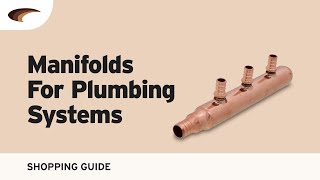
- Copper Sweat Manifolds: Copper sweat manifolds use soldered copper connections on the trunk side, making them a fit for installations where the rest of the water distribution system is copper. Individual PEX branch lines connect through valved or plain outlets on the manifold body. Soldering skill and torch access at the installation point are required, unlike crimp or push-fit designs.
- Copper Vent and Purge Manifolds: These manifolds are built for radiant heating and hydronic systems, combining air venting and system purging functions into a single fitting at the manifold. They let installers bleed air and flush debris from a loop without disconnecting individual lines. Copper construction matches the rest of a sweat-connected hydronic system.
- Crimp Style Manifolds: Crimp style manifolds connect to PEX tubing using copper crimp rings and a crimping tool, matching the most common PEX-A and PEX-B connection method used in home-run plumbing. Each outlet is sized to the tubing diameter it feeds. This style has a long track record and works with widely available crimping tools.
- PEX Press Plastic Manifolds: PEX press plastic manifolds use a press-fit connection method and a lightweight plastic body, offering a lower-weight alternative to metal manifolds for standard water distribution runs. Press connections require a press tool sized to the fitting, similar to press fittings used elsewhere in the system. Plastic construction resists corrosion compared to metal alternatives.
- ProPEX Style Manifolds: ProPEX style manifolds use an expansion-style connection, where the tubing is stretched over a fitting and allowed to contract back into place, creating a connection without crimping or soldering. This connection method is specific to compatible PEX-A tubing and expansion tools. Installers already using expansion fittings elsewhere in a project often standardize on this manifold style.
- Push-Fit Manifolds: Push-fit manifolds connect to tubing with a simple push-to-connect fitting, requiring no crimping, soldering, or specialized tool beyond a proper tubing cut. This makes them useful for repair work or tight spaces where running a crimp or press tool isn't practical. Push-fit connections can typically be released and reused with a disconnect tool if a line needs to be moved.
Buying Guide
Connection type is the first decision when selecting a PEX manifold. The manifold's connection method has to match both the tubing type already specified and the tools on hand. Crimp, press, expansion, and push-fit systems aren't interchangeable, so confirming the tubing type before ordering a manifold avoids a mismatched purchase.
Outlet count needs to match the number of fixtures or zones the manifold will serve, with some room built in if a layout might expand later. Manifolds are available with a range of outlet counts. Choosing one with too few outlets means adding a second manifold or a tee downstream, which adds complexity to the layout.
Valved outlets add the ability to shut off an individual line without affecting the rest of the system, which is useful for repairs and fixture replacement. PEX Manifolds without valved outlets cost less but require shutting down the whole manifold, or the main supply, to isolate a single line.
Material selection affects both compatibility and job conditions. Copper manifolds fit naturally into a copper-based system. They hold up well in radiant heating loops that run hot water continuously. Plastic and push-fit manifolds suit standard cold and hot water distribution where a lighter, corrosion-resistant option is preferred.
Mounting and space constraints matter in tight mechanical closets or stacked installations. A manifold's physical footprint, including outlet spacing and overall length, should be checked against the available mounting space before the rest of the plumbing is roughed in around it.
Frequently Asked Questions
What is a home-run PEX plumbing layout?
A home-run layout routes an individual PEX line from a central manifold to each fixture, rather than branching pipe from fixture to fixture. This isolates each line so a leak or repair only affects one fixture instead of a whole branch. Manifolds are the central point where all of these individual lines originate.
Can different PEX connection types be mixed on the same manifold?
A manifold is built around one connection method, such as crimp, press, or push-fit. Mixing types generally means adding a transition fitting rather than connecting tubing directly to an incompatible manifold outlet. Matching tubing and manifold connection type from the start avoids needing extra fittings.
Do all manifold outlets need individual shutoff valves?
Valved outlets aren't required for a manifold to function, but they allow shutting off a single fixture line without affecting the rest of the system. Manifolds without valves need the whole manifold or main supply shut off to isolate one line. Choosing valved outlets is a matter of how much individual control the layout needs.
Are copper or plastic manifolds better for radiant heat systems?
Copper manifolds are common in radiant heat and hydronic systems. They handle continuous hot water circulation well. They often include integrated air venting and purging ports. Plastic manifolds are more common in standard potable water distribution. The choice usually follows the rest of the system's material and connection type.
How many outlets should a PEX manifold have?
Outlet count should match the number of individual fixture or zone lines the layout needs to serve, with a small amount of room for future additions if practical. Manifolds are available in a range of outlet counts to fit different size homes and systems. Undersizing the outlet count typically means adding a second manifold later.
Resources
 --%3E %3C!DOCTYPE svg PUBLIC '-//W3C//DTD SVG 1.1//EN' 'http://www.w3.org/Graphics/SVG/1.1/DTD/svg11.dtd'%3E %3Csvg version='1.1' id='Layer_1' xmlns='http://www.w3.org/2000/svg' xmlns:xlink='http://www.w3.org/1999/xlink' x='0px' y='0px' width='90px' height='90px' viewBox='0 0 90 90' enable-background='new 0 0 90 90' xml:space='preserve'%3E %3Crect x='27' y='23' fill='%23FFFFFF' width='43' height='44'/%3E %3Cg%3E %3Cdefs%3E %3Crect id='SVGID_1_' width='90' height='90'/%3E %3C/defs%3E %3CclipPath id='SVGID_2_'%3E %3Cuse xlink:href='%23SVGID_1_' overflow='visible'/%3E %3C/clipPath%3E %3Cpath clip-path='url(%23SVGID_2_)' fill='%234186AD' d='M45,0C20.1,0,0,20.1,0,45c0,24.9,20.1,45,45,45c24.9,0,45-20.1,45-45 C90,20.1,69.9,0,45,0'/%3E %3C/g%3E %3Cpath fill='%23FFFFFF' d='M60.6,47.4l-22.5,14c-0.5,0.3-1,0.399-1.5,0.399s-0.9-0.1-1.4-0.399c-0.9-0.5-1.4-1.4-1.4-2.5v-28 c0-1,0.6-2,1.4-2.5c0.9-0.5,2-0.5,2.9,0.1l22.5,14.1C61.4,43.1,61.9,44,61.9,45S61.4,46.9,60.6,47.4'/%3E %3C/svg%3E)
Subcategories
- Copper Sweat Manifolds: Copper sweat manifolds use soldered copper connections on the trunk side, making them a fit for installations where the rest of the water distribution system is copper. Individual PEX branch lines connect through valved or plain outlets on the manifold body. Soldering skill and torch access at the installation point are required, unlike crimp or push-fit designs.
- Copper Vent and Purge Manifolds: These manifolds are built for radiant heating and hydronic systems, combining air venting and system purging functions into a single fitting at the manifold. They let installers bleed air and flush debris from a loop without disconnecting individual lines. Copper construction matches the rest of a sweat-connected hydronic system.
- Crimp Style Manifolds: Crimp style manifolds connect to PEX tubing using copper crimp rings and a crimping tool, matching the most common PEX-A and PEX-B connection method used in home-run plumbing. Each outlet is sized to the tubing diameter it feeds. This style has a long track record and works with widely available crimping tools.
- PEX Press Plastic Manifolds: PEX press plastic manifolds use a press-fit connection method and a lightweight plastic body, offering a lower-weight alternative to metal manifolds for standard water distribution runs. Press connections require a press tool sized to the fitting, similar to press fittings used elsewhere in the system. Plastic construction resists corrosion compared to metal alternatives.
- ProPEX Style Manifolds: ProPEX style manifolds use an expansion-style connection, where the tubing is stretched over a fitting and allowed to contract back into place, creating a connection without crimping or soldering. This connection method is specific to compatible PEX-A tubing and expansion tools. Installers already using expansion fittings elsewhere in a project often standardize on this manifold style.
- Push-Fit Manifolds: Push-fit manifolds connect to tubing with a simple push-to-connect fitting, requiring no crimping, soldering, or specialized tool beyond a proper tubing cut. This makes them useful for repair work or tight spaces where running a crimp or press tool isn't practical. Push-fit connections can typically be released and reused with a disconnect tool if a line needs to be moved.
Buying Guide
Connection type is the first decision when selecting a PEX manifold. The manifold's connection method has to match both the tubing type already specified and the tools on hand. Crimp, press, expansion, and push-fit systems aren't interchangeable, so confirming the tubing type before ordering a manifold avoids a mismatched purchase.
Outlet count needs to match the number of fixtures or zones the manifold will serve, with some room built in if a layout might expand later. Manifolds are available with a range of outlet counts. Choosing one with too few outlets means adding a second manifold or a tee downstream, which adds complexity to the layout.
Valved outlets add the ability to shut off an individual line without affecting the rest of the system, which is useful for repairs and fixture replacement. PEX Manifolds without valved outlets cost less but require shutting down the whole manifold, or the main supply, to isolate a single line.
Material selection affects both compatibility and job conditions. Copper manifolds fit naturally into a copper-based system. They hold up well in radiant heating loops that run hot water continuously. Plastic and push-fit manifolds suit standard cold and hot water distribution where a lighter, corrosion-resistant option is preferred.
Mounting and space constraints matter in tight mechanical closets or stacked installations. A manifold's physical footprint, including outlet spacing and overall length, should be checked against the available mounting space before the rest of the plumbing is roughed in around it.
Frequently Asked Questions
What is a home-run PEX plumbing layout?
A home-run layout routes an individual PEX line from a central manifold to each fixture, rather than branching pipe from fixture to fixture. This isolates each line so a leak or repair only affects one fixture instead of a whole branch. Manifolds are the central point where all of these individual lines originate.
Can different PEX connection types be mixed on the same manifold?
A manifold is built around one connection method, such as crimp, press, or push-fit. Mixing types generally means adding a transition fitting rather than connecting tubing directly to an incompatible manifold outlet. Matching tubing and manifold connection type from the start avoids needing extra fittings.
Do all manifold outlets need individual shutoff valves?
Valved outlets aren't required for a manifold to function, but they allow shutting off a single fixture line without affecting the rest of the system. Manifolds without valves need the whole manifold or main supply shut off to isolate one line. Choosing valved outlets is a matter of how much individual control the layout needs.
Are copper or plastic manifolds better for radiant heat systems?
Copper manifolds are common in radiant heat and hydronic systems. They handle continuous hot water circulation well. They often include integrated air venting and purging ports. Plastic manifolds are more common in standard potable water distribution. The choice usually follows the rest of the system's material and connection type.
How many outlets should a PEX manifold have?
Outlet count should match the number of individual fixture or zone lines the layout needs to serve, with a small amount of room for future additions if practical. Manifolds are available in a range of outlet counts to fit different size homes and systems. Undersizing the outlet count typically means adding a second manifold later.