



ProPEX Style Manifolds
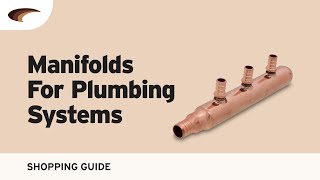
ProPEX style manifolds distribute water to multiple PEX-A branch lines using Uponor's expansion connection method, covering copper-bodied manifolds along with engineered polymer options from Uponor and Webstone. Multi-port manifold tees let installers add branch connections directly into a larger supply line.
Choosing between a copper and polymer-bodied manifold often comes down to budget and whether the installation calls for the corrosion resistance copper provides. Valved manifolds add individual shutoffs at each port, letting a plumber isolate one zone or fixture without shutting down the whole system.

Subcategories
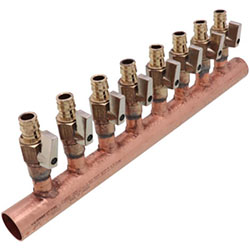
- ProPEX Copper Manifolds: ProPEX copper manifolds use type L copper with ProPEX outlets on each branch, often paired with a soldered ball valve for isolating individual loops without draining the whole manifold. Radiant floor and hydronic installers reach for these where copper's added durability is worth the higher material cost compared to plastic or EP manifolds.
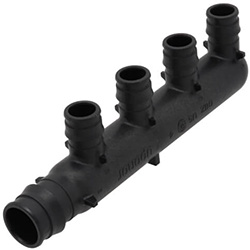
- Uponor EP Multi-Port Manifold Tees: EP multi-port manifold tees connect multiple PEX branch lines off a single trunk line using the same ProPEX expansion connection as the rest of an Uponor system, without the added cost of a full valved manifold body. Installers use these on smaller distribution runs or tight mechanical rooms where a compact tee-style layout fits better than a full manifold station.
- Uponor EP Valved Manifolds: EP valved manifolds use engineered polymer bodies with ProPEX outlets ranging from 3/8 inch through 3/4 inch, giving each branch its own valve for isolating or shutting down a single loop for repair. They work as a lower-cost alternative to copper valved manifolds where individual loop shutoff is still needed.
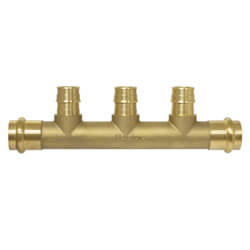
- Webstone Expansion PEX Multi-Port Manifold Tees: Webstone's expansion PEX manifold tees use F1960-style cold-expansion connections compatible with PEX-A tubing from manufacturers including Uponor and Rehau, offered with or without integral shutoff valves on each port. Plumbers reach for these when standardizing a manifold brand across a job that mixes PEX-A tubing from more than one manufacturer.
Buying Guide
Deciding between valved and valveless comes first. Valved manifolds let a tech isolate a single loop for repair or balancing without draining the whole system, which is worth the added cost on larger radiant jobs with many loops.
Material choice matters beyond upfront cost. Copper manifolds hold up well in mechanical rooms with more physical traffic, while engineered polymer manifolds cost less and handle mineral buildup differently than metal bodies.
Port count and spacing should account for every branch circuit needed at a mechanical room location, plus a couple of spare ports, since adding a second manifold later is more disruptive than sizing correctly the first time.
Compatibility across brands needs a check before ordering. The manifold's ProPEX or F1960-style connection has to match the PEX-A tubing brand already run in the walls or slab, since expansion connections from different manufacturers aren't always interchangeable without the matching expansion tool and fitting.
Tee-style fittings work for a handful of branches off a trunk line, while a full valved manifold station makes more sense as a central distribution point for a whole radiant zone or multi-fixture group.
Frequently Asked Questions
What's the difference between a valved and valveless ProPEX manifold?
Valved manifolds have a shutoff or balancing valve on each branch so a single loop can be isolated for repair, while valveless manifolds route all branches off one trunk without individual shutoff.
Can a Webstone expansion manifold be used with Uponor PEX-A tubing?
Yes. Webstone's expansion manifold tees use F1960-style cold-expansion connections compatible with PEX-A tubing from manufacturers including Uponor and Rehau.
Why choose a copper ProPEX manifold over an EP manifold?
Copper holds up well in mechanical rooms with more physical traffic and wear, while EP manifolds cost less and work fine on radiant jobs where that added durability matters less.
What sizes do Uponor EP valved manifolds come in?
EP valved manifolds come with ProPEX outlets ranging from 3/8 inch through 3/4 inch to match different tubing sizes used across a radiant or plumbing distribution system.
How many loops can one manifold handle before a second one is needed?
It depends on the manifold's port count, so counting branch circuits at each mechanical location before ordering, with a couple of spare ports, avoids having to add a second manifold station later.
Resources
 --%3E %3C!DOCTYPE svg PUBLIC '-//W3C//DTD SVG 1.1//EN' 'http://www.w3.org/Graphics/SVG/1.1/DTD/svg11.dtd'%3E %3Csvg version='1.1' id='Layer_1' xmlns='http://www.w3.org/2000/svg' xmlns:xlink='http://www.w3.org/1999/xlink' x='0px' y='0px' width='90px' height='90px' viewBox='0 0 90 90' enable-background='new 0 0 90 90' xml:space='preserve'%3E %3Crect x='27' y='23' fill='%23FFFFFF' width='43' height='44'/%3E %3Cg%3E %3Cdefs%3E %3Crect id='SVGID_1_' width='90' height='90'/%3E %3C/defs%3E %3CclipPath id='SVGID_2_'%3E %3Cuse xlink:href='%23SVGID_1_' overflow='visible'/%3E %3C/clipPath%3E %3Cpath clip-path='url(%23SVGID_2_)' fill='%234186AD' d='M45,0C20.1,0,0,20.1,0,45c0,24.9,20.1,45,45,45c24.9,0,45-20.1,45-45 C90,20.1,69.9,0,45,0'/%3E %3C/g%3E %3Cpath fill='%23FFFFFF' d='M60.6,47.4l-22.5,14c-0.5,0.3-1,0.399-1.5,0.399s-0.9-0.1-1.4-0.399c-0.9-0.5-1.4-1.4-1.4-2.5v-28 c0-1,0.6-2,1.4-2.5c0.9-0.5,2-0.5,2.9,0.1l22.5,14.1C61.4,43.1,61.9,44,61.9,45S61.4,46.9,60.6,47.4'/%3E %3C/svg%3E)
Subcategories
- ProPEX Copper Manifolds: ProPEX copper manifolds use type L copper with ProPEX outlets on each branch, often paired with a soldered ball valve for isolating individual loops without draining the whole manifold. Radiant floor and hydronic installers reach for these where copper's added durability is worth the higher material cost compared to plastic or EP manifolds.
- Uponor EP Multi-Port Manifold Tees: EP multi-port manifold tees connect multiple PEX branch lines off a single trunk line using the same ProPEX expansion connection as the rest of an Uponor system, without the added cost of a full valved manifold body. Installers use these on smaller distribution runs or tight mechanical rooms where a compact tee-style layout fits better than a full manifold station.
- Uponor EP Valved Manifolds: EP valved manifolds use engineered polymer bodies with ProPEX outlets ranging from 3/8 inch through 3/4 inch, giving each branch its own valve for isolating or shutting down a single loop for repair. They work as a lower-cost alternative to copper valved manifolds where individual loop shutoff is still needed.
- Webstone Expansion PEX Multi-Port Manifold Tees: Webstone's expansion PEX manifold tees use F1960-style cold-expansion connections compatible with PEX-A tubing from manufacturers including Uponor and Rehau, offered with or without integral shutoff valves on each port. Plumbers reach for these when standardizing a manifold brand across a job that mixes PEX-A tubing from more than one manufacturer.
Buying Guide
Deciding between valved and valveless comes first. Valved manifolds let a tech isolate a single loop for repair or balancing without draining the whole system, which is worth the added cost on larger radiant jobs with many loops.
Material choice matters beyond upfront cost. Copper manifolds hold up well in mechanical rooms with more physical traffic, while engineered polymer manifolds cost less and handle mineral buildup differently than metal bodies.
Port count and spacing should account for every branch circuit needed at a mechanical room location, plus a couple of spare ports, since adding a second manifold later is more disruptive than sizing correctly the first time.
Compatibility across brands needs a check before ordering. The manifold's ProPEX or F1960-style connection has to match the PEX-A tubing brand already run in the walls or slab, since expansion connections from different manufacturers aren't always interchangeable without the matching expansion tool and fitting.
Tee-style fittings work for a handful of branches off a trunk line, while a full valved manifold station makes more sense as a central distribution point for a whole radiant zone or multi-fixture group.
Frequently Asked Questions
What's the difference between a valved and valveless ProPEX manifold?
Valved manifolds have a shutoff or balancing valve on each branch so a single loop can be isolated for repair, while valveless manifolds route all branches off one trunk without individual shutoff.
Can a Webstone expansion manifold be used with Uponor PEX-A tubing?
Yes. Webstone's expansion manifold tees use F1960-style cold-expansion connections compatible with PEX-A tubing from manufacturers including Uponor and Rehau.
Why choose a copper ProPEX manifold over an EP manifold?
Copper holds up well in mechanical rooms with more physical traffic and wear, while EP manifolds cost less and work fine on radiant jobs where that added durability matters less.
What sizes do Uponor EP valved manifolds come in?
EP valved manifolds come with ProPEX outlets ranging from 3/8 inch through 3/4 inch to match different tubing sizes used across a radiant or plumbing distribution system.
How many loops can one manifold handle before a second one is needed?
It depends on the manifold's port count, so counting branch circuits at each mechanical location before ordering, with a couple of spare ports, avoids having to add a second manifold station later.