




Filters
SORT
Product Availability –
Size –
Review Score –
 --%3E %3Csvg version='1.1' id='Fill' xmlns='http://www.w3.org/2000/svg' xmlns:xlink='http://www.w3.org/1999/xlink' x='0px' y='0px' viewBox='0 0 100 100' enable-background='new 0 0 100 100' xml:space='preserve'%3E %3Cpath fill='%23F15C02' d='M79.44,0.95H20.56C9.78,0.95,0.95,9.78,0.95,20.56v58.87c0,10.79,8.82,19.61,19.61,19.61h58.87 c10.79,0,19.61-8.83,19.61-19.61V20.56C99.05,9.78,90.22,0.95,79.44,0.95z M65.38,58.24l9.38,29.58L49.69,69.78L24.5,87.82 l9.34-29.6L8.8,39.6l30.73-0.17c0,0,6.98-19.61,10-28.93c0.54,1.36,9.88,29.1,9.88,29.1H91.2L65.38,58.24z'/%3E %3C/svg%3E)
Price Range –
PVC Schedule 40 Eccentric Reducer Couplings

 --%3E %3Csvg version='1.1' id='No-RB' xmlns='http://www.w3.org/2000/svg' xmlns:xlink='http://www.w3.org/1999/xlink' x='0px' y='0px' viewBox='0 0 100 100' enable-background='new 0 0 100 100' xml:space='preserve'%3E %3Cpath fill='%23CECECE' d='M79.44,0.95H20.56C9.78,0.95,0.95,9.78,0.95,20.56v58.87c0,10.79,8.82,19.61,19.61,19.61h58.87 c10.79,0,19.61-8.83,19.61-19.61V20.56C99.05,9.78,90.22,0.95,79.44,0.95z M65.38,58.24l9.38,29.58L49.69,69.78L24.5,87.82 l9.34-29.6L8.8,39.6l30.73-0.17c0,0,6.98-19.61,10-28.93c0.54,1.36,9.88,29.1,9.88,29.1H91.2L65.38,58.24z'/%3E %3C/svg%3E)

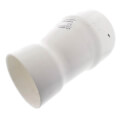
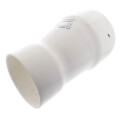
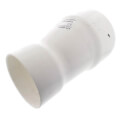
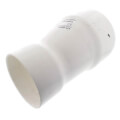
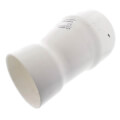
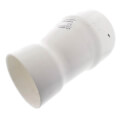
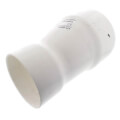
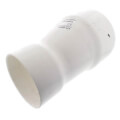
PVC Schedule 40 Eccentric Reducer Couplings are drainage fittings that step down pipe from one diameter to a smaller one while keeping the top or bottom of the pipe run level instead of centering both openings. Offsetting the reduction to one side keeps waste and water flowing along a consistent slope rather than pooling at a sudden step change, which matters most on horizontal DWV runs where a concentric reducer would create a low spot that traps solids. Made from Schedule 40 PVC, these couplings carry the same pressure and chemical resistance as standard Schedule 40 pipe and fittings, and they solvent-weld into place with standard PVC cement. Plumbers reach for an eccentric reducer specifically when stepping down a drain line size mid-run, where a standard concentric reducer would introduce an unwanted trap point in the line.
Subcategories
- Hub x Hub Eccentric Reducer Couplings: Both ends are bell-shaped hubs sized to receive the two different pipe diameters. Common where two lengths of pipe need to be joined mid-run without a spigot end available on either side. Both joints solvent-weld with standard PVC cement.
- Hub x Spigot Eccentric Reducer Couplings: One hub end and one plain spigot end, used to step down at the end of a run or to connect directly into the hub of the next fitting downstream. Cuts the connection to a single solvent-weld joint on the discharge side. Common on branch drain terminations.
- Small Diameter Reducers (2 to 3 Inch): Cover the tightest step-downs typically found on fixture branch lines and secondary drain runs. The most common size jump seen in residential remodels and fixture rough-ins. Stocked in both hub x hub and hub x spigot configurations.
- Large Diameter Reducers (4 Inch and Up): Handle bigger drops in main drain and vent stacks, common in commercial and multi-family DWV systems where a building drain steps down to a smaller branch. Same offset design as smaller sizes, scaled up for larger pipe runs.
Buying Guide
Picking the right reducer starts with confirming both pipe diameters on either side of the transition, since a coupling sized for the wrong upstream or downstream diameter won't seat properly for a solvent weld. PVC Schedule 40 Eccentric Reducer Couplings are built specifically for drainage applications where keeping the pipe's top or bottom flush matters more than centering the flow path, so an eccentric fitting is the right call any time a horizontal run steps down in size and a low spot needs to be avoided. A concentric reducer, by contrast, centers both openings and works fine on vertical runs or pressure lines where gravity flow and solids buildup aren't a concern, but using one on a horizontal drain line risks creating a trap point that collects debris over time. Connection type is the next decision: hub x hub couplings join two pipe ends mid-run, while hub x spigot couplings are a better fit at the end of a branch line where the fitting connects straight into the next component's hub. Schedule 40 wall thickness and standard PVC cement compatibility mean these couplings install the same way as any other DWV fitting on the job, with no special primer or technique required beyond standard solvent-weld practice. Because orientation matters with an eccentric fitting, it's worth double-checking that the flat side lines up correctly with the pipe run's slope before the joint is cemented, since a fitting installed upside down defeats the purpose of the offset design entirely.
Frequently Asked Questions
When should an eccentric reducer be used instead of a concentric one?
An eccentric reducer belongs on horizontal drain runs where keeping the pipe's top or bottom level matters, while a concentric reducer, which centers both openings, works fine on vertical runs or pressure lines.
Does orientation matter when installing an eccentric reducer coupling?
Yes, the flat side of the offset needs to line up with the pipe run's slope, and installing the fitting upside down creates the same low spot the fitting was meant to avoid.
What's the difference between hub x hub and hub x spigot versions?
A hub x hub coupling has two bell-shaped ends for joining pipe mid-run, while a hub x spigot coupling has one hub and one plain end for connecting directly into the next fitting's hub.
Can these couplings be used on pressure piping instead of drainage?
They're built for DWV drainage applications where flow relies on gravity and slope rather than pressure, so a pressure-rated reducer fitting is the better choice for supply or force-main lines.
What cement is needed to install a Schedule 40 PVC reducer coupling?
Standard PVC solvent cement rated for Schedule 40 pipe and fittings works for both joints, with no special primer or adhesive required beyond normal solvent-weld practice.
