




Filters
SORT
Product Availability –
Brand –
Size –
Review Score –
 --%3E %3Csvg version='1.1' id='Fill' xmlns='http://www.w3.org/2000/svg' xmlns:xlink='http://www.w3.org/1999/xlink' x='0px' y='0px' viewBox='0 0 100 100' enable-background='new 0 0 100 100' xml:space='preserve'%3E %3Cpath fill='%23F15C02' d='M79.44,0.95H20.56C9.78,0.95,0.95,9.78,0.95,20.56v58.87c0,10.79,8.82,19.61,19.61,19.61h58.87 c10.79,0,19.61-8.83,19.61-19.61V20.56C99.05,9.78,90.22,0.95,79.44,0.95z M65.38,58.24l9.38,29.58L49.69,69.78L24.5,87.82 l9.34-29.6L8.8,39.6l30.73-0.17c0,0,6.98-19.61,10-28.93c0.54,1.36,9.88,29.1,9.88,29.1H91.2L65.38,58.24z'/%3E %3C/svg%3E)
Price Range –
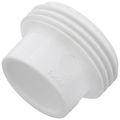
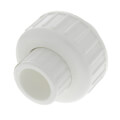
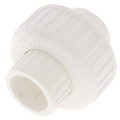
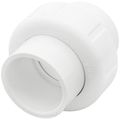
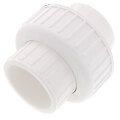
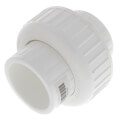
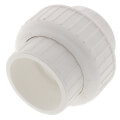
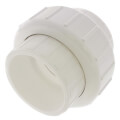
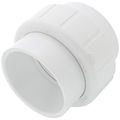
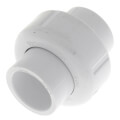
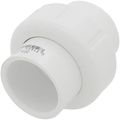
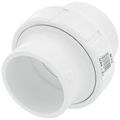
PVC Sch 40 Unions (Socket)








 --%3E %3Csvg version='1.1' id='No-RB' xmlns='http://www.w3.org/2000/svg' xmlns:xlink='http://www.w3.org/1999/xlink' x='0px' y='0px' viewBox='0 0 100 100' enable-background='new 0 0 100 100' xml:space='preserve'%3E %3Cpath fill='%23CECECE' d='M79.44,0.95H20.56C9.78,0.95,0.95,9.78,0.95,20.56v58.87c0,10.79,8.82,19.61,19.61,19.61h58.87 c10.79,0,19.61-8.83,19.61-19.61V20.56C99.05,9.78,90.22,0.95,79.44,0.95z M65.38,58.24l9.38,29.58L49.69,69.78L24.5,87.82 l9.34-29.6L8.8,39.6l30.73-0.17c0,0,6.98-19.61,10-28.93c0.54,1.36,9.88,29.1,9.88,29.1H91.2L65.38,58.24z'/%3E %3C/svg%3E)
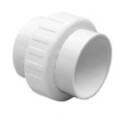
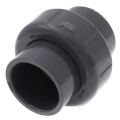
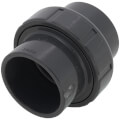

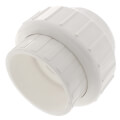
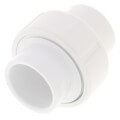
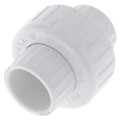
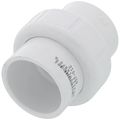
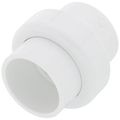
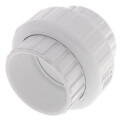
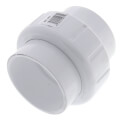
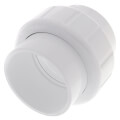
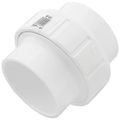
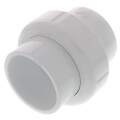
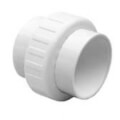
PVC Sch 40 Unions (Socket) are three-piece fittings that let a technician disconnect a section of PVC pipe for service without cutting into solvent-welded joints on either side. Spears manufactures its socket unions to a working pressure rating of 150 psi at 73 degrees Fahrenheit, with socket ends sized to match standard Schedule 40 pipe from 1/2 inch through 2 inches. Each union relies on either an EPDM or Buna-N O-ring seal between the two body halves, held together by a threaded ring nut, so the joint can be broken and resealed repeatedly without replacing the fitting. Plumbers install socket unions on either side of pumps, filters, valves, and other components that eventually need removal for repair or replacement. Skipping a union at those points means cutting the pipe every time that component needs service, which adds labor and material cost to what should be routine maintenance.
Subcategories
- EPDM O-Ring Socket Unions: Standard PVC Sch 40 socket unions use an EPDM O-ring seal between the two body halves, rated by Spears to 150 psi at 73 degrees Fahrenheit. Sizes run from 1/2 inch through 1-1/2 inch socket, matching common residential and light commercial PVC pipe runs. Plumbers solvent-weld each end of the union onto the pipe run, then use the threaded ring nut to draw the two halves together against the O-ring. EPDM performs well across a wide temperature range, making it the common default for potable water and general plumbing lines.
- Buna-N O-Ring Socket Unions: Buna-N socket unions use the same three-piece body and threaded ring nut design as EPDM versions but substitute a Buna-N O-ring for the seal. Spears offers this series in sizes including 1-1/4 inch socket, matching the same Schedule 40 pipe dimensions as its EPDM counterpart. Buna-N resists oils and fuels better than EPDM, making it a better fit on lines that may carry fuel oil or other petroleum-based fluids. Solvent-weld installation and pressure rating stay consistent with the EPDM series.
- Large-Diameter Socket Unions (2 Inch): Large-diameter socket unions extend the same three-piece union design up to a 2-inch socket size, covering larger PVC pipe runs than the standard 1/2 to 1-1/2 inch range. Spears' 457-020 model uses a Buna-N O-ring seal at the 2-inch size, matching the smaller union's threaded ring nut and solvent-weld socket ends. Contractors specify 2-inch unions on larger service lines, pump discharge piping, or filtration systems where a bigger pipe diameter still needs a serviceable disconnect point. Installation and disassembly work the same as smaller sizes, just with a larger body and ring nut.
Buying Guide
Sizing a socket union starts with matching it to the existing pipe run rather than picking a size independently, since PVC Sch 40 Unions (Socket) only seal correctly when the union's socket opening matches the outside diameter of Schedule 40 pipe already installed on both sides of the joint. Seal material comes next. EPDM O-rings handle general potable water and plumbing lines across a wide temperature range, while Buna-N O-rings hold up better on lines that may see oil or fuel contact, so checking what the line actually carries narrows the choice between the two. Pressure rating matters on any pressurized line, since Spears rates its socket unions to 150 psi at 73 degrees Fahrenheit, with that rating dropping as fluid temperature climbs toward the 140 degree limit for PVC pressure fittings generally. Placement planning deserves attention before solvent welding anything into place, since a union installed on both sides of a pump, filter, or valve allows that component to come out later without cutting the pipe, while skipping the union at those points turns routine maintenance into a repiping job. Diameter range is the final check on larger service lines, since standard sizes cover 1/2 inch through 1-1/2 inch while a 2-inch option exists for bigger runs. Working through pipe match, seal material, pressure rating, and placement in that order keeps a union selection straightforward before solvent welding begins.
Frequently Asked Questions
What's the pressure rating on a PVC Sch 40 socket union?
Spears rates its Schedule 40 PVC socket unions to 150 psi at 73 degrees Fahrenheit. That rating drops as fluid temperature rises, consistent with the 140 degree Fahrenheit general limit for PVC pressure fittings.
What's the difference between an EPDM and a Buna-N O-ring union?
EPDM O-ring unions suit general potable water and plumbing lines across a wide temperature range. Buna-N O-ring unions resist oil and fuel contact better, making them the better choice on lines that might carry petroleum-based fluids.
Where should a socket union get installed in a PVC pipe run?
Socket unions typically install on both sides of pumps, filters, valves, or other components that eventually need removal for service. Placing a union at those points allows disconnection without cutting into solvent-welded pipe later.
What sizes do PVC Sch 40 socket unions come in?
Standard socket unions cover 1/2 inch through 1-1/2 inch, with a 2-inch option available for larger service lines. Matching the union's socket size to the existing pipe's outside diameter keeps the solvent-weld joint sealing correctly.
Can a PVC socket union be taken apart and reused?
The three-piece union design, held together by a threaded ring nut around an O-ring seal, allows the joint to be broken and resealed repeatedly without replacing the fitting. Regular inspection of the O-ring for wear keeps the seal reliable after repeated disassembly.
