




Filters
SORT
Product Availability –
Brand –
Review Score –
 --%3E %3Csvg version='1.1' id='Fill' xmlns='http://www.w3.org/2000/svg' xmlns:xlink='http://www.w3.org/1999/xlink' x='0px' y='0px' viewBox='0 0 100 100' enable-background='new 0 0 100 100' xml:space='preserve'%3E %3Cpath fill='%23F15C02' d='M79.44,0.95H20.56C9.78,0.95,0.95,9.78,0.95,20.56v58.87c0,10.79,8.82,19.61,19.61,19.61h58.87 c10.79,0,19.61-8.83,19.61-19.61V20.56C99.05,9.78,90.22,0.95,79.44,0.95z M65.38,58.24l9.38,29.58L49.69,69.78L24.5,87.82 l9.34-29.6L8.8,39.6l30.73-0.17c0,0,6.98-19.61,10-28.93c0.54,1.36,9.88,29.1,9.88,29.1H91.2L65.38,58.24z'/%3E %3C/svg%3E)
 --%3E %3Csvg version='1.1' id='With-RB' xmlns='http://www.w3.org/2000/svg' xmlns:xlink='http://www.w3.org/1999/xlink' x='0px' y='0px' viewBox='0 0 100 100' enable-background='new 0 0 100 100' xml:space='preserve'%3E %3Cpath fill='%23FBC8B4' d='M79.44,0.95H20.56C9.78,0.95,0.95,9.78,0.95,20.56v58.87c0,10.79,8.82,19.61,19.61,19.61h58.87 c10.79,0,19.61-8.83,19.61-19.61V20.56C99.05,9.78,90.22,0.95,79.44,0.95z M65.38,58.24l9.38,29.58L49.69,69.78L24.5,87.82 l9.34-29.6L8.8,39.6l30.73-0.17c0,0,6.98-19.61,10-28.93c0.54,1.36,9.88,29.1,9.88,29.1H91.2L65.38,58.24z'/%3E %3C/svg%3E)
Price Range –
Pop-Up Assemblies


 --%3E %3Csvg version='1.1' id='No-RB' xmlns='http://www.w3.org/2000/svg' xmlns:xlink='http://www.w3.org/1999/xlink' x='0px' y='0px' viewBox='0 0 100 100' enable-background='new 0 0 100 100' xml:space='preserve'%3E %3Cpath fill='%23CECECE' d='M79.44,0.95H20.56C9.78,0.95,0.95,9.78,0.95,20.56v58.87c0,10.79,8.82,19.61,19.61,19.61h58.87 c10.79,0,19.61-8.83,19.61-19.61V20.56C99.05,9.78,90.22,0.95,79.44,0.95z M65.38,58.24l9.38,29.58L49.69,69.78L24.5,87.82 l9.34-29.6L8.8,39.6l30.73-0.17c0,0,6.98-19.61,10-28.93c0.54,1.36,9.88,29.1,9.88,29.1H91.2L65.38,58.24z'/%3E %3C/svg%3E)

 --%3E %3Csvg version='1.1' id='Half' xmlns='http://www.w3.org/2000/svg' xmlns:xlink='http://www.w3.org/1999/xlink' x='0px' y='0px' viewBox='0 0 100 100' enable-background='new 0 0 100 100' xml:space='preserve'%3E %3Cg%3E %3Cpath fill='%23F15C02' d='M30.05,70.23l3.79-12.01L8.8,39.6l30.73-0.17c0,0,6.98-19.61,10-28.93c0.54,1.36,9.88,29.1,9.88,29.1h1.58 L93.71,7.18c-3.58-3.82-8.66-6.23-14.28-6.23H20.56C9.78,0.95,0.95,9.78,0.95,20.56v58.87c0,5.41,2.22,10.32,5.79,13.88 L30.05,70.23z'/%3E %3C/g%3E %3Cpath fill='%23FBC8B4' d='M93.71,7.18L60.98,39.6H91.2L65.38,58.24l9.38,29.58L49.69,69.78L24.5,87.82l5.55-17.59L6.75,93.32 c3.55,3.54,8.44,5.73,13.82,5.73h58.87c10.79,0,19.61-8.83,19.61-19.61V20.56C99.05,15.4,97.01,10.69,93.71,7.18z'/%3E %3C/svg%3E)
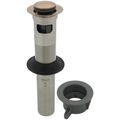
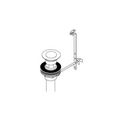

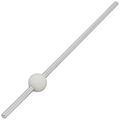
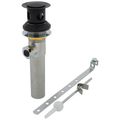

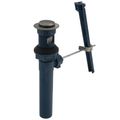

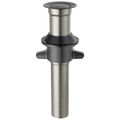
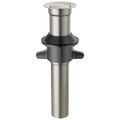
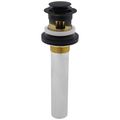
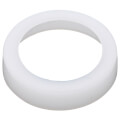
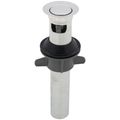
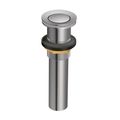

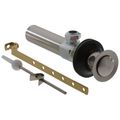
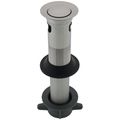
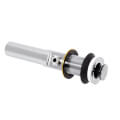
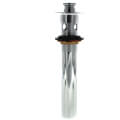
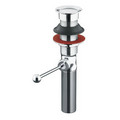
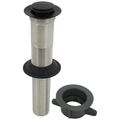
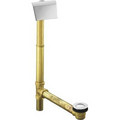

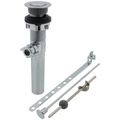

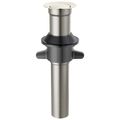
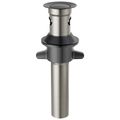
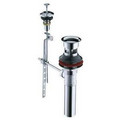

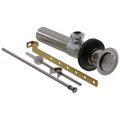

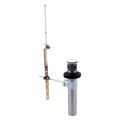

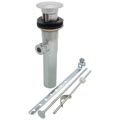
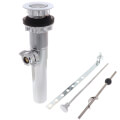
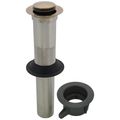
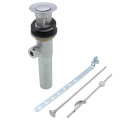
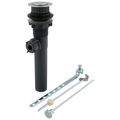
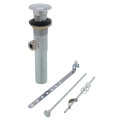
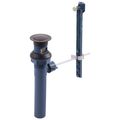
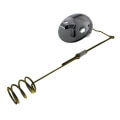
Pop-up assemblies are the drain stopper mechanisms installed in bathroom sinks and lavatories that let a user open and close the drain without touching the stopper directly. Plumbers install these assemblies during new bathroom builds and remodels, and replace them on service calls when a stopper won't seal, won't stay open, or has a broken linkage. A typical assembly includes the stopper itself, a pivot rod that passes through the drain body, and a lift rod or knob that connects to the pivot from above the sink deck. Most assemblies fit standard 1-1/4 inch lavatory drain openings, though some specialty sinks use different sizing. Matching the finish of the pop-up assembly to the rest of the faucet trim matters for a clean look, since these parts sit in plain view above the sink. Choosing an assembly with the right stopper style, tip-toe, lift-and-turn, or push-button, depends on the fixture and what the customer prefers for daily use.
Subcategories
- Lift Rod Pop-Up Assemblies: Lift rod assemblies use a rod and knob mounted behind the faucet that raises and lowers the stopper mechanically. Plumbers install these on standard bathroom sinks where the homeowner wants a traditional look and a rod they can reach without bending down. The rod threads through the faucet body or mounts separately depending on the sink design, and the linkage below connects to the stopper through a strap and pivot ball.
- Tip-Toe Pop-Up Assemblies: Tip-toe assemblies open and close when a user presses down on the stopper itself, with no visible rod or knob above the sink deck. Contractors favor these for a cleaner look on vanities where a lift rod would clutter the faucet area. The mechanism relies on a spring-loaded cartridge inside the drain body rather than an external linkage.
- Push-Button Pop-Up Assemblies: Push-button assemblies use a small button set into the top of the stopper that a user presses to toggle the drain open or closed. They fit the same 1-1/4 inch drain openings as other pop-up styles, making them a straightforward swap on an existing sink. Plumbers reach for these on remodels where the customer specifically wants to eliminate any rod or lever.
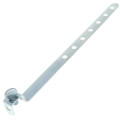
- Replacement Stoppers & Linkage Kits: Replacement stoppers and linkage kits let a plumber fix a single failed component, like a cracked stopper or a stripped pivot ball, without replacing the entire assembly. Stocking these separately saves a trip back to the supply house when only one part of an otherwise functional assembly has failed. Kits typically include the strap, pivot rod, and retaining nut needed to reseat the connection.
Buying Guide
Selecting a pop-up assembly starts with identifying which stopper style is already installed, since replacing an assembly with the same operating style avoids extra plumbing work under the sink. A straight swap of a lift rod assembly for another lift rod assembly means the existing rod, strap, and pivot connections carry over with little adjustment. Switching styles, such as moving from a lift rod to a tip-toe or push-button stopper, usually calls for a full assembly rather than just the stopper, since the mechanisms and how they connect to the drain body differ.
Finish matching matters more on pop-up assemblies than on many other plumbing parts because the stopper and any visible rod sit in plain view above the sink deck. Contractors pair the finish to the faucet, not just the sink hardware, so chrome, brushed nickel, and matte black options all need to line up with what's already installed or specified for the job.
For a repair rather than a full replacement, check whether the failure is in the stopper, the strap, or the pivot ball before ordering a complete assembly. A worn strap or a stripped pivot connection can often be fixed with a linkage kit alone, which costs less in parts and takes less time on a service call than removing and reinstalling the whole unit.
Frequently Asked Questions
What size drain opening do pop-up assemblies fit?
Most pop-up assemblies fit standard 1-1/4 inch lavatory drain openings, which covers the majority of bathroom sinks. Specialty or older fixtures occasionally use a different size, so it's worth confirming drain diameter before ordering a replacement.
Can I switch from a lift rod stopper to a tip-toe stopper?
Switching stopper styles usually requires a full assembly rather than just the stopper, since a lift rod and a tip-toe mechanism connect to the drain body differently. Reusing the existing tailpiece and drain body is common, but the stopper mechanism itself needs to match the new style.
Why does my pop-up stopper not stay open or closed?
A stopper that won't hold position usually points to a worn pivot ball, a bent strap, or a linkage that's come loose from the lift rod. Checking those connections under the sink often resolves the issue without replacing the entire assembly.
Do pop-up assembly finishes need to match the faucet?
Matching the finish to the faucet, not just the sink hardware, keeps the look consistent since the stopper and any visible rod sit above the sink deck in plain view. Chrome, brushed nickel, and matte black are the most common finish options to coordinate.
What's included in a linkage kit?
A linkage kit typically includes the strap, pivot rod, and retaining nut needed to reconnect a lift rod to the stopper. Replacing just these parts costs less and takes less time than swapping the entire pop-up assembly when the stopper itself is still in good condition.
