




Reduced Pressure Zone (RPZ) Valves & Assemblies
Reduced pressure zone (RPZ) assemblies are backflow preventers that protect potable water supplies from contamination. They keep non-potable water, chemicals, or other fluids from siphoning back into the clean water system. An RPZ assembly uses two independently operating check valves with a pressure-monitored relief valve between them. If either check valve fails, the relief valve opens and discharges water rather than allowing contaminated water to reverse flow into the supply. Building codes generally require RPZ assemblies on connections with a high health hazard rating, such as irrigation systems, boiler feed lines, and fire suppression systems tied into potable water.
Plumbers and mechanical contractors install RPZ assemblies at the point where a potable water line connects to a system that could introduce contamination. Correct sizing and orientation are critical to both code compliance and long-term performance. Assemblies come in various sizes to match pipe diameter and flow demand. Most jurisdictions require annual testing by a certified backflow tester to confirm the check valves and relief valve are functioning within tolerance. Choose an assembly rated for the application's pressure and flow. Installing it with the clearance required for relief valve discharge helps the system pass inspection and perform reliably over time.





Subcategories
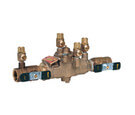
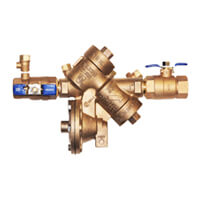
- Apollo Valves Reduced Pressure Principle Assemblies: Apollo reduced pressure principle assemblies are used across residential and commercial potable water protection applications, sized to match common pipe diameters found in both new construction and retrofit work. Their bodies are typically bronze or epoxy-coated cast iron, matched to the piping material and water conditions at the installation point. Apollo assemblies are installed with the same clearance and orientation requirements as other RPZ devices to allow proper relief valve discharge.
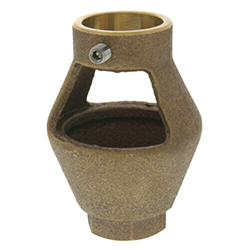
- Backflow Preventer Air Gaps: Backflow preventer air gaps provide a physical separation between a water outlet and the flood level of a fixture. They offer a non-mechanical way to prevent backflow in specific applications, such as RPZ assembly discharge lines. They're often required at the relief valve outlet of an RPZ assembly to safely direct discharge water to a drain without creating a cross-connection. Air gap fittings come in sizes matched to the discharge pipe diameter of the assembly they serve.
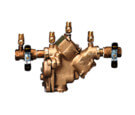
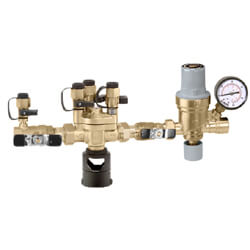
- Caleffi RPZ Assemblies: Caleffi RPZ assemblies serve the same backflow prevention role as other reduced pressure zone devices, protecting potable water systems on connections with a high contamination risk. Their compact valve bodies are designed for tighter mechanical room clearances compared to some traditional cast assemblies. Caleffi's lineup includes both bronze and stainless steel options depending on the water chemistry at the installation site.
- Febco 825Y RPZ Assemblies: Febco 825Y assemblies are reduced pressure principle backflow preventers commonly specified for irrigation and fire line connections to potable water. The 825Y series is available in a range of pipe sizes and uses a Y-pattern body configuration that affects installation orientation and clearance needs. Like other RPZ devices, these require periodic testing by a certified backflow tester to confirm proper operation.
- Febco 860 RPZ Assemblies: Febco 860 assemblies are a reduced pressure zone line built for general potable water protection applications, including boiler feed and irrigation connections. The 860 series covers a range of sizes suited to both residential and light commercial installations. As with all RPZ assemblies, correct installation clearance is needed to allow the relief valve to discharge freely if the check valves fail.
- Febco 880V RPZ Assemblies: Febco 880V assemblies are reduced pressure principle backflow preventers designed with a vertical installation orientation for applications where space constraints don't allow a standard horizontal setup. They serve the same protective function as horizontal RPZ assemblies, monitoring pressure between two check valves and discharging through a relief valve if either check valve fails. The 880V series is commonly specified for retrofit installations where existing piping limits orientation options.
Buying Guide
Selecting a reduced pressure zone assembly starts with confirming the local plumbing code's backflow prevention requirement for the specific connection. Many jurisdictions mandate RPZ assemblies on any connection rated as a high health hazard, including irrigation, boiler feed, and fire suppression tie-ins. Some jurisdictions also specify particular approved assemblies or testing requirements.
Sizing an RPZ assembly to the pipe diameter and expected flow rate is the next step. An undersized assembly restricts flow and increases pressure loss, while an oversized one adds unnecessary cost and space requirements. Installers use flow curves, which show the pressure drop at different flow rates, to confirm the assembly won't create excessive pressure loss in the system.
Installation location needs enough clearance around the assembly for testing access and relief valve discharge. Most codes require the assembly to sit above the floor or ground by a minimum height to prevent the discharge from flooding back into the device. Indoor installations typically need a floor drain positioned to catch relief valve discharge, while outdoor installations may need protection from freezing in colder climates.
Body material selection depends on the water conditions and cost considerations for the installation. Bronze assemblies resist corrosion well in most water conditions, while epoxy-coated cast iron offers a lower-cost alternative for less corrosive applications. Stainless steel assemblies handle more aggressive water chemistry but come at a higher cost than bronze or cast iron options.
After installation, reduced pressure zone (RPZ) assemblies require annual testing in most jurisdictions by a certified backflow prevention tester. The tester checks that both check valves hold pressure and that the relief valve opens at the correct differential. Keeping test reports on file and scheduling the annual test proactively helps building owners stay in compliance and avoid water service interruptions from a failed inspection.
Frequently Asked Questions
When is an RPZ assembly required instead of a simpler backflow preventer?
Reduced pressure zone assemblies are typically required on connections rated as a high health hazard. In these cases, a backflow event could introduce a contaminant that poses a serious health risk. Examples include irrigation systems using fertilizers or pesticides, boiler feed lines with treatment chemicals, and fire systems with antifreeze additives. Lower-hazard connections may only require a double check valve assembly, which doesn't have the same relief valve protection. Local plumbing codes and the water authority specify which device type is required for a given connection.
How much clearance does an RPZ assembly need for installation?
Most manufacturers and plumbing codes require at least 12 inches of clearance around the assembly for testing access. The assembly also needs additional height above the floor or ground so the relief valve can discharge without backing up. Exact clearance requirements vary by size and manufacturer. Indoor installations also need a floor drain sized to handle the assembly's maximum relief discharge rate.
How often does an RPZ assembly need to be tested?
Most jurisdictions require annual testing of RPZ assemblies by a certified backflow prevention tester, though some high-hazard applications may require more frequent testing. The test confirms both check valves hold their rated pressure differential and that the relief valve opens correctly if either check valve fails. Test reports typically need to be filed with the local water authority to maintain compliance.
Can an RPZ assembly be installed in any orientation?
Standard RPZ assemblies are designed for horizontal installation with the relief valve facing downward. Some manufacturers offer vertical-orientation models for space-constrained installations, such as the Febco 880V. Installing a horizontal-only assembly vertically can prevent the relief valve from draining properly and may void the manufacturer's warranty. Matching the installation to the assembly's designed orientation avoids this problem.
What causes an RPZ assembly's relief valve to discharge water continuously?
Continuous discharge usually means one of the check valves isn't sealing properly. Common causes are debris caught in the valve seat or worn valve components, which let pressure build in the relief zone and trip the relief valve open. Thermal expansion in a closed system without adequate expansion capacity can also cause intermittent discharge. Identifying which check valve is failing determines whether the assembly needs cleaning, rebuilding, or replacement.
Resources

 --%3E %3C!DOCTYPE svg PUBLIC '-//W3C//DTD SVG 1.1//EN' 'http://www.w3.org/Graphics/SVG/1.1/DTD/svg11.dtd'%3E %3Csvg version='1.1' id='Layer_1' xmlns='http://www.w3.org/2000/svg' xmlns:xlink='http://www.w3.org/1999/xlink' x='0px' y='0px' width='90px' height='90px' viewBox='0 0 90 90' enable-background='new 0 0 90 90' xml:space='preserve'%3E %3Crect x='27' y='23' fill='%23FFFFFF' width='43' height='44'/%3E %3Cg%3E %3Cdefs%3E %3Crect id='SVGID_1_' width='90' height='90'/%3E %3C/defs%3E %3CclipPath id='SVGID_2_'%3E %3Cuse xlink:href='%23SVGID_1_' overflow='visible'/%3E %3C/clipPath%3E %3Cpath clip-path='url(%23SVGID_2_)' fill='%234186AD' d='M45,0C20.1,0,0,20.1,0,45c0,24.9,20.1,45,45,45c24.9,0,45-20.1,45-45 C90,20.1,69.9,0,45,0'/%3E %3C/g%3E %3Cpath fill='%23FFFFFF' d='M60.6,47.4l-22.5,14c-0.5,0.3-1,0.399-1.5,0.399s-0.9-0.1-1.4-0.399c-0.9-0.5-1.4-1.4-1.4-2.5v-28 c0-1,0.6-2,1.4-2.5c0.9-0.5,2-0.5,2.9,0.1l22.5,14.1C61.4,43.1,61.9,44,61.9,45S61.4,46.9,60.6,47.4'/%3E %3C/svg%3E)
Subcategories
- Apollo Valves Reduced Pressure Principle Assemblies: Apollo reduced pressure principle assemblies are used across residential and commercial potable water protection applications, sized to match common pipe diameters found in both new construction and retrofit work. Their bodies are typically bronze or epoxy-coated cast iron, matched to the piping material and water conditions at the installation point. Apollo assemblies are installed with the same clearance and orientation requirements as other RPZ devices to allow proper relief valve discharge.
- Backflow Preventer Air Gaps: Backflow preventer air gaps provide a physical separation between a water outlet and the flood level of a fixture. They offer a non-mechanical way to prevent backflow in specific applications, such as RPZ assembly discharge lines. They're often required at the relief valve outlet of an RPZ assembly to safely direct discharge water to a drain without creating a cross-connection. Air gap fittings come in sizes matched to the discharge pipe diameter of the assembly they serve.
- Caleffi RPZ Assemblies: Caleffi RPZ assemblies serve the same backflow prevention role as other reduced pressure zone devices, protecting potable water systems on connections with a high contamination risk. Their compact valve bodies are designed for tighter mechanical room clearances compared to some traditional cast assemblies. Caleffi's lineup includes both bronze and stainless steel options depending on the water chemistry at the installation site.
- Febco 825Y RPZ Assemblies: Febco 825Y assemblies are reduced pressure principle backflow preventers commonly specified for irrigation and fire line connections to potable water. The 825Y series is available in a range of pipe sizes and uses a Y-pattern body configuration that affects installation orientation and clearance needs. Like other RPZ devices, these require periodic testing by a certified backflow tester to confirm proper operation.
- Febco 860 RPZ Assemblies: Febco 860 assemblies are a reduced pressure zone line built for general potable water protection applications, including boiler feed and irrigation connections. The 860 series covers a range of sizes suited to both residential and light commercial installations. As with all RPZ assemblies, correct installation clearance is needed to allow the relief valve to discharge freely if the check valves fail.
- Febco 880V RPZ Assemblies: Febco 880V assemblies are reduced pressure principle backflow preventers designed with a vertical installation orientation for applications where space constraints don't allow a standard horizontal setup. They serve the same protective function as horizontal RPZ assemblies, monitoring pressure between two check valves and discharging through a relief valve if either check valve fails. The 880V series is commonly specified for retrofit installations where existing piping limits orientation options.
Buying Guide
Selecting a reduced pressure zone assembly starts with confirming the local plumbing code's backflow prevention requirement for the specific connection. Many jurisdictions mandate RPZ assemblies on any connection rated as a high health hazard, including irrigation, boiler feed, and fire suppression tie-ins. Some jurisdictions also specify particular approved assemblies or testing requirements.
Sizing an RPZ assembly to the pipe diameter and expected flow rate is the next step. An undersized assembly restricts flow and increases pressure loss, while an oversized one adds unnecessary cost and space requirements. Installers use flow curves, which show the pressure drop at different flow rates, to confirm the assembly won't create excessive pressure loss in the system.
Installation location needs enough clearance around the assembly for testing access and relief valve discharge. Most codes require the assembly to sit above the floor or ground by a minimum height to prevent the discharge from flooding back into the device. Indoor installations typically need a floor drain positioned to catch relief valve discharge, while outdoor installations may need protection from freezing in colder climates.
Body material selection depends on the water conditions and cost considerations for the installation. Bronze assemblies resist corrosion well in most water conditions, while epoxy-coated cast iron offers a lower-cost alternative for less corrosive applications. Stainless steel assemblies handle more aggressive water chemistry but come at a higher cost than bronze or cast iron options.
After installation, reduced pressure zone (RPZ) assemblies require annual testing in most jurisdictions by a certified backflow prevention tester. The tester checks that both check valves hold pressure and that the relief valve opens at the correct differential. Keeping test reports on file and scheduling the annual test proactively helps building owners stay in compliance and avoid water service interruptions from a failed inspection.
Frequently Asked Questions
When is an RPZ assembly required instead of a simpler backflow preventer?
Reduced pressure zone assemblies are typically required on connections rated as a high health hazard. In these cases, a backflow event could introduce a contaminant that poses a serious health risk. Examples include irrigation systems using fertilizers or pesticides, boiler feed lines with treatment chemicals, and fire systems with antifreeze additives. Lower-hazard connections may only require a double check valve assembly, which doesn't have the same relief valve protection. Local plumbing codes and the water authority specify which device type is required for a given connection.
How much clearance does an RPZ assembly need for installation?
Most manufacturers and plumbing codes require at least 12 inches of clearance around the assembly for testing access. The assembly also needs additional height above the floor or ground so the relief valve can discharge without backing up. Exact clearance requirements vary by size and manufacturer. Indoor installations also need a floor drain sized to handle the assembly's maximum relief discharge rate.
How often does an RPZ assembly need to be tested?
Most jurisdictions require annual testing of RPZ assemblies by a certified backflow prevention tester, though some high-hazard applications may require more frequent testing. The test confirms both check valves hold their rated pressure differential and that the relief valve opens correctly if either check valve fails. Test reports typically need to be filed with the local water authority to maintain compliance.
Can an RPZ assembly be installed in any orientation?
Standard RPZ assemblies are designed for horizontal installation with the relief valve facing downward. Some manufacturers offer vertical-orientation models for space-constrained installations, such as the Febco 880V. Installing a horizontal-only assembly vertically can prevent the relief valve from draining properly and may void the manufacturer's warranty. Matching the installation to the assembly's designed orientation avoids this problem.
What causes an RPZ assembly's relief valve to discharge water continuously?
Continuous discharge usually means one of the check valves isn't sealing properly. Common causes are debris caught in the valve seat or worn valve components, which let pressure build in the relief zone and trip the relief valve open. Thermal expansion in a closed system without adequate expansion capacity can also cause intermittent discharge. Identifying which check valve is failing determines whether the assembly needs cleaning, rebuilding, or replacement.