




Rigid/IMC Insulated Conduit Chase Nipples


 --%3E %3Csvg version='1.1' id='No-RB' xmlns='http://www.w3.org/2000/svg' xmlns:xlink='http://www.w3.org/1999/xlink' x='0px' y='0px' viewBox='0 0 100 100' enable-background='new 0 0 100 100' xml:space='preserve'%3E %3Cpath fill='%23CECECE' d='M79.44,0.95H20.56C9.78,0.95,0.95,9.78,0.95,20.56v58.87c0,10.79,8.82,19.61,19.61,19.61h58.87 c10.79,0,19.61-8.83,19.61-19.61V20.56C99.05,9.78,90.22,0.95,79.44,0.95z M65.38,58.24l9.38,29.58L49.69,69.78L24.5,87.82 l9.34-29.6L8.8,39.6l30.73-0.17c0,0,6.98-19.61,10-28.93c0.54,1.36,9.88,29.1,9.88,29.1H91.2L65.38,58.24z'/%3E %3C/svg%3E)




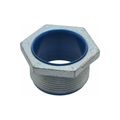


Rigid/IMC Insulated Conduit Chase Nipples are threaded fittings that pass through a knockout to join a box to a conduit coupling, connect two boxes side by side, or tie a fixture housing into a continuous conduit run. Trade sizes run from 1/2 inch to 4 inch, covering everything from a single branch circuit to a heavy feeder. Construction uses alloy steel with a zinc plating and chromate finish, built to outlast die cast alternatives on the same job. A factory-installed insulated throat bushing, made from DuPont Zytel nylon, lines the fitting where wire passes through to keep conductor insulation from wearing against the metal edge. Electricians pull this fitting out of the truck whenever two enclosures need to connect through a single opening without running a full coupling and extra pipe between them, since one fitting and a locknut close the gap in a single step.
Subcategories
- 1/2 in. to 1-1/4 in. Chase Nipples: Smaller trade sizes from 1/2 inch to 1-1/4 inch cover most residential and light commercial branch circuits. Electricians use these sizes to join a device box to a coupling or connect two boxes through a shared knockout on everyday wiring runs. Alloy steel construction with a zinc plating and chromate finish holds up on this size range the same way it does on larger nipples.
- 1-1/2 in. to 4 in. Chase Nipples: Larger trade sizes from 1-1/2 inch up to 4 inch handle feeder runs and heavier conductor bundles on commercial and industrial jobs. The same alloy steel body and precision-machined threads scale up to these sizes without switching to a different fitting family. Crews specify the larger sizes wherever conduit fill requires more room than a branch-circuit nipple provides.
- Nylon-Insulated Throat Chase Nipples: An insulated version adds a factory-installed throat bushing made from DuPont Zytel nylon, ordered by adding a B suffix to the base catalog number. The nylon liner keeps conductor insulation from wearing against the fitting's cut metal edge as wires get pulled through. Jobs with code requirements for insulated fittings, or runs with larger conductors prone to abrasion, call for this version over a non-insulated nipple.
- Locknut-Secured Chase Nipples: Chase nipples thread into one knockout and get secured on the opposite side with a locknut instead of a second coupling. That single-locknut design connects two boxes side by side, joins a box to a coupling, or ties a fixture housing into a continuous conduit run. A low profile keeps the assembly compact in tight panel and junction box layouts where a standard coupling and extra pipe won't fit.
Buying Guide
Start by measuring the trade size of the conduit on both sides of the connection. Chase nipples run from 1/2 inch up to 4 inch, and the nipple has to match the conduit size exactly since there's no reducing function built into the fitting itself. Branch circuit work typically stays in the 1/2 inch to 1-1/4 inch range, while feeder runs and heavier commercial jobs move into the larger sizes.
Next, confirm whether the job requires an insulated throat. Rigid/IMC Insulated Conduit Chase Nipples add a factory-installed nylon bushing that protects conductor insulation from the fitting's cut metal edge during a wire pull. Larger conductors and certain code-driven applications call for this protection, while smaller branch circuits sometimes run on a non-insulated nipple instead, so checking the job specification before ordering avoids buying the wrong version.
Check the material and finish next. Alloy steel with a zinc plating and chromate finish resists corrosion and holds up to repeated wire pulls better than a die cast fitting of the same size. Precision-machined threads and a smooth interior diameter matter most on runs where a wire bundle has to slide through cleanly without snagging.
Finally, confirm the fitting carries the listings a job requires. UL 514B and NEMA FB1 certification cover most standard installations, and confirming these marks against the project specification before rough-in keeps the job on schedule during inspection.
Frequently Asked Questions
What sizes do rigid/IMC insulated chase nipples come in?
Chase nipples for rigid and IMC conduit run from 1/2 inch up to 4 inch in trade size. Smaller sizes cover typical branch circuit work, while the larger sizes handle feeder runs on commercial and industrial jobs. The nipple size has to match the conduit on both sides of the connection exactly.
What does the insulated throat on a chase nipple protect against?
The insulated throat is a factory-installed nylon bushing, made from DuPont Zytel, that lines the fitting where wire passes through. Insulation on the fitting keeps conductor insulation from wearing against the cut metal edge during a wire pull. Larger conductors and certain code-driven applications typically call for this protection over a non-insulated nipple.
How does a chase nipple connect two electrical boxes?
A chase nipple threads into a knockout on one box and gets secured on the opposite side with a locknut instead of a second coupling. That setup joins two boxes side by side or back to back through a single opening. The same design also connects a fixture housing into a continuous conduit run.
What material are rigid/IMC chase nipples made from?
Chase nipples in this category use alloy steel with a zinc plating and chromate finish, built to outlast a die cast fitting of the same size. Precision-machined threads and a smooth interior diameter help wire pull through cleanly without snagging. The finish resists corrosion in typical indoor electrical installations.
What certifications should a rigid/IMC chase nipple carry?
Chase nipples built to UL 514B and NEMA FB1 standards cover most standard rigid and IMC conduit installations. Confirming these certifications against a project's specification before rough-in helps the job pass inspection without delay. Federal Standard A-A-50553 compliance shows up on some product lines as an additional reference point.
