




Vertical Double Deflection Registers (92VHO Series)


 --%3E %3Csvg version='1.1' id='No-RB' xmlns='http://www.w3.org/2000/svg' xmlns:xlink='http://www.w3.org/1999/xlink' x='0px' y='0px' viewBox='0 0 100 100' enable-background='new 0 0 100 100' xml:space='preserve'%3E %3Cpath fill='%23CECECE' d='M79.44,0.95H20.56C9.78,0.95,0.95,9.78,0.95,20.56v58.87c0,10.79,8.82,19.61,19.61,19.61h58.87 c10.79,0,19.61-8.83,19.61-19.61V20.56C99.05,9.78,90.22,0.95,79.44,0.95z M65.38,58.24l9.38,29.58L49.69,69.78L24.5,87.82 l9.34-29.6L8.8,39.6l30.73-0.17c0,0,6.98-19.61,10-28.93c0.54,1.36,9.88,29.1,9.88,29.1H91.2L65.38,58.24z'/%3E %3C/svg%3E)
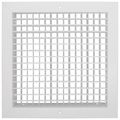

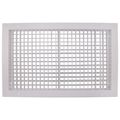


Vertical double deflection registers in the 92VHO series are supply air outlets built with two rows of blades set at right angles: a front row of vertical blades for left-right throw adjustment and a rear row of horizontal blades for up-down control. HVAC contractors install this style where airflow needs to be steered away from a nearby wall, furniture, or a room's occupants, since each blade row adjusts independently. The double deflection design gives more precise directional control than a single-blade register, which matters most in rooms with irregular layouts or low ceiling clearance. Sizing the register to the duct's face area, not just the rough opening, keeps air velocity in a comfortable range and avoids a noticeable whistle at higher static pressure. Technicians commonly swap in a 92VHO series register during a remodel when the existing opening size needs to be matched exactly.
Subcategories
- Standard Duct Opening Sizes: Registers in this series come in a range of duct opening sizes to match common residential and light commercial duct dimensions. Matching the register's rough opening to the actual duct size, rather than rounding up or down, prevents air leakage around the frame. Contractors measure the existing opening before ordering a replacement to avoid a mismatched fit. A slightly oversized frame can still work with foam gasketing at the perimeter.
- Baked Enamel Finish Options: Finish options typically include a baked enamel coating in white or a similar neutral tone to blend with most wall and ceiling colors. Property managers often standardize on one finish across a building to simplify future replacements. A durable baked-on finish resists yellowing better than a painted-on coating over time. Custom color matching is available through some suppliers for higher-visibility installations.
- Damper-Equipped Models: Damper-equipped models add an opposed-blade damper behind the register face, letting a technician balance airflow to an individual room without a separate balancing damper further up the duct run. This option suits retrofit jobs where accessing the duct run itself isn't practical. The damper is adjusted with a screwdriver slot visible through the register face. Non-damper models rely entirely on the register blades for direction, not volume control.
- Sidewall and Ceiling Mount Frames: Frame styles vary slightly for sidewall versus ceiling mounting, affecting how the register sits flush against the surface. A sidewall frame typically has a slight lip to cover minor gaps in a wall opening, while a ceiling frame is built to hang level against gravity. Choosing the correct frame style for the mounting location avoids a visible gap or an uneven seat against the surface. Technicians confirm mounting orientation before ordering to match blade direction correctly.
Buying Guide
Selecting the right register starts with confirming the duct opening's exact dimensions, since a rough opening that's even a half inch off can leave a visible gap or require field-modifying the frame. Measuring twice before ordering saves a return trip, especially on a ceiling installation where the frame sits at height.
Blade orientation matters for room layout. Placing the vertical blade row toward the occupied side of a room lets a technician steer air away from a desk, bed, or seating area, while the horizontal row fine-tunes how far up or down the air throws. For a room with a low ceiling, aiming the horizontal blades downward less aggressively reduces the draft felt at head height.
Deciding between a damper-equipped and a standard Vertical Double Deflection Registers (92VHO Series) model depends on whether the duct run already has a balancing damper upstream. If it doesn't, the built-in damper option saves a separate trip into the ductwork to add one. Finish selection is largely cosmetic, though a baked enamel coating holds up better over years of cleaning than a painted surface.
Finally, check the register's free area rating against the CFM the duct is expected to deliver. An undersized free area increases static pressure and can cause a noticeable noise at the register, particularly on high-velocity systems feeding a single small room.
Frequently Asked Questions
What does double deflection mean on a supply register?
Double deflection describes two independent rows of adjustable blades, one vertical and one horizontal, that let a technician direct airflow both side to side and up and down. A single deflection register only offers one axis of adjustment, which limits how precisely air can be steered around furniture or occupants.
How do I measure for a replacement register in this series?
Measure the rough duct opening's width and height directly, not the visible frame of the old register, since frames often overlap the opening slightly. Ordering to the duct opening size, plus checking that the new frame's overlap matches the old one, avoids gaps or a register that won't sit flush.
Is a damper-equipped register necessary if the duct already has a balancing damper?
A damper-equipped register is optional when the duct run already includes a balancing damper upstream, since volume control is already handled there. Adding a second damper at the register can still help fine-tune individual room comfort without walking back to the main duct run.
What finish options are typically available?
Baked enamel in white is the most common finish, chosen for its resistance to yellowing and ease of cleaning. Some suppliers offer additional colors or a custom finish for installations where matching a specific wall color matters.
Can this register be mounted on a ceiling instead of a wall?
Ceiling-rated frames are built to hang level and support the register's weight from above, which differs from a sidewall frame's design. Confirming the frame is rated for the intended mounting location, before installation, prevents a sagging or improperly seated register over time.
