





'/%3E%3C/svg%3E)
 --%3E %3Csvg version='1.1' id='Fill' xmlns='http://www.w3.org/2000/svg' xmlns:xlink='http://www.w3.org/1999/xlink' x='0px' y='0px' viewBox='0 0 100 100' enable-background='new 0 0 100 100' xml:space='preserve'%3E %3Cpath fill='%23F15C02' d='M79.44,0.95H20.56C9.78,0.95,0.95,9.78,0.95,20.56v58.87c0,10.79,8.82,19.61,19.61,19.61h58.87 c10.79,0,19.61-8.83,19.61-19.61V20.56C99.05,9.78,90.22,0.95,79.44,0.95z M65.38,58.24l9.38,29.58L49.69,69.78L24.5,87.82 l9.34-29.6L8.8,39.6l30.73-0.17c0,0,6.98-19.61,10-28.93c0.54,1.36,9.88,29.1,9.88,29.1H91.2L65.38,58.24z'/%3E %3C/svg%3E)
 --%3E %3Csvg version='1.1' id='Half' xmlns='http://www.w3.org/2000/svg' xmlns:xlink='http://www.w3.org/1999/xlink' x='0px' y='0px' viewBox='0 0 100 100' enable-background='new 0 0 100 100' xml:space='preserve'%3E %3Cg%3E %3Cpath fill='%23F15C02' d='M30.05,70.23l3.79-12.01L8.8,39.6l30.73-0.17c0,0,6.98-19.61,10-28.93c0.54,1.36,9.88,29.1,9.88,29.1h1.58 L93.71,7.18c-3.58-3.82-8.66-6.23-14.28-6.23H20.56C9.78,0.95,0.95,9.78,0.95,20.56v58.87c0,5.41,2.22,10.32,5.79,13.88 L30.05,70.23z'/%3E %3C/g%3E %3Cpath fill='%23FBC8B4' d='M93.71,7.18L60.98,39.6H91.2L65.38,58.24l9.38,29.58L49.69,69.78L24.5,87.82l5.55-17.59L6.75,93.32 c3.55,3.54,8.44,5.73,13.82,5.73h58.87c10.79,0,19.61-8.83,19.61-19.61V20.56C99.05,15.4,97.01,10.69,93.71,7.18z'/%3E %3C/svg%3E)

MANUALS (1)
Product Highlights


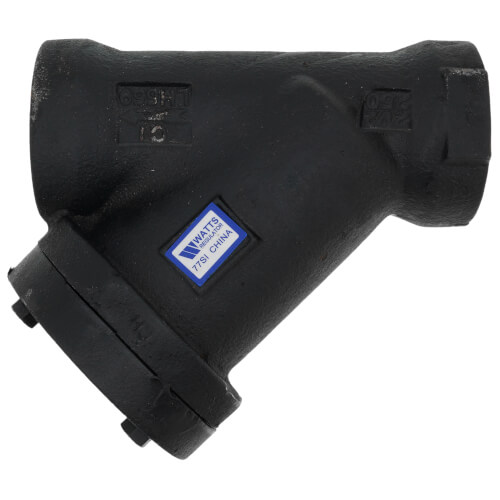
Description
"Do not use this item for any installation or repair of potable water applications. This product does not comply with the ""Safe Drinking Water Act,"" which requires that products meet low-lead standards in order to be used in systems providing water for human consumption (drinking or cooking). This item is for non-potable (non-human consumption) water applications only."
Specs
| Size: | 2-1/2" |
|---|---|
| Material: | Cast Iron |
| Connection Type: | FNPT x FNPT |
| Connection Method: | Threaded |
| Application: | Plumbing |
| Thread Type: | Female |
| Pressure Rating: | 400 psi @ 150ºF (WOG) 250 psi @ 406ºF (WSP) |


Questions?
Compare Similar Products
250 psi @ 406ºF (WSP)
Product Reviews
YES
As described , good quality and great customer service.
 --%3E %3Csvg version='1.1' id='With-RB' xmlns='http://www.w3.org/2000/svg' xmlns:xlink='http://www.w3.org/1999/xlink' x='0px' y='0px' viewBox='0 0 100 100' enable-background='new 0 0 100 100' xml:space='preserve'%3E %3Cpath fill='%23FBC8B4' d='M79.44,0.95H20.56C9.78,0.95,0.95,9.78,0.95,20.56v58.87c0,10.79,8.82,19.61,19.61,19.61h58.87 c10.79,0,19.61-8.83,19.61-19.61V20.56C99.05,9.78,90.22,0.95,79.44,0.95z M65.38,58.24l9.38,29.58L49.69,69.78L24.5,87.82 l9.34-29.6L8.8,39.6l30.73-0.17c0,0,6.98-19.61,10-28.93c0.54,1.36,9.88,29.1,9.88,29.1H91.2L65.38,58.24z'/%3E %3C/svg%3E)
Once received it was as expected
A necessary compliment for pumps
Plug not included
Good product for the money
Good value
Gets the Job Done, Did not leak!
Good Basic Inexpensive
Product Q&A
7 QuestionsQ: Does this strainer come with a plug for the drain/blow off port?
Asked by RG 10 years ago
Add your answer
Verified Reply- SupplyHouse StaffNo, it does not. The 3/4" model has 3/8" FNPT threads on the drain.
The unit I received did not come with a plug.
Q: Can you buy smaller mesh screens for it. I want to remove sediment from my boiler water as it is plugging up my mixing valve.
Asked by Just fix it the newbie 13 years ago
Add your answer
I am unaware of any alternate strainers. But here is a caution: don't install a strainer in the main supply or return of the boiler - install it in a side-stream, so if the strainer plugs, it won't cut off the flow through the boiler.
Yes, you can put a screen in to filter out particulates. I use my Y in a water fall. A screen keeps the ports on the water fall open. The smakker the screen, the more impurities you will collect. ( these may have to be removed later by taking the Y apart. ) You can also predict that if the screen gets really small flow diminishes his may make you wish your had not messed with it. So here's a way to get the size correct. Take mason Jar an collected some watering it. If you see no particulates in check in the morning with a bigger sample ( gallon jug). When you can identify the size of the parch clues you can buy a filter to control them. Go down to home depot and ask them for screen to habdkle the particles you have seen. They can probably set you uo with a screen you can just wad up and shove in the Y to control particulate. Make sure it is big enough to make water flow through it but noy occlue the flow altoether. lohn
To add to the previous comment: The main purpose of the strainer is to be in the main flow. If you install it on the side-stream, it is basically useless, because not all of the particles are going to be restrained in the mesh. The bottom line is, if you install the strainer, make sure you clean it on the regular basis. Otherwise don't bother, because you can cause a lot of damage to the boiler, if the mesh clogs and flow is significantly reduced. A lot of times in more delicate systems two manometers are installed before and after the strainer in order to monitor the flow. If the pressure on the downstream side (after the strainer) drops by +-10%, it is about time to clean the mesh. Again monitor and service your system on the regular basis. The plug size is 3/8" for the 1" strainer, and 1/2" for 1-1/4" strainer.
Q: I bought the 2" version of the Iron Wye Strainer. I cannot remove the screen retainer plug using 18" pipe wrenches. I want to make sure I can get it off before installing it to the system. It looks like the plug was installed into the fitting body without thread compound and then painted over. Any suggestions appreciated. Yes, I have thought about using bigger wrenches but then I'd have to buy them just for this.
Asked by Stephen 14 years ago
Add your answer
My contractor did not have problems removing the plug and replacing it with a pressure gauge.
Stephen: Have you tried using a cheater bar? I find a 2 foot piece of pipe over an 18" pipe wrench is usually enough leverage to open anything I have. Good Luck, Brad
Hit it with a 24" and it should break loose, I don't think I had too much trouble with mine. Hope this helps
Heat the plug up using a propane or other torch, to soften up the paint. Then wire brush the plug threads and apply a penetrating fluid such as Liquid Wrench or Thrust (WD40 doesn't usually work for this,) and let set for 10-15 minutes. Then try your wrenches. If it does not turn, reheat the plug (The penetrating fluid is flammable so be sure your working outside or over a noncombustible floor)then try your wrenches. I hope this helps. If your piping a lot of 2" you should be using 24" wrenches. Gary
I recall buying one of these, but did not have to use it. That said, the plug should come out. Perhaps if he has access to a substantial vise to clamp it in (by the hex surface on the body) and a short length of pipe to slip over the wrench handle (cheater), he could get enough torque on it to get it out.
Try using a cheater pipe to put over the handles of your pipe wrenches which will give you more leverage.
I would heat it with a torch.
Hi: Its cast iron and super strong so you will not break it. Put it in a big bench top vice and use a cheater bar ( Like a piece of black or galvanized pipe ) 24-36 inches long that fits over the end of your pipe wrench. That should allow you to break it free. John
Q: cAN THIS WYE STRAINER BE USED FOR NATURAL GAS.
Asked by 14 years ago
Add your answer
Verified Reply- PexSupply StaffThis part is not UL/FM rated. It cannot be used with natural gas.
Q: How is this installed
Asked by 14 years ago
Add your answer
Verified Reply- PexSupply StaffThe strainer must be pointing down in order for it to function as intended.
Q: can strainer be placed in vertical application
Asked by mike 15 years ago
Add your answer
Verified Reply- PexSupply StaffThis is not recommended by the manufacturer.
Q: What particle size will the mesh strainer remove from the water? I need a very fine screen for the application I have in mind.
Asked by wbarlow 15 years ago
Add your answer
Verified Reply- PexSupply StaffThis strainer has #20 mesh. It will remove particles larger than .841 millimeters.