



'/%3E%3C/svg%3E)
 --%3E %3Csvg version='1.1' id='Fill' xmlns='http://www.w3.org/2000/svg' xmlns:xlink='http://www.w3.org/1999/xlink' x='0px' y='0px' viewBox='0 0 100 100' enable-background='new 0 0 100 100' xml:space='preserve'%3E %3Cpath fill='%23F15C02' d='M79.44,0.95H20.56C9.78,0.95,0.95,9.78,0.95,20.56v58.87c0,10.79,8.82,19.61,19.61,19.61h58.87 c10.79,0,19.61-8.83,19.61-19.61V20.56C99.05,9.78,90.22,0.95,79.44,0.95z M65.38,58.24l9.38,29.58L49.69,69.78L24.5,87.82 l9.34-29.6L8.8,39.6l30.73-0.17c0,0,6.98-19.61,10-28.93c0.54,1.36,9.88,29.1,9.88,29.1H91.2L65.38,58.24z'/%3E %3C/svg%3E)
 --%3E %3Csvg version='1.1' id='Half' xmlns='http://www.w3.org/2000/svg' xmlns:xlink='http://www.w3.org/1999/xlink' x='0px' y='0px' viewBox='0 0 100 100' enable-background='new 0 0 100 100' xml:space='preserve'%3E %3Cg%3E %3Cpath fill='%23F15C02' d='M30.05,70.23l3.79-12.01L8.8,39.6l30.73-0.17c0,0,6.98-19.61,10-28.93c0.54,1.36,9.88,29.1,9.88,29.1h1.58 L93.71,7.18c-3.58-3.82-8.66-6.23-14.28-6.23H20.56C9.78,0.95,0.95,9.78,0.95,20.56v58.87c0,5.41,2.22,10.32,5.79,13.88 L30.05,70.23z'/%3E %3C/g%3E %3Cpath fill='%23FBC8B4' d='M93.71,7.18L60.98,39.6H91.2L65.38,58.24l9.38,29.58L49.69,69.78L24.5,87.82l5.55-17.59L6.75,93.32 c3.55,3.54,8.44,5.73,13.82,5.73h58.87c10.79,0,19.61-8.83,19.61-19.61V20.56C99.05,15.4,97.01,10.69,93.71,7.18z'/%3E %3C/svg%3E)
' fill='%23F15C02' d='M49 0C21.938 0 0 21.938 0 49s21.938 49 49 49 49-21.938 49-49S76.062 0 49 0m0 82.709a7.54 7.54 0 1 1 0-15.08 7.54 7.54 0 0 1 0 15.08m7.54-28.412a7.541 7.541 0 0 1-15.08 0V22.831a7.54 7.54 0 0 1 15.08 0v31.466z'/%3E%3C/svg%3E)
MANUALS (4)
Non-Potable Water Applications

Product Highlights


Description
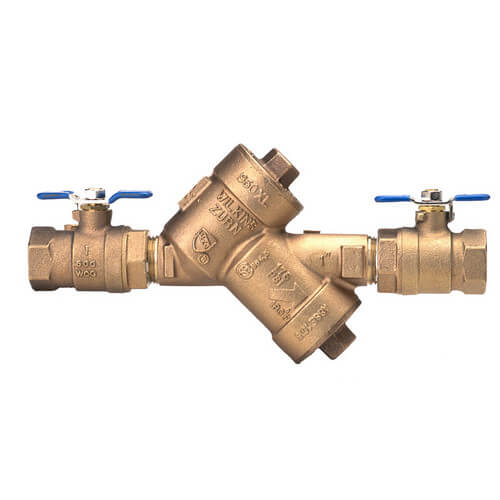
This valve assembly is designed for installation on potable water lines to protect against both back-siphonage and back-pressure of polluted water into the water supply. Assembly shall provide protection where a potential health hazard does not exist.
Standards Compliance
(All sizes approved horizontal. Vertical approvals as listed below.)
- ASSE® Listed 1015 ( vertical 3/4", 1-1/4", 1-1/2" & 2")
- IAPMO® Listed (vertical 1-1/4"-2")
- CSA® Listed ( vertical 3/4", 1-1/4", 1-1/2" & 2")
- AWWA Compliant C510 (vertical 3/4")
- UL® Classified (less shut-off valves only)
- C-UL® Classified (less shut-off valves only)
- Approved by the Foundation for Cross Connection Control and Hydraulic Research at the University of Southern California (vertical 3/4")
- City of Los Angeles Approved (vertical 1-1/4"-2")
- NYC MEA 426-89-M VOL 3
- Main valve body: Cast Bronze ASTM B 584
- Access covers: Cast Bronze ASTM B 584
- Internals: Stainless Steel, 300 Series
- Elastomers: Silicone (FDA approved), Buna Nitrile (FDA approved)
- Polymers: Noryl, NSF Listed
- Springs: Stainless steel, 300 series
Specs
| Size: | 1" |
|---|---|
| Max Pressure (PSI): | 175 |
| Length: | 12-1/4" |
| Max Temp (F): | 180°F |
| Height: | 6-1/2" |
| Hydrostatic Test Pressure: | 350 PSI |
| Material: | Cast Bronze |
| Features: | 1/4 Turn Ball Valves |
| Connection Type: | Female Threaded |


Questions?
Product Reviews
Most Liked Positive Review
Part and Service Was Excellent
Most Liked Negative Review
 --%3E %3Csvg version='1.1' id='With-RB' xmlns='http://www.w3.org/2000/svg' xmlns:xlink='http://www.w3.org/1999/xlink' x='0px' y='0px' viewBox='0 0 100 100' enable-background='new 0 0 100 100' xml:space='preserve'%3E %3Cpath fill='%23FBC8B4' d='M79.44,0.95H20.56C9.78,0.95,0.95,9.78,0.95,20.56v58.87c0,10.79,8.82,19.61,19.61,19.61h58.87 c10.79,0,19.61-8.83,19.61-19.61V20.56C99.05,9.78,90.22,0.95,79.44,0.95z M65.38,58.24l9.38,29.58L49.69,69.78L24.5,87.82 l9.34-29.6L8.8,39.6l30.73-0.17c0,0,6.98-19.61,10-28.93c0.54,1.36,9.88,29.1,9.88,29.1H91.2L65.38,58.24z'/%3E %3C/svg%3E)
Pain in the rear
I would buy this product again.

Best double check available!
Purchased 4 of these valves. Prompt delivery low price.
Exactly what I ordered and fast delivery.
Only brand I use now
Part and Service Was Excellent
Recommended by our local water company
Excellent Service
Perfect product
Double Check Valve Assembly
Product Q&A
3 QuestionsQ: Can this product be used outdoors in a cold (freezing) climate? Is there a process for winterizing this valve?
Asked by Ryann 13 years ago
Add your answer
Ryan, I do not run irrigation in the winter during freezing temps. I shut off the supply and drain pressure off the demand side off the valve as part of my 'winterizing' the irrigation system. I installed mine below grade in an irrigation box. I didn't like the above ground as it was an eyesore to the landscaping. With the double-check valve you can install below grade in most counties (check with your municipality about their requirements before purchasing). We live in NC and get freezing temps, but I've had no issues. If you want to install above grade and use in freezing temps you'll have to insulate the valve and use a well-insulated cover (box or decorative rock cover). Rob T.
You need to take the valve inside during the winter before the temperature dips below freezing. The valve is meant to be installed on the between the water supply (just after the water meter and a shutoff valve) and your irrigation system (or some other system). Turn the shutoff valve off before removing the the back flow valve. Its that easy. I usually evacuate the pipes that attach to this valve to just below the frost line.
I have successfully used an insulation bag for the past two years on my double check valve system. It is situated outdoors and has been subjected to freezing temperatures during that time. As for winterizing the valve, that I have not done.
Q: What kind of warranty is there on the wilkins 950 xl 3/4" backflow valve?
Asked by vic 15 years ago
Add your answer
Verified Reply- PexSupply StaffAll Wilkins products carry a one-year warranty from date of purchase (on manufacturer defect only).
Q: sales engineer, will this model be compliant with most EPA agencies as a back-flow prevent-er. our village currently requires a dual check valve for new installations. our IEPA does not consider the dual check valve points worthy because it cannot be checked.
Asked by Robert Berns village trustee 16 years ago
Add your answer
Verified Reply- PexSupply StaffNo, according to EPA this valve assembly will not comply with their standards. This valve meets ASSE® Listed 1015 and EPA requires ASME B16.34-1996.