




Black Reducing Couplings (Imported)


 --%3E %3Csvg version='1.1' id='Fill' xmlns='http://www.w3.org/2000/svg' xmlns:xlink='http://www.w3.org/1999/xlink' x='0px' y='0px' viewBox='0 0 100 100' enable-background='new 0 0 100 100' xml:space='preserve'%3E %3Cpath fill='%23F15C02' d='M79.44,0.95H20.56C9.78,0.95,0.95,9.78,0.95,20.56v58.87c0,10.79,8.82,19.61,19.61,19.61h58.87 c10.79,0,19.61-8.83,19.61-19.61V20.56C99.05,9.78,90.22,0.95,79.44,0.95z M65.38,58.24l9.38,29.58L49.69,69.78L24.5,87.82 l9.34-29.6L8.8,39.6l30.73-0.17c0,0,6.98-19.61,10-28.93c0.54,1.36,9.88,29.1,9.88,29.1H91.2L65.38,58.24z'/%3E %3C/svg%3E)




 --%3E %3Csvg version='1.1' id='No-RB' xmlns='http://www.w3.org/2000/svg' xmlns:xlink='http://www.w3.org/1999/xlink' x='0px' y='0px' viewBox='0 0 100 100' enable-background='new 0 0 100 100' xml:space='preserve'%3E %3Cpath fill='%23CECECE' d='M79.44,0.95H20.56C9.78,0.95,0.95,9.78,0.95,20.56v58.87c0,10.79,8.82,19.61,19.61,19.61h58.87 c10.79,0,19.61-8.83,19.61-19.61V20.56C99.05,9.78,90.22,0.95,79.44,0.95z M65.38,58.24l9.38,29.58L49.69,69.78L24.5,87.82 l9.34-29.6L8.8,39.6l30.73-0.17c0,0,6.98-19.61,10-28.93c0.54,1.36,9.88,29.1,9.88,29.1H91.2L65.38,58.24z'/%3E %3C/svg%3E)
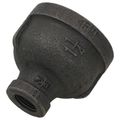


Black Reducing Couplings (Imported) join two pipe sizes in a straight run of black malleable iron pipe, letting installers step down from a larger line to a smaller branch without changing direction. The fittings meet Class 150 ASTM A197 and ASME B16.3 standards, with female NPT threads on both ends conforming to ASME B1.20.1, and carry a 300 psi pressure rating at a 350 degree Fahrenheit temperature rating. Contractors use them on natural gas lines, compressed air systems, low-pressure steam, and other non-potable applications where black iron pipe is already specified. Reducing pipe size within a single fitting instead of pairing a bushing with a separate coupling saves a joint and a potential leak point on every reduction in the run. Stocking a full range of reducing sizes, from small residential gas branches up to larger commercial mains, keeps a rough-in crew moving without a mid-job parts run.
Subcategories
- Small Reducing Sizes: Small reducing couplings step down from 1/2 inch or 3/4 inch black iron pipe to a 1/4 inch or 3/8 inch branch, commonly used on residential gas appliance connectors and small branch lines. Class 150 construction rates these fittings to 300 psi and 350 degrees Fahrenheit, the same rating as the larger sizes in the line. Plumbers and gas fitters use them anywhere a larger trunk line feeds a smaller appliance connection such as a water heater or range. Female NPT threads on both ends let the fitting thread directly onto pipe without additional adapters.
- Mid-Range Reducing Sizes: Mid-range reducing couplings cover sizes such as 2 inch by 1 inch and 2 inch by 1-1/2 inch, common on commercial gas piping and compressed air distribution systems. Like the rest of the line, these fittings carry a Class 150 rating of 300 psi at 350 degrees Fahrenheit and meet ASTM A197 and ASME B16.3 standards. Mechanical contractors use this range when stepping down a main trunk line to feed a bank of smaller branch lines. Both ends use female NPT threads conforming to ASME B1.20.1.
- Large Reducing Sizes: Large reducing couplings, such as 2-1/2 inch by 2 inch and 6 inch by 4 inch, handle transitions on larger commercial and industrial gas or compressed air mains. The Class 150 rating stays consistent across the line at 300 psi and 350 degrees Fahrenheit regardless of size. Contractors specify this range on larger trunk lines feeding multiple smaller branches downstream. Because malleable iron threads more easily than steel at larger diameters, black iron remains a common choice for these bigger transitions.
- Gas and Compressed Air Rated Fittings: Every reducing coupling in this line is rated for natural gas, compressed air, low-pressure steam, and other non-potable applications rather than potable water service. The black finish resists rust in environments exposed to oil, gas, and general moisture better than an unfinished fitting would. Gas fitters rely on the Class 150, 300 psi rating to confirm the fitting meets code requirements for typical residential and commercial gas pressures. NPT threads conforming to ASME B1.20.1 create a tight mechanical seal without welding or flaring.
Buying Guide
Confirm the two pipe sizes being joined before ordering, since a reducing coupling is specified by its larger size first and its smaller size second, such as 2 inch by 1 inch. Black Reducing Couplings (Imported) come in a wide range from small residential sizes like 1/2 inch by 1/4 inch up to large commercial sizes like 6 inch by 4 inch, so match the fitting to both pipe diameters in the transition exactly rather than rounding to the nearest available size. Check that the application is non-potable, since these Class 150 malleable iron fittings are built for natural gas, compressed air, low-pressure steam, and similar systems rather than drinking water lines. Confirm the pressure and temperature requirements of the system fall within the 300 psi and 350 degree Fahrenheit rating before specifying the fitting, particularly on compressed air systems that may run at higher pressure. Verify thread type matches the rest of the run, since these fittings use female NPT threads on both ends and require male threaded pipe or nipples on each side. On larger diameter transitions, confirm local code allows a straight reducing coupling rather than requiring a reducing tee or other fitting at that location. Finally, check finish requirements, since black fittings suit gas and general piping while galvanized versions exist separately for systems where corrosion resistance matters more.
Frequently Asked Questions
What does the size notation on a reducing coupling mean?
A reducing coupling lists its larger pipe size first and its smaller size second, such as 2 inch by 1 inch. Both ends use female NPT threads sized to match male threaded pipe or nipples. Ordering the correct notation prevents a mismatched fitting from showing up on the job.
Are black reducing couplings rated for potable water?
Black malleable iron reducing couplings are built for natural gas, compressed air, low-pressure steam, and other non-potable applications rather than drinking water lines. Potable water systems typically require different materials such as copper, brass, or approved plastic piping. Checking the application before specifying black iron avoids a code violation.
What pressure rating do Class 150 black reducing couplings carry?
Class 150 black reducing couplings carry a 300 psi pressure rating and a 350 degree Fahrenheit temperature rating. The rating stays consistent across the full range of sizes in the line, from small residential fittings up to large commercial transitions. Confirming the system's operating pressure against this rating before ordering avoids an undersized fitting.
What standards do imported black malleable iron reducing couplings meet?
Black malleable iron reducing couplings typically meet ASTM A197 for material composition and ASME B16.3 for dimensional standards, with NPT threads conforming to ASME B1.20.1. Meeting these standards confirms the fitting threads correctly and holds the rated pressure. Checking for these markings on the fitting body helps confirm compliance before installation.
What is the largest size available in a reducing coupling?
Reducing couplings in this category are available up to 6 inch by 4 inch for larger commercial and industrial gas or compressed air mains. Smaller sizes down to 1/2 inch by 1/4 inch cover residential appliance connections. Selecting the right size depends on matching both pipe diameters in the transition exactly.
