




Filters
SORT
Product Availability –
Review Score –
 --%3E %3Csvg version='1.1' id='Fill' xmlns='http://www.w3.org/2000/svg' xmlns:xlink='http://www.w3.org/1999/xlink' x='0px' y='0px' viewBox='0 0 100 100' enable-background='new 0 0 100 100' xml:space='preserve'%3E %3Cpath fill='%23F15C02' d='M79.44,0.95H20.56C9.78,0.95,0.95,9.78,0.95,20.56v58.87c0,10.79,8.82,19.61,19.61,19.61h58.87 c10.79,0,19.61-8.83,19.61-19.61V20.56C99.05,9.78,90.22,0.95,79.44,0.95z M65.38,58.24l9.38,29.58L49.69,69.78L24.5,87.82 l9.34-29.6L8.8,39.6l30.73-0.17c0,0,6.98-19.61,10-28.93c0.54,1.36,9.88,29.1,9.88,29.1H91.2L65.38,58.24z'/%3E %3C/svg%3E)
Price Range –
Carrier Reversing Valves

 --%3E %3Csvg version='1.1' id='No-RB' xmlns='http://www.w3.org/2000/svg' xmlns:xlink='http://www.w3.org/1999/xlink' x='0px' y='0px' viewBox='0 0 100 100' enable-background='new 0 0 100 100' xml:space='preserve'%3E %3Cpath fill='%23CECECE' d='M79.44,0.95H20.56C9.78,0.95,0.95,9.78,0.95,20.56v58.87c0,10.79,8.82,19.61,19.61,19.61h58.87 c10.79,0,19.61-8.83,19.61-19.61V20.56C99.05,9.78,90.22,0.95,79.44,0.95z M65.38,58.24l9.38,29.58L49.69,69.78L24.5,87.82 l9.34-29.6L8.8,39.6l30.73-0.17c0,0,6.98-19.61,10-28.93c0.54,1.36,9.88,29.1,9.88,29.1H91.2L65.38,58.24z'/%3E %3C/svg%3E)


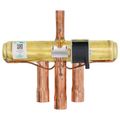
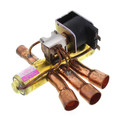
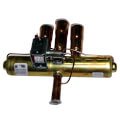
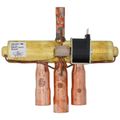
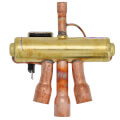
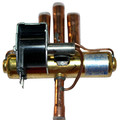
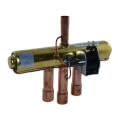
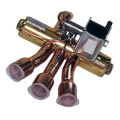
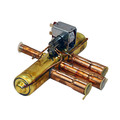
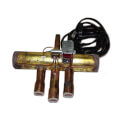
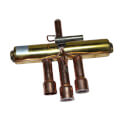

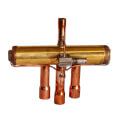
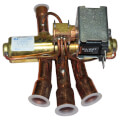
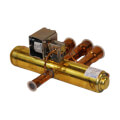
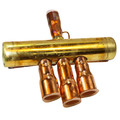
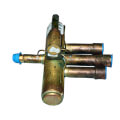
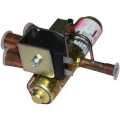

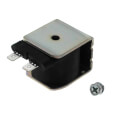
Carrier Reversing Valves are the component inside a heat pump that switches refrigerant flow direction, letting the same outdoor unit deliver both heating and cooling from one compressor. Physically, a reversing valve is a brass, multi-pronged fitting with three tube connections on one side and a single connection on the other, mounted in the outdoor unit near the compressor. When the thermostat calls for heat, the valve shifts position and redirects refrigerant so the indoor coil releases heat instead of absorbing it, reversing the normal cooling cycle. Techs replacing a reversing valve need to match tonnage, port size, and coil voltage to the specific Carrier system, since a mismatched valve will not seat properly or seal against the line set. A stuck or leaking reversing valve is one of the more common reasons a heat pump cools fine but will not heat, or the reverse, which makes a correctly matched replacement valve a frequent need on service trucks running heat pump calls.
Subcategories
- Reversing Valve Assemblies: A reversing valve assembly is the complete brass valve body, built with three tube connections on one side and one on the other, that Carrier uses across its heat pump lineup. Techs replace the full assembly when the valve body itself is cracked, leaking refrigerant, or physically stuck in one position. Matching tonnage and connection size to the outdoor unit is critical, since a mismatched valve body will not seal against the existing line set. Replacing the full assembly is the more involved of the two common jobs, since it requires recovering refrigerant and brazing new connections.
- Solenoid Coils: The solenoid coil is the electrical component mounted on the valve body that shifts it between heating and cooling positions when energized by the thermostat's control signal. Coils commonly fail independently of the valve body, so swapping just the coil is often enough when refrigerant flow reverses inconsistently or not at all. Coil replacement does not require breaking into the refrigerant circuit, making it a faster repair than a full valve swap. Confirming the coil's voltage and connector type against the existing wiring harness prevents a return trip for the wrong part.
- OEM Replacement Kits: OEM replacement kits package a Carrier valve and coil matched to specific model and tonnage ranges, intended for techs who want factory-matched components rather than assembling a valve from separate parts. Kits typically include mounting hardware and sometimes a service valve for refrigerant recovery, cutting down on a separate parts list for the job. Using OEM-matched kits reduces callback risk tied to mismatched port sizing or coil voltage on a mixed-parts repair. Choosing a matched kit saves time on jobs where a technician wants one part number covering the whole repair.
Buying Guide
Start a reversing valve replacement by confirming the failure is actually the valve and not a control board or thermostat wiring issue, since misdiagnosis is the most common reason a swapped valve does not fix the complaint. A heat pump that cools normally but will not heat, or heats but will not cool, and has been confirmed to have correct thermostat signal and control voltage at the valve's coil terminal, points to the valve itself. Once the valve is confirmed as the failure point, the next decision is whether to replace just the solenoid coil or the full valve body. If refrigerant still reverses when the valve is manually actuated but does not respond to the thermostat signal, a coil swap usually solves it without opening the refrigerant circuit. If the valve is stuck, leaking, or the body itself is damaged, a full assembly replacement is needed, along with refrigerant recovery and brazing equipment. Carrier Reversing Valves must match the outdoor unit's tonnage and port size exactly, since a valve sized for a different tonnage range will not seat correctly against the existing line set, even if the coil voltage and connector type match. Techs should also check whether the system uses a heat-pump-specific valve versus a straight air conditioner configuration, since the two are not interchangeable. Keeping the original model and serial number on hand when ordering a replacement avoids guesswork on port size and connection style.
Frequently Asked Questions
How do I know if a Carrier heat pump's reversing valve is bad?
A heat pump that runs fine in cooling mode but blows cold air when set to heat, or the reverse, points to a reversing valve stuck in one position. Confirming thermostat signal and control voltage are reaching the valve's coil first rules out a wiring or control board issue before pulling the valve. Unusual buzzing or clicking noises from the outdoor unit when the system tries to switch modes are another common symptom of a failing valve.
Can the solenoid coil be replaced without replacing the whole reversing valve?
Coil replacement is possible and common when the valve body itself still shifts correctly but does not respond to the thermostat's signal. Swapping just the coil avoids opening the refrigerant circuit, so it is a faster and less involved repair than a full valve replacement. If the valve body is stuck, cracked, or leaking refrigerant, the coil alone will not fix the problem and the full assembly needs replacement.
What information is needed to order the correct Carrier reversing valve?
Matching the outdoor unit's tonnage, port or connection size, and coil voltage to the replacement valve prevents ordering a part that will not seat against the existing line set. Keeping the original unit's model and serial number on hand when ordering removes most of the guesswork. Heat-pump-specific valves and straight air conditioner configurations are not interchangeable, so confirming system type matters as well.
Is replacing a reversing valve a job that requires refrigerant recovery?
Replacing the full valve body requires recovering refrigerant from the system first, since the valve sits directly in the refrigerant circuit and has to be brazed in and out. A coil-only replacement does not require recovery, since the coil sits on the outside of the valve body and only handles the electrical signal that shifts it. Confirming which repair is needed before starting the job determines what recovery equipment to bring.
What does it mean when a reversing valve is described as three tubes on one side?
Carrier describes its reversing valves as a brass, multi-pronged fitting with three tube connections on one side and a single connection on the other. The physical layout is what allows the valve to redirect refrigerant flow between the indoor and outdoor coils when it shifts position. Recognizing this layout helps a tech identify the valve in the outdoor unit and trace which line goes where during a replacement.
