




Filters
SORT
Product Availability –
Brand –
Size –
Review Score –
 --%3E %3Csvg version='1.1' id='Fill' xmlns='http://www.w3.org/2000/svg' xmlns:xlink='http://www.w3.org/1999/xlink' x='0px' y='0px' viewBox='0 0 100 100' enable-background='new 0 0 100 100' xml:space='preserve'%3E %3Cpath fill='%23F15C02' d='M79.44,0.95H20.56C9.78,0.95,0.95,9.78,0.95,20.56v58.87c0,10.79,8.82,19.61,19.61,19.61h58.87 c10.79,0,19.61-8.83,19.61-19.61V20.56C99.05,9.78,90.22,0.95,79.44,0.95z M65.38,58.24l9.38,29.58L49.69,69.78L24.5,87.82 l9.34-29.6L8.8,39.6l30.73-0.17c0,0,6.98-19.61,10-28.93c0.54,1.36,9.88,29.1,9.88,29.1H91.2L65.38,58.24z'/%3E %3C/svg%3E)
Price Range –
Compression Tees


 --%3E %3Csvg version='1.1' id='No-RB' xmlns='http://www.w3.org/2000/svg' xmlns:xlink='http://www.w3.org/1999/xlink' x='0px' y='0px' viewBox='0 0 100 100' enable-background='new 0 0 100 100' xml:space='preserve'%3E %3Cpath fill='%23CECECE' d='M79.44,0.95H20.56C9.78,0.95,0.95,9.78,0.95,20.56v58.87c0,10.79,8.82,19.61,19.61,19.61h58.87 c10.79,0,19.61-8.83,19.61-19.61V20.56C99.05,9.78,90.22,0.95,79.44,0.95z M65.38,58.24l9.38,29.58L49.69,69.78L24.5,87.82 l9.34-29.6L8.8,39.6l30.73-0.17c0,0,6.98-19.61,10-28.93c0.54,1.36,9.88,29.1,9.88,29.1H91.2L65.38,58.24z'/%3E %3C/svg%3E)

 --%3E %3Csvg version='1.1' id='Half' xmlns='http://www.w3.org/2000/svg' xmlns:xlink='http://www.w3.org/1999/xlink' x='0px' y='0px' viewBox='0 0 100 100' enable-background='new 0 0 100 100' xml:space='preserve'%3E %3Cg%3E %3Cpath fill='%23F15C02' d='M30.05,70.23l3.79-12.01L8.8,39.6l30.73-0.17c0,0,6.98-19.61,10-28.93c0.54,1.36,9.88,29.1,9.88,29.1h1.58 L93.71,7.18c-3.58-3.82-8.66-6.23-14.28-6.23H20.56C9.78,0.95,0.95,9.78,0.95,20.56v58.87c0,5.41,2.22,10.32,5.79,13.88 L30.05,70.23z'/%3E %3C/g%3E %3Cpath fill='%23FBC8B4' d='M93.71,7.18L60.98,39.6H91.2L65.38,58.24l9.38,29.58L49.69,69.78L24.5,87.82l5.55-17.59L6.75,93.32 c3.55,3.54,8.44,5.73,13.82,5.73h58.87c10.79,0,19.61-8.83,19.61-19.61V20.56C99.05,15.4,97.01,10.69,93.71,7.18z'/%3E %3C/svg%3E)

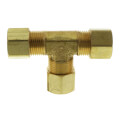
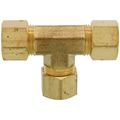
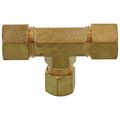
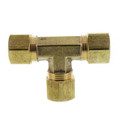
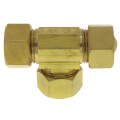

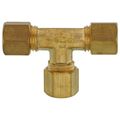
Compression Tees are three-way plumbing fittings that branch a line without soldering, torches, or flux. Contractors reach for a compression tee when working on live or wet lines, in tight crawlspaces, or anywhere an open flame creates risk. Each fitting uses a nut, sleeve, and body to form a mechanical seal, and lead-free brass versions carry a maximum working pressure of 200 psi across a temperature range from negative 65 degrees Fahrenheit to 250 degrees Fahrenheit. Compression Tees work with copper and plastic tubing, though installers need to match nominal pipe size to actual tubing outside diameter, since half-inch nominal copper measures five-eighths inch on the outside. Because no heat or curing time is involved, a compression tee lets a plumber branch, repair, or isolate a line and restore water service during a single visit.
Subcategories
- All-Compression Tees: An all-compression tee joins three tubing runs using compression nuts and sleeves on every port, with no threads or solder anywhere on the fitting. Plumbers use this style for quick branch connections on copper or plastic supply lines in mechanical rooms and under fixtures. Lead-free brass versions are rated to 200 psi and handle temperatures from negative 65 degrees Fahrenheit to 250 degrees Fahrenheit, making the fitting suitable for both hot and cold distribution lines.
- Reducing Compression Tees: A reducing compression tee connects two different tubing diameters within a single fitting, tapering from a larger main line to a smaller branch line. Installers rely on this configuration when tapping a smaller fixture supply off a larger distribution line, without needing a separate reducer fitting. The fitting still uses a nut-and-sleeve compression joint on each port, and lead-free brass construction keeps the connection rated for potable water service up to 200 psi.
- Compression x MIP Tees: A compression by male iron pipe tee pairs two compression ports with one threaded male NPT outlet, letting a plumber transition from tubing to a threaded valve or fixture in one fitting. Contractors use this configuration to feed shutoff valves or gauge ports directly off a branch line. The threaded outlet accepts standard NPT connections, while the compression side keeps the working pressure rating at 200 psi.
- Compression x FIP Tees: A compression by female iron pipe tee adds a threaded female NPT outlet to a standard compression run, giving installers a connection point for nipples, sensors, or drain valves. Service technicians favor this style when a branch needs to accept a threaded male fitting without extra adapters. Like other compression tees, the fitting is built from lead-free brass and handles a temperature range from negative 65 to 250 degrees Fahrenheit.
- Lead-Free Brass Compression Tees: Lead-free brass compression tees are manufactured to meet potable water standards, so installers can use them on drinking water supply lines without separate certification concerns. The three-piece nut, sleeve, and body construction forms a mechanical seal on copper or plastic tubing without heat. Trade professionals choose this material for repair work in occupied buildings, since the fitting carries a 200 psi maximum working pressure and requires no cure time before the line goes back into service.
Buying Guide
Start by matching tubing size correctly, since compression fittings are sized to actual tubing outside diameter rather than nominal pipe size; half-inch nominal copper measures five-eighths inch OD, so a five-eighths inch compression tee is the correct match, not a half-inch one. Confirm the tubing material next. Compression Tees accept both copper and plastic tubing, but the tubing has to be round, smooth, and free of scoring where the sleeve seats, or the joint will leak under pressure. Check the pressure and temperature conditions of the line before ordering. Lead-free brass compression tees are rated to 200 psi and handle a range from negative 65 to 250 degrees Fahrenheit, which covers most potable water and hydronic branch lines. Decide on port configuration based on what the branch needs to connect to: an all-compression tee works for tubing-to-tubing branches, while a compression by MIP or FIP tee lets the branch feed a threaded valve, gauge, or fixture connection directly. For any job touching drinking water, confirm the fitting carries lead-free certification before installation. Reducing tees save a fitting and a joint when the branch line runs smaller than the main, which reduces failure points in a repair. Keep spare nuts and sleeves on the truck, since a compression joint can be reused if the sleeve is replaced during a callback.
Frequently Asked Questions
What's the difference between a compression tee and a soldered tee?
A compression tee joins three tubing runs using a nut-and-sleeve mechanical seal, so no torch, flux, or solder is needed. A soldered tee requires heat to melt solder into the joint, which means clearing the line of water and creating a dry, oxide-free surface first. Compression Tees are the faster option for repairs on occupied systems or wherever an open flame is not practical.
Can Compression Tees be used on drinking water lines?
Lead-free brass compression tees are manufactured to meet potable water standards, so they're suitable for drinking water supply lines. The nut, sleeve, and body construction forms a mechanical seal without introducing lead into the water path. Confirming lead-free marking on the fitting body before installation is still good practice.
What size compression tee is needed for half-inch copper pipe?
Half-inch nominal copper pipe actually measures five-eighths inch on the outside diameter, so the correct fitting is a five-eighths inch compression tee rather than a half-inch one. Compression fittings are always sized to the tubing's actual OD, not the nominal pipe size. Checking the tubing with a caliper or size gauge before ordering prevents a mismatched fitting on the job.
What pressure and temperature can a compression tee handle?
Lead-free brass compression tees typically carry a maximum working pressure of 200 psi across a temperature range from negative 65 to 250 degrees Fahrenheit. The range covers most residential and light commercial water and hydronic branch lines. Confirming the rating on the specific fitting is still worthwhile, since reducing or specialty tees can carry different limits.
Do Compression Tees work with plastic tubing as well as copper?
Compression Tees are compatible with both copper and plastic tubing, provided the tubing is round, smooth, and undamaged where the sleeve seats. Plastic tubing needs a support insert in some cases to keep the tubing from collapsing when the nut is tightened. Confirming manufacturer compatibility for the specific tubing material avoids a leak at the sleeve.
