




Filters
SORT
Product Availability –
Size –
Review Score –
 --%3E %3Csvg version='1.1' id='Fill' xmlns='http://www.w3.org/2000/svg' xmlns:xlink='http://www.w3.org/1999/xlink' x='0px' y='0px' viewBox='0 0 100 100' enable-background='new 0 0 100 100' xml:space='preserve'%3E %3Cpath fill='%23F15C02' d='M79.44,0.95H20.56C9.78,0.95,0.95,9.78,0.95,20.56v58.87c0,10.79,8.82,19.61,19.61,19.61h58.87 c10.79,0,19.61-8.83,19.61-19.61V20.56C99.05,9.78,90.22,0.95,79.44,0.95z M65.38,58.24l9.38,29.58L49.69,69.78L24.5,87.82 l9.34-29.6L8.8,39.6l30.73-0.17c0,0,6.98-19.61,10-28.93c0.54,1.36,9.88,29.1,9.88,29.1H91.2L65.38,58.24z'/%3E %3C/svg%3E)
Price Range –
Copper 90° Street Elbows



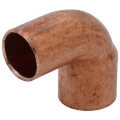

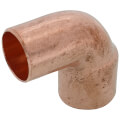
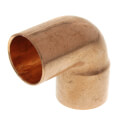


Copper 90° Street Elbows are wrot copper pressure fittings that change pipe direction by ninety degrees using one female solder cup and one male street end, letting a plumber join directly into another fitting without adding a coupling. NIBCO manufactures these fittings to ASME/ANSI B16.22 and MSS SP-104 or SP-109 standards, and the lead-free versions carry NSF/ANSI 61 certification for potable water use. Plumbers use street elbows in tight spaces, such as behind a wall or inside a mechanical closet, where a standard elbow plus a separate coupling would take up room the installation doesn't have. Short radius and long turn radius versions are both available, giving installers a way to match the elbow's bend to the clearance around a fixture or appliance. Because the fitting solders directly into a female cup on the next component, it saves a joint on every direction change, meaning one less solder connection that could eventually leak, which keeps Copper 90° Street Elbows a standard stock item for plumbing, air conditioning, and refrigeration rough-in work.
Subcategories
- Close Rough (Short Radius) Street Elbows: Close rough street elbows use a tighter bend radius than a standard 90-degree fitting, which lets the elbow fit into confined spaces without eating up extra clearance. NIBCO's 607 series is built as a wrot copper solder joint fitting with one cup end and one street end, made to ASME/ANSI B16.22 material standards. Plumbers reach for this style behind fixtures, inside stud bays, and anywhere a standard-radius elbow plus coupling won't fit. The tighter bend does restrict flow slightly more than a long radius fitting, so it works best on shorter runs.
- Long Radius (Long Turn) Street Elbows: Long radius street elbows use a wider bend than the close rough style, which keeps water moving with less turbulence through the fitting. NIBCO's 607-LT series is the long radius counterpart to the standard 607 elbow, built to the same wrot copper pressure fitting standards. Plumbers and mechanical contractors choose this style on longer supply runs and larger diameter pipe, where reducing flow restriction matters more than saving space. The wider sweep also puts less stress on the pipe at the point of the turn.
- DWV Street Elbows: DWV street elbows are built for drain, waste, and vent systems rather than pressurized supply lines, so they carry a different fitting designation on NIBCO's catalog. The 907 series is a wrot copper 90-degree elbow with a cup end and street end, sized for gravity-fed waste lines rather than pressurized water. Plumbers use the long turn radius on DWV elbows to keep waste flowing smoothly through the turn instead of pooling or backing up. Vent stacks and drain runs with a tight 90-degree turn are the most common place to find this style.
Buying Guide
Picking the right street elbow starts with matching the connection type to the rest of the run. A street elbow has one female solder cup and one male street end, so it solders directly into the next fitting without a coupling, which only works when the adjoining pipe or fitting accepts that male end. Confirming pipe size and wall thickness against the fitting's rated size avoids a mismatch that shows up only after the joint is soldered and pressure tested.
Radius selection comes next. Close rough elbows fit into tight spaces like stud bays and behind fixtures, but the tighter bend adds slightly more flow restriction than a long radius fitting covers on a longer run. Copper 90° Street Elbows in the long turn style suit larger diameter pipe and longer supply lines where minimizing turbulence and pressure loss matters more than saving an inch of clearance.
Application decides the final choice. Pressure-rated street elbows handle potable water, air conditioning, and refrigeration lines, while DWV street elbows are built for gravity-fed drain and vent systems and are not interchangeable with pressure fittings. Lead-free construction is required for any fitting touching potable water, so contractors working residential supply lines should confirm the NSF/ANSI 61 certification before ordering. Stocking a mix of close rough, long turn, and DWV street elbows in common sizes covers most rough-in scenarios without a special trip to the supply house.
Frequently Asked Questions
What's the difference between a street elbow and a regular 90-degree elbow?
A street elbow has one female solder cup and one male street end, letting it solder directly into the next fitting without a separate coupling. A regular 90-degree elbow has two female cups instead, so it needs a piece of pipe or another fitting on each side to make the connection.
When should a plumber use a close rough elbow instead of a long radius elbow?
Close rough elbows use a tighter bend, which makes them the better choice in confined spaces like stud bays or behind fixtures where a wider sweep won't fit. Long radius elbows take up more room but reduce flow restriction, so they work better on longer runs and larger diameter pipe.
Are copper street elbows rated for potable water?
Lead-free copper street elbows carry NSF/ANSI 61 certification, which qualifies them for potable water systems along with air conditioning and refrigeration lines. Confirming the lead-free designation on the packaging or spec sheet before installing on a domestic water line matters for code compliance.
Can a DWV street elbow be used on a pressurized water line?
DWV street elbows are built for gravity-fed drain and vent systems, not pressurized supply lines, so swapping one in for a pressure-rated fitting is not appropriate. Pressure-rated street elbows like the 607 or 607-LT series are the correct choice for any line carrying water under pressure.
What standards govern wrot copper street elbow manufacturing?
Wrot copper pressure fittings are produced to ASME/ANSI B16.22 material and workmanship standards, with dimensional requirements set by MSS SP-104 or SP-109. Manufacturing takes place in ISO 9001 certified facilities, which sets a consistent quality baseline across fitting sizes and styles.
