




Filters
SORT
Product Availability –
ID –
OD –
Review Score –
 --%3E %3Csvg version='1.1' id='Fill' xmlns='http://www.w3.org/2000/svg' xmlns:xlink='http://www.w3.org/1999/xlink' x='0px' y='0px' viewBox='0 0 100 100' enable-background='new 0 0 100 100' xml:space='preserve'%3E %3Cpath fill='%23F15C02' d='M79.44,0.95H20.56C9.78,0.95,0.95,9.78,0.95,20.56v58.87c0,10.79,8.82,19.61,19.61,19.61h58.87 c10.79,0,19.61-8.83,19.61-19.61V20.56C99.05,9.78,90.22,0.95,79.44,0.95z M65.38,58.24l9.38,29.58L49.69,69.78L24.5,87.82 l9.34-29.6L8.8,39.6l30.73-0.17c0,0,6.98-19.61,10-28.93c0.54,1.36,9.88,29.1,9.88,29.1H91.2L65.38,58.24z'/%3E %3C/svg%3E)
Price Range –
Copper Access Tees

 --%3E %3Csvg version='1.1' id='No-RB' xmlns='http://www.w3.org/2000/svg' xmlns:xlink='http://www.w3.org/1999/xlink' x='0px' y='0px' viewBox='0 0 100 100' enable-background='new 0 0 100 100' xml:space='preserve'%3E %3Cpath fill='%23CECECE' d='M79.44,0.95H20.56C9.78,0.95,0.95,9.78,0.95,20.56v58.87c0,10.79,8.82,19.61,19.61,19.61h58.87 c10.79,0,19.61-8.83,19.61-19.61V20.56C99.05,9.78,90.22,0.95,79.44,0.95z M65.38,58.24l9.38,29.58L49.69,69.78L24.5,87.82 l9.34-29.6L8.8,39.6l30.73-0.17c0,0,6.98-19.61,10-28.93c0.54,1.36,9.88,29.1,9.88,29.1H91.2L65.38,58.24z'/%3E %3C/svg%3E)







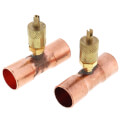
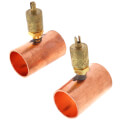

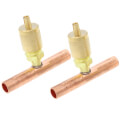
Copper access tees are branch fittings that include a removable cap or plug, giving a plumber a permanent entry point into a copper line for cleaning, inspection, or future service without cutting into the pipe again. They install the same way as a standard copper tee, sweat-soldered into the branch run, but the access opening means a drain line, condensate run, or water line can be reopened for a snake, camera, or test gauge whenever it's needed down the road.
Builders and service plumbers favor this style of fitting anywhere a line is likely to need periodic clearing or testing, since cutting a fresh access point into finished copper piping later means additional soldering, added cost, and disruption to whatever's built around that section of pipe. Placing an access tee during the original rough-in avoids all of that.
Subcategories
- Cleanout Access Tees: Cleanout access tees are used on drain and waste lines where a plumber may need to run a cable or auger through the line later. The removable plug threads or presses into the branch opening, letting the line be resealed cleanly after service.
- Test Tees: Test tees give access for pressure testing a line during rough-in or after a repair, letting a plumber attach a test cap or gauge without disturbing the rest of the assembly. They're commonly placed near the low point of a run so trapped water or debris can also be checked.
- Reducing Access Tees: Reducing access tees combine a branch size change with a removable access opening, useful where the main run is a larger diameter than the branch being tapped. This keeps a transition fitting and an access point from having to be installed separately in a tight space.
Buying Guide
Confirm the copper tube size of both the main run and the branch before ordering, since a copper access tee has to match the outside diameter of the pipe it's soldered into just like a standard fitting. Reducing versions need both the main and branch size specified correctly to avoid an awkward fit at the joint.
Check what the access opening is designed to accept. Some access tees use a threaded plug, others a push-fit or friction cap, and the choice affects how quickly the opening can be reopened for service and whether a wrench or special tool is needed on site.
Think through where the access point needs to sit before soldering it in. A cleanout access tee only helps if it's reachable after walls, ceilings, or cabinetry go in, so plan the location with future service access in mind rather than just the shortest pipe run.
Material grade should match the rest of the copper system already installed, keeping wall thickness and pressure rating consistent across the whole run rather than mixing a lighter-duty access tee into an otherwise heavier system.
Copper access tees, like other sweat fittings, need clean, properly fluxed joints and the correct solder type for the application, whether that's a potable water line or a drain-waste-vent run, since using the wrong solder or flux on a water line can create a code or health concern.
Frequently Asked Questions
What's the difference between a copper access tee and a standard tee?
A standard tee only has three soldered outlets, while an access tee adds a removable cap or plug on the branch so the line can be reopened later for cleaning, inspection, or testing without cutting the pipe.
Where should an access tee be installed?
It should go somewhere it will remain reachable after the surrounding walls, ceilings, or cabinetry are finished, since the whole point of the fitting is being able to reopen it for service later.
Can an access tee be used on a pressurized water line?
Yes, test tees and similar access fittings are commonly used on water lines for pressure testing during rough-in, as long as the cap or plug is rated for the system's working pressure.
Do access tees need a special tool to open?
It depends on the style. Some use a threaded plug that needs a wrench, while others use a push-fit or friction cap that can be removed by hand, so check the specific fitting before assuming either way.
Are reducing access tees installed differently than straight ones?
Installation is the same sweat-soldering process, but a reducing access tee also requires confirming both the main and branch pipe sizes match correctly since the branch is a different diameter than the main run.
