




Filters
SORT
Product Availability –
Brand –
Size –
Review Score –
 --%3E %3Csvg version='1.1' id='Fill' xmlns='http://www.w3.org/2000/svg' xmlns:xlink='http://www.w3.org/1999/xlink' x='0px' y='0px' viewBox='0 0 100 100' enable-background='new 0 0 100 100' xml:space='preserve'%3E %3Cpath fill='%23F15C02' d='M79.44,0.95H20.56C9.78,0.95,0.95,9.78,0.95,20.56v58.87c0,10.79,8.82,19.61,19.61,19.61h58.87 c10.79,0,19.61-8.83,19.61-19.61V20.56C99.05,9.78,90.22,0.95,79.44,0.95z M65.38,58.24l9.38,29.58L49.69,69.78L24.5,87.82 l9.34-29.6L8.8,39.6l30.73-0.17c0,0,6.98-19.61,10-28.93c0.54,1.36,9.88,29.1,9.88,29.1H91.2L65.38,58.24z'/%3E %3C/svg%3E)
Price Range –
EMT Raintight Compression Connectors

 --%3E %3Csvg version='1.1' id='No-RB' xmlns='http://www.w3.org/2000/svg' xmlns:xlink='http://www.w3.org/1999/xlink' x='0px' y='0px' viewBox='0 0 100 100' enable-background='new 0 0 100 100' xml:space='preserve'%3E %3Cpath fill='%23CECECE' d='M79.44,0.95H20.56C9.78,0.95,0.95,9.78,0.95,20.56v58.87c0,10.79,8.82,19.61,19.61,19.61h58.87 c10.79,0,19.61-8.83,19.61-19.61V20.56C99.05,9.78,90.22,0.95,79.44,0.95z M65.38,58.24l9.38,29.58L49.69,69.78L24.5,87.82 l9.34-29.6L8.8,39.6l30.73-0.17c0,0,6.98-19.61,10-28.93c0.54,1.36,9.88,29.1,9.88,29.1H91.2L65.38,58.24z'/%3E %3C/svg%3E)

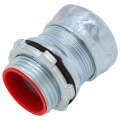
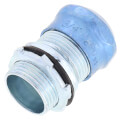
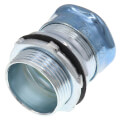
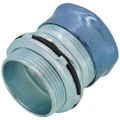
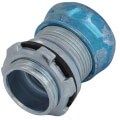
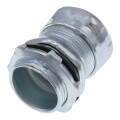
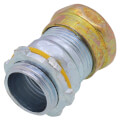
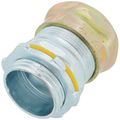
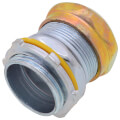
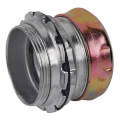
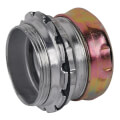
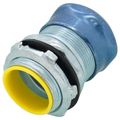
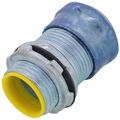
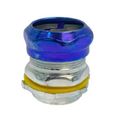
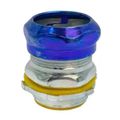
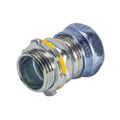
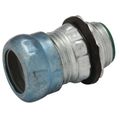
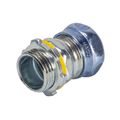
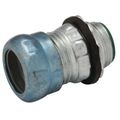
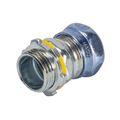

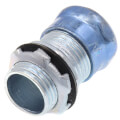
EMT Raintight Compression Connectors join electrical metallic tubing to a box or enclosure while sealing out moisture in wet or outdoor locations. A compression nut, often colored blue to mark the connector as rain tight, draws a gasketed ring down against the conduit to form the seal, and the steel body carries a zinc finish for corrosion resistance. Arlington, Southwire, and Steel City make connectors in this category in trade sizes from 1/2 inch up to 2 inches, covering the range most residential and commercial EMT runs use. Some models add an insulated throat, protecting conductor insulation from abrasion where the wire enters the fitting, while standard models skip that liner for applications where it isn't required. Choosing between insulated and non-insulated, and confirming trade size against the conduit already run, keeps an outdoor or below-grade EMT installation sealed against the elements it's meant to withstand.
Subcategories
- Standard Compression Connectors: Standard compression connectors seal EMT conduit to a box or enclosure without an insulated throat liner. Arlington's 820RT covers 1/2 inch trade size in steel with rain tight and concrete tight sealing. Electricians use this style on outdoor conduit runs and slab-poured concrete boxes where an insulated throat isn't specified.
- Insulated Throat Compression Connectors: Insulated throat connectors add a plastic liner inside the fitting where conductors pass through, protecting wire insulation from the sharp edge of the cut conduit. Arlington's 821ART brings that insulated throat to the 3/4 inch trade size while keeping the same rain tight and concrete tight rating. Code requirements or conductor type on a given job often dictate whether the insulated version is the right call.
- Larger Trade Size Connectors: Larger trade size connectors handle feeder and service conduit runs rather than typical branch circuit EMT. Arlington's 824RT covers 1-1/2 inch trade size and Steel City's TC116A-RT covers 2 inch, both in steel with rain tight and concrete tight sealing. Commercial and industrial jobs running larger conduit to outdoor equipment or service entrances need these bigger sizes.
- Mid-Size Connectors: Mid-size connectors cover the 3/4 inch trade size common on branch circuits feeding outdoor fixtures, receptacles, and equipment. Southwire's 652SRT is a steel raintight compression connector built for this size range. Residential and light commercial outdoor wiring most often uses this size range for exterior lighting and receptacle circuits.
Buying Guide
Matching trade size to the conduit already run is the starting point for any compression connector order. Sizes commonly available run from 1/2 inch, covering typical branch circuit EMT, up through 2 inch for feeder and service runs, so checking the conduit's stamped size against the connector before heading to the job keeps the install moving. Mixing up a trade size means a connector that won't seat against the conduit at all, not just a loose fit.
Insulated versus non-insulated throat is the next call. EMT Raintight Compression Connectors with an insulated throat add a plastic liner that protects conductor insulation from the cut edge of the conduit, which some code requirements or conductor types call for. Standard non-insulated connectors work fine where that protection isn't specified by code or job spec.
Sealing performance is what separates a raintight connector from a standard indoor compression fitting. The blue compression nut used across most raintight lines marks the connector as rated for wet locations, and the gasketed compression ring underneath does the actual sealing work against the conduit. Confirming that a connector carries a rain tight and concrete tight listing, not just a compression rating, matters most on outdoor runs, direct-burial applications, or conduit poured into concrete, where a standard indoor connector would let moisture into the box over time.
Frequently Asked Questions
What makes a connector rain tight versus a standard EMT connector?
A rain tight compression connector uses a gasketed compression ring under the nut to seal against the conduit, often marked with a blue compression nut for quick identification. Standard indoor compression connectors skip that gasket and aren't rated for wet or outdoor locations.
What trade sizes are available in raintight compression connectors?
Commonly available sizes run from 1/2 inch up to 2 inch trade size, covering typical branch circuits through larger feeder and service conduit. Arlington, Southwire, and Steel City all offer connectors across that size range.
When does an insulated throat matter on a compression connector?
An insulated throat adds a plastic liner where conductors pass through the fitting, protecting wire insulation from the cut edge of the conduit. Job specifications or code requirements on a given project typically determine whether the insulated version is required.
Are these connectors rated for concrete-encased conduit?
Many EMT Raintight Compression Connectors carry both a rain tight and a concrete tight rating, meaning they seal against both moisture and direct concrete contact. Checking the specific listing on the connector confirms both ratings before pouring conduit into a slab.
What material are these connectors made from?
Raintight compression connectors in this category are steel, typically with a zinc finish for corrosion resistance. Models like Arlington's 820RT and Steel City's TC116A-RT share this steel construction across different trade sizes.
