

CONTACT & SUPPORT
Live Chat: Online Now



'/%3E%3C/svg%3E)
Hover image to zoom
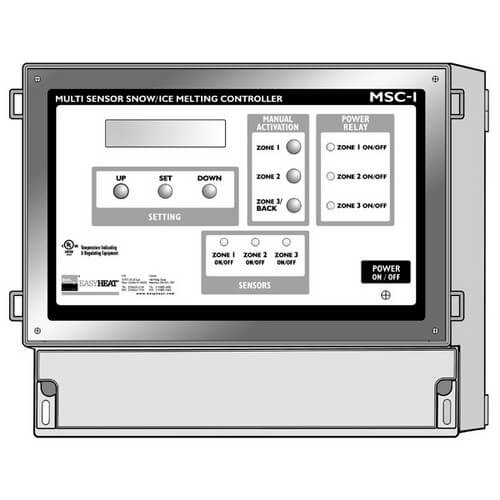
Control Panel w/ TS-1 Temperature Sensor for Snow & Ice Melting Installations
 --%3E %3Csvg version='1.1' id='No-RB' xmlns='http://www.w3.org/2000/svg' xmlns:xlink='http://www.w3.org/1999/xlink' x='0px' y='0px' viewBox='0 0 100 100' enable-background='new 0 0 100 100' xml:space='preserve'%3E %3Cpath fill='%23CECECE' d='M79.44,0.95H20.56C9.78,0.95,0.95,9.78,0.95,20.56v58.87c0,10.79,8.82,19.61,19.61,19.61h58.87 c10.79,0,19.61-8.83,19.61-19.61V20.56C99.05,9.78,90.22,0.95,79.44,0.95z M65.38,58.24l9.38,29.58L49.69,69.78L24.5,87.82 l9.34-29.6L8.8,39.6l30.73-0.17c0,0,6.98-19.61,10-28.93c0.54,1.36,9.88,29.1,9.88,29.1H91.2L65.38,58.24z'/%3E %3C/svg%3E)
Hover image to zoom
$3,160.69 each

Backorder
MANUALS (2)
Free Shipping This item ships free
Easy Returns No restocking fee for 90 days
Product Highlights
–

120v

4-3/4" Depth

10-1/4"

11" Width

PSR Heat Cable, ADKS De-Icing Cable, MSP-1, MSA-1, TS-1, MSG-1
Description
–
The MSC-1control panel manages snow and ice melting systems for sidewalks, driveways, gutters and downspouts. Suitable for controlling heating cables and mats, the
MSC-1 can monitor snow and ice accumulation in three separate snow melting application zones. The MSC-1 programming allows each zone to be controlled independently or on a priority basis.
The MSC-1 can access information from three different types of moisture sensors - surface (in-ground), aerial and gutter - and one type of temperature sensor. The surface, aerial and gutter sensors detect moisture (snow, ice, sleet, etc.) and send appropriate signals to the MSC-1. Similarly, the temperature sensor sends temperature data back to the MSC-1. Independent temperature and moisture information is processed by the MSC-1 to ensure that heating equipment will only be energized during freezing conditions. Each MSC-1 must have a temperature sensor, TS-1, in order to function. The TS-1 is included with each MSC-1.
The TS-1 temperature sensor measures outside temperatures and is placed in the area that best represents the outdoor temperature conditions. The TS-1 operates on low voltage provided by the MSC-1 control unit and allows the MSC to determine when to activate snowmelting or de-icing equipment. Easily affixed to a wall or fascia by two screws, the TS-1's small size and neutral color allows the sensor to discreetly blend with almost any background. The TS-1 is supplied with 10' (3.05m) of connection wire which may be extended up to 500' (152.40m) with an appropriately rated 18 - 20 AWG 3 wire unshielded cable
Features:
The MSC-1 can access information from three different types of moisture sensors - surface (in-ground), aerial and gutter - and one type of temperature sensor. The surface, aerial and gutter sensors detect moisture (snow, ice, sleet, etc.) and send appropriate signals to the MSC-1. Similarly, the temperature sensor sends temperature data back to the MSC-1. Independent temperature and moisture information is processed by the MSC-1 to ensure that heating equipment will only be energized during freezing conditions. Each MSC-1 must have a temperature sensor, TS-1, in order to function. The TS-1 is included with each MSC-1.
The TS-1 temperature sensor measures outside temperatures and is placed in the area that best represents the outdoor temperature conditions. The TS-1 operates on low voltage provided by the MSC-1 control unit and allows the MSC to determine when to activate snowmelting or de-icing equipment. Easily affixed to a wall or fascia by two screws, the TS-1's small size and neutral color allows the sensor to discreetly blend with almost any background. The TS-1 is supplied with 10' (3.05m) of connection wire which may be extended up to 500' (152.40m) with an appropriately rated 18 - 20 AWG 3 wire unshielded cable
- Automatic snow/ice melting control
- Housed in enclosure suitable for commercial/industrial applications
- LCD display, programming, and associated indicator lights for operation of each zone
- Manual zone activiation
- UL Listed to US and Canadian safety standards
- Hold on Time: Adjustable 0-10 hours in half-hour increments
- Maximizes energy efficiency
- Monitors and controls 3 separate zones, sequentially or independently
- Reduced power requirements when priority operation mode is used
Specs
–
| Voltage: | 120v |
|---|---|
| Depth (Inches): | 4-3/4" |
| Height: | 10-1/4" |
| Width (Inches): | 11" |
| Humidity Range: | 0 to 90% RH (non-condensing) |
| Ambient Temperature: | -4°F to 50°F |
| Used With: | PSR Heat Cable ADKS De-Icing Cable MSP-1 MSA-1 TS-1 MSG-1 |


Questions?
Speak with a real person who will go out of the way to help!
Call or text 888-757-4774
Monday – Thursday
8am–7:45pm
Friday
9am–7:45pm
Saturday – Sunday
9am–5:45pm
Product Reviews
Be the first to write a review.
Free Shipping
On orders over $99
We offer flexible shipping and scheduling options, up-to-date delivery estimates, and free ground shipping on any order over $99 to make sure your order gets to you on-time, for less.
Shipping PolicyEasy Returns
Returning items is as simple as 1-2-3
Ordered the wrong product? Item damaged in transit? Our 3-step process makes returning products easy – even up to a year after purchase – with no restocking fees on returns made within 90 days.
Return Policy