




Expansion PEX Brass Ball Valves w/ Drain

 --%3E %3Csvg version='1.1' id='No-RB' xmlns='http://www.w3.org/2000/svg' xmlns:xlink='http://www.w3.org/1999/xlink' x='0px' y='0px' viewBox='0 0 100 100' enable-background='new 0 0 100 100' xml:space='preserve'%3E %3Cpath fill='%23CECECE' d='M79.44,0.95H20.56C9.78,0.95,0.95,9.78,0.95,20.56v58.87c0,10.79,8.82,19.61,19.61,19.61h58.87 c10.79,0,19.61-8.83,19.61-19.61V20.56C99.05,9.78,90.22,0.95,79.44,0.95z M65.38,58.24l9.38,29.58L49.69,69.78L24.5,87.82 l9.34-29.6L8.8,39.6l30.73-0.17c0,0,6.98-19.61,10-28.93c0.54,1.36,9.88,29.1,9.88,29.1H91.2L65.38,58.24z'/%3E %3C/svg%3E)

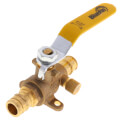
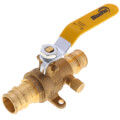
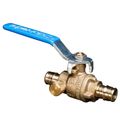

Expansion PEX Brass Ball Valves w/ Drain are full port shutoff valves built for cold expansion PEX-A systems, combining a quarter turn brass ball valve with a waste drain port so a line can be emptied without cutting it open. Full port Bluefin models connect directly to PEX-A tubing using an expansion fitting, and installation calls for a dedicated PEX expansion tool rather than a crimp ring or clamp. Sizes span 1/2 inch through 1 inch, covering branch lines, baseboard loops, and smaller mains. Lead-free brass construction keeps these valves suitable for potable water applications, and the drain spout simplifies winterization, repairs, and seasonal flushing on hydronic or domestic systems. Some configurations add a drop ear elbow so the valve also serves as a mounting point for a fixture stub out. Combining shutoff, drain, and sometimes fixture support into one fitting cuts labor time on jobs where cutting into finished walls or ceilings isn't practical.
Subcategories
- Drop Ear Ball Valves w/ Drain: Drop ear ball valves pair a full port shutoff and waste drain with a mounting ear that screws to a stud or blocking. Installers use this style for fixture rough-ins such as washing machine boxes or angle stop supply stubs, where the valve needs to stay fixed in place behind a wall. The PPBVD075-DE, for example, offers a 3/4 inch expansion PEX connection with an integrated drop ear elbow. Sizes in this group typically run 1/2 inch and 3/4 inch for standard residential branch lines.
- Standard Ball Valves w/ Drain: Standard models skip the mounting ear and function as an inline shutoff with a waste drain port for mid-run installation. Mechanical contractors use them on mains, risers, and radiant or baseboard loops where a line needs periodic draining for repairs or seasonal shutdown. The PXBVD100 is a 1 inch full port version built for larger branch or main line sizes. Full port design keeps flow resistance low compared to standard port valves of the same size.
- Hose Drain Ball Valves: Hose drain models replace the open waste port with a garden hose thread connection, letting an installer attach a hose for controlled draining into a floor drain or outside the structure. Boiler technicians and radiant installers rely on this style when draining a loop directly onto a floor isn't practical. The PPBV075HD and PPBV100HD cover 3/4 inch and 1 inch expansion PEX connections in this configuration. Lead-free brass construction carries over from the rest of the line.
Buying Guide
Choosing the right valve starts with the drain style a job actually needs. A mid-run shutoff on a main or baseboard loop generally calls for a standard waste drain valve, while a fixture rough-in behind a finished wall benefits from a drop ear version that doubles as a mounting bracket. Jobs where draining into a hose or remote location matters, such as boiler loops tucked into tight mechanical rooms, call for a hose drain connection instead of an open waste port.
Size selection should match the existing PEX-A tubing diameter, since expansion fittings are not interchangeable across tubing types. A 1/2 inch valve suits a typical fixture branch, while 3/4 inch and 1 inch sizes handle mains, risers, and higher flow baseboard zones. Full port construction matters on larger lines, since it keeps pressure drop low compared to reduced port valves.
Installation requires a PEX expansion tool sized to match the fitting, plus PEX-A tubing rated for cold expansion. Expansion PEX Brass Ball Valves w/ Drain are not compatible with crimp or clamp style PEX-B or PEX-C systems, so confirming tubing type before ordering avoids a mismatched fitting. Lead-free brass certification should be confirmed on any valve destined for potable water rather than a closed hydronic loop, since not every brass alloy meets the same lead content standard.
Frequently Asked Questions
What size Expansion PEX Brass Ball Valve w/ Drain fits a typical washing machine or fixture supply line?
Fixture branches commonly use a 1/2 inch expansion PEX ball valve w/ drain, often in a drop ear configuration so the valve can be screwed to a stud behind the fixture. Larger demand fixtures or combined supply lines may call for a 3/4 inch version instead. Checking the existing PEX-A tubing size before ordering avoids a mismatched expansion fitting.
Can these valves be used with PEX-B or PEX-C tubing?
Expansion PEX Brass Ball Valves w/ Drain are built for PEX-A tubing and the cold expansion method, not for crimp or clamp style PEX-B or PEX-C systems. Installing one on the wrong tubing type results in a connection that won't seal properly. A PEX expansion tool is required regardless of valve size.
What's the difference between a drop ear valve and a standard drain valve?
A drop ear valve includes a mounting ear that anchors to a stud or blocking, keeping the valve fixed in place for fixture rough-ins. A standard drain valve has no mounting ear and installs mid-run on a main, riser, or loop. Both styles share the same full port brass body and waste drain function.
How does the waste drain feature help during winterization?
The waste drain port lets a line empty without cutting into the pipe or disconnecting it from the system. Opening the drain releases trapped water from the branch, helping to prevent freeze damage in unheated spaces. Seasonal shutdown and spring startup go faster on cabins, irrigation feeds, or exterior hose bibb lines as a result.
Is a hose drain or an open waste port better for boiler loop draining?
A hose drain connection works well in tight mechanical rooms where draining directly onto the floor isn't practical, since it lets a hose carry water to a floor drain or outside the building. An open waste port suits locations with a floor drain close by. Either style still provides the same full port shutoff and lead-free brass body as the rest of the line.
