




Grundfos TP Series In-Line Circulators

 --%3E %3Csvg version='1.1' id='No-RB' xmlns='http://www.w3.org/2000/svg' xmlns:xlink='http://www.w3.org/1999/xlink' x='0px' y='0px' viewBox='0 0 100 100' enable-background='new 0 0 100 100' xml:space='preserve'%3E %3Cpath fill='%23CECECE' d='M79.44,0.95H20.56C9.78,0.95,0.95,9.78,0.95,20.56v58.87c0,10.79,8.82,19.61,19.61,19.61h58.87 c10.79,0,19.61-8.83,19.61-19.61V20.56C99.05,9.78,90.22,0.95,79.44,0.95z M65.38,58.24l9.38,29.58L49.69,69.78L24.5,87.82 l9.34-29.6L8.8,39.6l30.73-0.17c0,0,6.98-19.61,10-28.93c0.54,1.36,9.88,29.1,9.88,29.1H91.2L65.38,58.24z'/%3E %3C/svg%3E)

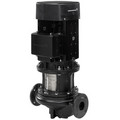
Grundfos TP Series In-Line Circulators are single-stage, close-coupled circulator pumps built with the pump and motor as separate units, which reduces sensitivity to impurities in the pumped liquid compared to a canned-rotor design. The line covers hydronic heating, cooling, and hot water recirculation systems in residential and commercial buildings, with housings available in cast iron, stainless steel, and bronze depending on the fluid being circulated. TP models run at fixed speed, while TPE models add an integrated frequency converter that adjusts speed continuously between minimum and maximum performance curves to match variable system demand. Standard TP and TPD pumps handle liquid temperatures from negative 40 degrees Fahrenheit up to 302 degrees Fahrenheit, with a maximum ambient temperature of 131 degrees Fahrenheit and operating pressure up to 25 bar. Bronze and stainless steel housings resist corrosion in domestic hot water recirculation loops, where standard cast iron would wear faster. Picking the right housing material and speed control type up front keeps a circulator matched to the system it serves for the long run.
Subcategories
- TP Fixed-Speed Circulators: TP models run at a fixed speed set at installation, using a standard motor paired with a close-coupled pump end. The pump and motor stay separate units in this design, which cuts down on sensitivity to impurities in the circulated fluid compared with a canned-rotor circulator. Standard TP and TPD pumps handle liquid temperatures up to 302 degrees Fahrenheit and operating pressure up to 25 bar, covering most hydronic heating and cooling loops. Fixed-speed operation suits systems with steady, predictable flow requirements rather than one with frequent load swings.
- TPE Variable-Speed E-Circulators: TPE models add an integrated frequency converter directly to the motor, letting the pump adjust speed continuously between its minimum and maximum performance curves instead of running at one fixed point. Grundfos rates TPE pumps for maximum working pressure of 145 psi and maximum fluid temperature of 284 degrees Fahrenheit. Variable-speed operation targets large heating or cooling water systems where demand changes throughout the day, and Grundfos reports energy savings up to 50 percent compared with a fixed-speed pump running at a single point regardless of actual demand. Because the speed control is built into the motor, no separate variable frequency drive needs to be wired and mounted alongside the pump.
- Bronze and Stainless Steel In-Line Circulators: Bronze and stainless steel housings resist corrosion in domestic hot water recirculation loops and lightly acidic industrial applications where a standard cast iron housing would wear faster. Internal construction otherwise follows the same close-coupled, single-stage design used across the TP and TPE line. Plumbers spec this housing material specifically for potable hot water recirculation systems rather than closed-loop hydronic heating, where the circulated water differs chemically from a sealed heating loop. Both fixed-speed TP and variable-speed TPE versions are available with bronze or stainless steel construction.
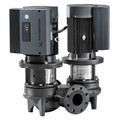
- Cast Iron In-Line Circulators: Cast iron housings cover standard closed-loop hydronic heating and cooling applications where the circulated fluid isn't potable water. Cast iron construction costs less than bronze or stainless steel while performing the same close-coupled, single-stage pumping function. Grundfos offers cast iron TP and TPE pumps in single-head and twin-head configurations, with twin-head models providing a built-in backup pump in the same housing. Standard closed hydronic systems, such as boiler loops and chilled water systems, are the typical application for cast iron construction.
Buying Guide
Start with what's actually flowing through the system. Closed hydronic heating or chilled water loops call for a standard cast iron housing, while domestic hot water recirculation or a lightly acidic industrial fluid calls for bronze or stainless steel construction to resist corrosion that would wear cast iron faster. Speed control is the next decision. A fixed-speed TP pump suits a system with steady, predictable flow, while a variable-speed TPE pump with its integrated frequency converter fits a building where heating or cooling demand swings throughout the day, since it adjusts output continuously instead of running at one point regardless of actual load. Grundfos TP Series In-Line Circulators differ in their pressure and temperature ratings depending on which sub-line gets specified: standard TP and TPD pumps handle liquid temperatures up to 302 degrees Fahrenheit and pressure up to 25 bar, while TPE pumps carry a maximum working pressure of 145 psi and a maximum fluid temperature of 284 degrees Fahrenheit. Confirm the system's actual operating pressure and temperature against those limits before finalizing a spec, particularly on a high-temperature boiler loop that could exceed a TPE pump's lower pressure ceiling. Single-head models cover most residential and light commercial jobs, while twin-head configurations add a built-in backup pump in the same housing, worth considering on a critical system where downtime for a pump swap isn't an option. Confirming fluid type, speed control, and pressure rating together up front avoids specifying a pump that can't handle the system's actual operating conditions.
Frequently Asked Questions
What's the difference between a TP and a TPE circulator?
TP pumps run at a fixed speed using a standard motor, while TPE pumps include an integrated frequency converter that adjusts speed continuously between minimum and maximum performance curves. Variable-speed TPE pumps suit systems with demand that changes throughout the day, and Grundfos reports energy savings up to 50 percent over a fixed-speed pump running at one point regardless of actual load.
When does a bronze or stainless steel housing make more sense than cast iron?
Bronze and stainless steel housings resist corrosion in domestic hot water recirculation loops and lightly acidic industrial fluids, where cast iron would wear faster. Closed hydronic heating and chilled water loops that don't circulate potable water typically use standard cast iron construction instead.
What temperature and pressure can these circulators handle?
Standard TP and TPD pumps handle liquid temperatures up to 302 degrees Fahrenheit and operating pressure up to 25 bar. TPE pumps carry a maximum working pressure of 145 psi and a maximum fluid temperature of 284 degrees Fahrenheit, so checking the actual sub-line rating against a system's operating conditions matters before finalizing a spec.
What does a twin-head configuration add over a single-head pump?
A twin-head configuration adds a second pump in the same housing, providing a built-in backup if one pump end fails or needs service. Single-head models cover most residential and light commercial jobs where a backup pump isn't a requirement.
Why are the pump and motor separate units on a TP circulator instead of one sealed assembly?
The close-coupled design used across the TP and TPE line keeps the pump and motor as separate units, which reduces sensitivity to impurities in the circulated fluid compared with a canned-rotor design. Separating the components also simplifies servicing the motor without disturbing the wetted pump end.
