




Filters
SORT
Product Availability –
Review Score –
 --%3E %3Csvg version='1.1' id='Fill' xmlns='http://www.w3.org/2000/svg' xmlns:xlink='http://www.w3.org/1999/xlink' x='0px' y='0px' viewBox='0 0 100 100' enable-background='new 0 0 100 100' xml:space='preserve'%3E %3Cpath fill='%23F15C02' d='M79.44,0.95H20.56C9.78,0.95,0.95,9.78,0.95,20.56v58.87c0,10.79,8.82,19.61,19.61,19.61h58.87 c10.79,0,19.61-8.83,19.61-19.61V20.56C99.05,9.78,90.22,0.95,79.44,0.95z M65.38,58.24l9.38,29.58L49.69,69.78L24.5,87.82 l9.34-29.6L8.8,39.6l30.73-0.17c0,0,6.98-19.61,10-28.93c0.54,1.36,9.88,29.1,9.88,29.1H91.2L65.38,58.24z'/%3E %3C/svg%3E)
 --%3E %3Csvg version='1.1' id='With-RB' xmlns='http://www.w3.org/2000/svg' xmlns:xlink='http://www.w3.org/1999/xlink' x='0px' y='0px' viewBox='0 0 100 100' enable-background='new 0 0 100 100' xml:space='preserve'%3E %3Cpath fill='%23FBC8B4' d='M79.44,0.95H20.56C9.78,0.95,0.95,9.78,0.95,20.56v58.87c0,10.79,8.82,19.61,19.61,19.61h58.87 c10.79,0,19.61-8.83,19.61-19.61V20.56C99.05,9.78,90.22,0.95,79.44,0.95z M65.38,58.24l9.38,29.58L49.69,69.78L24.5,87.82 l9.34-29.6L8.8,39.6l30.73-0.17c0,0,6.98-19.61,10-28.93c0.54,1.36,9.88,29.1,9.88,29.1H91.2L65.38,58.24z'/%3E %3C/svg%3E)
Price Range –
Lennox Transformers





 --%3E %3Csvg version='1.1' id='No-RB' xmlns='http://www.w3.org/2000/svg' xmlns:xlink='http://www.w3.org/1999/xlink' x='0px' y='0px' viewBox='0 0 100 100' enable-background='new 0 0 100 100' xml:space='preserve'%3E %3Cpath fill='%23CECECE' d='M79.44,0.95H20.56C9.78,0.95,0.95,9.78,0.95,20.56v58.87c0,10.79,8.82,19.61,19.61,19.61h58.87 c10.79,0,19.61-8.83,19.61-19.61V20.56C99.05,9.78,90.22,0.95,79.44,0.95z M65.38,58.24l9.38,29.58L49.69,69.78L24.5,87.82 l9.34-29.6L8.8,39.6l30.73-0.17c0,0,6.98-19.61,10-28.93c0.54,1.36,9.88,29.1,9.88,29.1H91.2L65.38,58.24z'/%3E %3C/svg%3E)

 --%3E %3Csvg version='1.1' id='Half' xmlns='http://www.w3.org/2000/svg' xmlns:xlink='http://www.w3.org/1999/xlink' x='0px' y='0px' viewBox='0 0 100 100' enable-background='new 0 0 100 100' xml:space='preserve'%3E %3Cg%3E %3Cpath fill='%23F15C02' d='M30.05,70.23l3.79-12.01L8.8,39.6l30.73-0.17c0,0,6.98-19.61,10-28.93c0.54,1.36,9.88,29.1,9.88,29.1h1.58 L93.71,7.18c-3.58-3.82-8.66-6.23-14.28-6.23H20.56C9.78,0.95,0.95,9.78,0.95,20.56v58.87c0,5.41,2.22,10.32,5.79,13.88 L30.05,70.23z'/%3E %3C/g%3E %3Cpath fill='%23FBC8B4' d='M93.71,7.18L60.98,39.6H91.2L65.38,58.24l9.38,29.58L49.69,69.78L24.5,87.82l5.55-17.59L6.75,93.32 c3.55,3.54,8.44,5.73,13.82,5.73h58.87c10.79,0,19.61-8.83,19.61-19.61V20.56C99.05,15.4,97.01,10.69,93.71,7.18z'/%3E %3C/svg%3E)


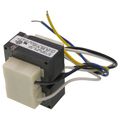



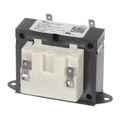


Lennox transformers step down line voltage from a furnace, air handler, or condensing unit's incoming power supply to the 24 volts that low-voltage thermostats, relays, and control boards run on. A failed transformer is a common reason a system stops responding to the thermostat even though the blower and compressor still have power, since the control circuit loses its 24V supply while the high-voltage side stays energized. Lennox stocks these transformers across several VA ratings and primary voltage inputs, including 40VA units built for a 208/240VAC primary and 24VAC secondary, alongside 70VA and 75VA models rated for 120VAC, 400VAC, or 480VAC primary service depending on the equipment being fed. Matching the replacement transformer's VA rating and primary voltage to the original part, rather than just the secondary voltage, keeps the control circuit from being underpowered or overloaded once it goes back into the cabinet.
Subcategories
- 40VA Control Transformers: 40VA transformers cover the lightest control loads found on residential furnaces and single-stage air conditioners, converting a 208/240VAC primary down to a 24VAC secondary. A system running only a thermostat, a gas valve, and a blower relay off the control circuit rarely exceeds the 40VA capacity. Lennox lists these as Class 2 transformers, meaning the secondary side is current-limited for safety. Model R39370B001 is one example carried in this rating.
- 70VA and 75VA Transformers: 70VA and 75VA transformers step up available control power for systems carrying heavier accessory loads, such as zone control boards, humidifiers, or additional relays layered onto the base furnace or air handler control circuit. Primary voltage options extend beyond the standard 208/240VAC to include 120VAC and, on some models, 400VAC or 480VAC service. Replacing an overloaded 40VA transformer with a 75VA unit is a common upgrade path when a contractor adds zoning to an existing system. The secondary output stays at 24VAC across the higher VA ratings.
- Primary Voltage Variants: Lennox transformers are stocked across multiple primary voltage inputs, including 120VAC, 208/240VAC, 400VAC, and 480VAC, to match whatever line voltage feeds the equipment cabinet. Commercial rooftop units and light commercial packaged equipment are more likely to need the 400VAC or 480VAC primary variants than a typical residential split system. Confirming the primary voltage on the equipment's data plate before ordering prevents a mismatch that would either underpower the control circuit or damage the transformer. Secondary voltage on residential and light commercial HVAC control transformers stays consistently at 24VAC regardless of primary input.
Buying Guide
Matching VA rating comes first. Adding up the draw of every low-voltage component on the control circuit, thermostat, gas valve, inducer relay, zone board, and humidifier if one is present, and confirming the total stays under the transformer's rated capacity prevents nuisance transformer failures down the line. A system that has grown accessories since it was installed, most often through an added zone control board, is the typical reason a 40VA transformer that worked for years suddenly starts tripping or failing.
Primary voltage is the second check, and it is easy to get backward from the secondary voltage that shows the same 24VAC across nearly every option. The equipment's data plate, not the old transformer's label if it has corroded or faded, is the reliable place to confirm whether the incoming line is 120VAC, 208/240VAC, 400VAC, or 480VAC.
Class 2 rating matters for code compliance on the low-voltage side. Lennox Transformers ship as Class 2 devices, meaning the secondary circuit is current-limited in a way that lets it run without the same conduit and wiring requirements as a full line-voltage circuit.
Foot-mount versus plug-in style depends on how the original transformer was secured inside the cabinet. Replacing a foot-mounted unit with a plug-in style, or the reverse, adds mounting work that a matched replacement avoids.
Frequently Asked Questions
How do I know what VA rating my replacement transformer needs?
Add up the rated draw of everything on the low-voltage control circuit, including the thermostat, gas valve, blower relay, and any zone board or humidifier, then choose a transformer rated above that total. A 40VA unit covers most single-stage systems without added accessories, while 70VA or 75VA units cover systems with zoning or other add-ons.
What primary voltages do Lennox transformers come in?
Lennox stocks control transformers with 120VAC, 208/240VAC, 400VAC, and 480VAC primary inputs, all stepping down to a 24VAC secondary. Checking the equipment's data plate confirms which primary voltage the replacement needs.
Why did my transformer fail after adding a zone control system?
Adding a zone board layers additional low-voltage draw onto a control circuit that was likely already close to its original transformer's rated capacity. Upgrading from a 40VA to a 70VA or 75VA transformer is the standard fix when a zoning retrofit pushes the load past what the original transformer supports.
Is a Lennox control transformer a Class 2 device?
Yes, Lennox lists its residential and light commercial control transformers as Class 2, which means the secondary side is current-limited for safety and does not require the same wiring methods as a line-voltage circuit.
Does the secondary voltage change between the different VA ratings?
No, the secondary voltage stays at 24VAC across the 40VA, 70VA, and 75VA options. Only the primary voltage input and the VA capacity change between models.
